
Understanding the Role of Prediction Imaging in Custom Facial Implants
Understanding Your Imaging Predictions
One of the first questions patients ask after receiving their prediction imaging is:
“Is this what I will actually look like after surgery?”
The answer is no—but that is not what the imaging is intended to do.
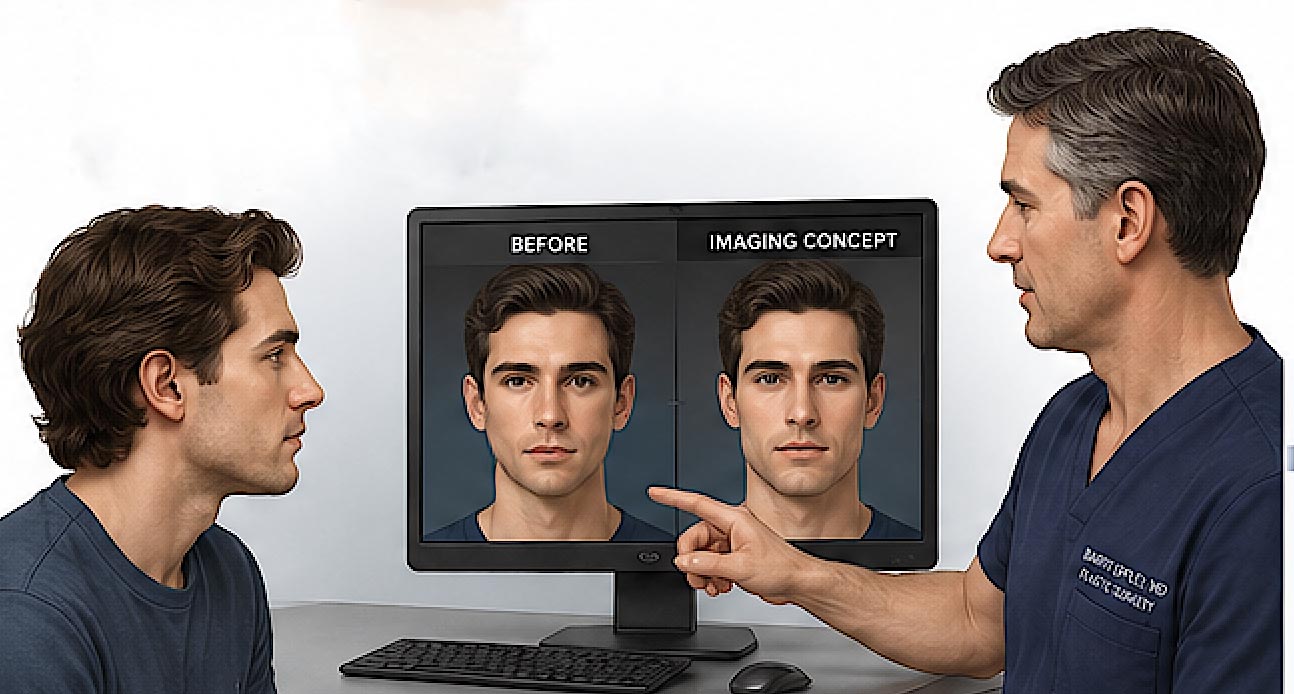
Computer imaging is one of the most valuable planning tools used in facial aesthetic surgery because it allows you and Dr. Eppley to communicate visually before surgery. Rather than trying to describe your goals with words alone, the imaging creates a visual discussion about the changes you would like to achieve.
Think of it as a blueprint—not a prediction.
Why We Create Computer Imaging
Every patient has a different idea of what “better” looks like.
Some patients want subtle refinement, while others desire a stronger or more dramatic facial structure. Computer imaging helps transform those ideas into a visual plan.
The initial images you receive are simply the starting point. They represent Dr. Eppley’s interpretation of the goals you described during your consultation.
Your job is to carefully review the images and tell us:
- What do you like?
- What don’t you like?
- Is any area too large or too small?
- Would you prefer a stronger or more subtle change?
- Does the overall appearance feel natural and balanced?
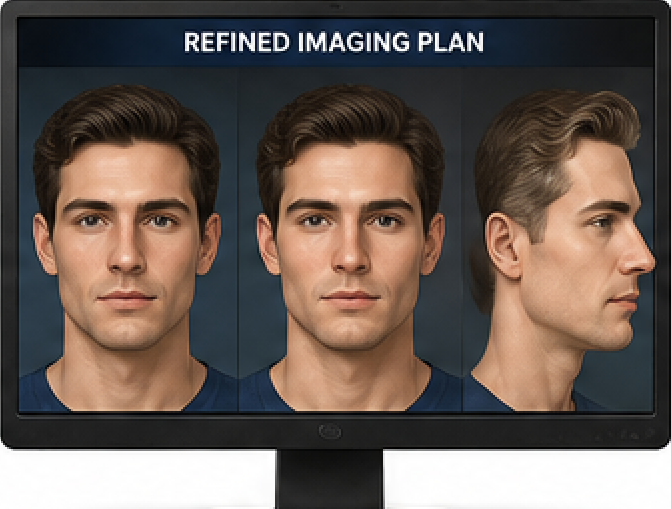
Your feedback is then used to modify the imaging until it represents the aesthetic direction you are seeking.
Only after this process is complete does the imaging become the surgical blueprint used for operative planning and, when appropriate, the design of your custom facial implant(s).
Why Imaging Is Not an Exact Prediction
Imaging of your pictures cannot account for the many biological variables involved in surgery.
Every patient’s soft tissues, skin thickness, muscle activity, bone anatomy, healing response, swelling, and scar formation are unique. These factors cannot be perfectly reproduced by software.
For this reason, prediction imaging should never be viewed as a guarantee of your final appearance.
Instead, it represents the intended aesthetic goal—the destination you would like to achieve.
An architect’s rendering is a good comparison. Before a home is built, an artist creates an illustration of the finished design. The completed house closely follows that plan, but it is never an exact copy of the drawing. Prediction imaging serves the same purpose in facial surgery.
Don’t Judge the Small Details
Because these images are created by digitally modifying photographs, they frequently contain small imperfections.
You may notice:
- Minor asymmetries
- Slight distortions
- Irregular skin contours
- Areas that appear blurred or unnatural
- Small photographic artifacts
These are normal and expected.
The purpose of the imaging is not to perfect every pixel. It is to evaluate the overall facial changes.
Focus on the big picture rather than the tiny details.
The Three Most Important Questions Imaging Answers
Successful facial surgery begins with answering three important questions:
1. Are we trying to create the right look?

Does the overall facial change match your personal aesthetic goals?
2. Is the amount of change correct?
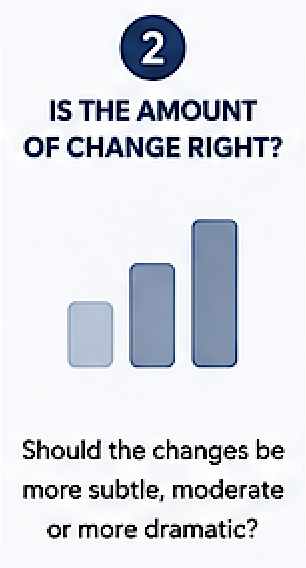
Should the changes be more conservative or more dramatic?
Finding the right degree of enhancement is often more important than deciding which procedure will be performed.
3. Does everything work together?
The face functions as a single aesthetic unit.
Changing one area almost always changes the appearance of neighboring features. Increasing chin projection affects neck definition. Enhancing the cheeks changes how the eyes and jawline are perceived. Augmenting the forehead can alter the balance of the nose and chin.
Computer imaging allows us to evaluate facial harmony before surgery rather than after.
The Value of Prediction Imaging
Prediction imaging is not designed to promise an exact surgical result.
Its real value is that it allows both patient and surgeon to agree on a shared aesthetic vision before surgery begins.
Without a clearly defined goal, surgical planning becomes guesswork.
With a well-developed imaging plan, every decision—from procedure selection to implant design—is based on a clearly established target.
For patients undergoing custom facial implant surgery, this process is particularly important because each implant is individually designed to achieve the agreed-upon facial changes.
Ultimately, prediction imaging helps transform your ideas into a surgical plan. It is one of the most effective tools available for improving communication, refining expectations, and creating a customized approach to facial enhancement.
Remember: The imaging is not a guarantee of what you will look like—it is the roadmap that guides us toward the facial changes you want to achieve.