
Indications for Custom Facial Implants
Principles and Regional Applications of Custom Facial Skeletal Augmentation
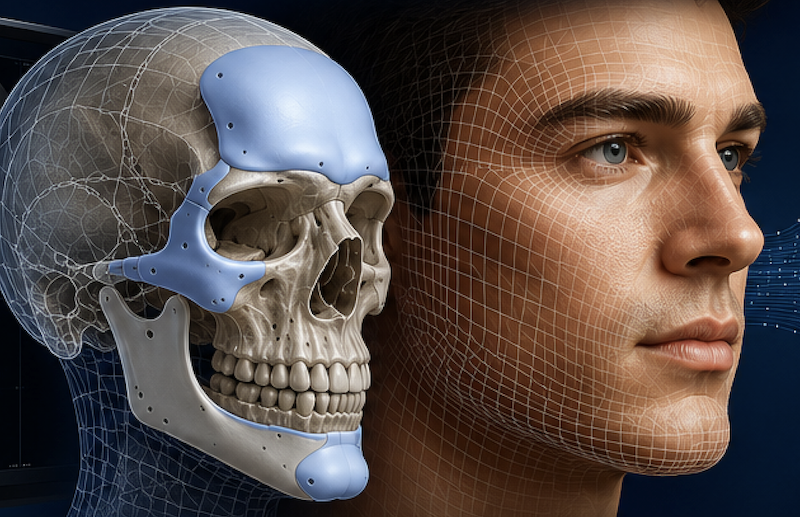
Custom facial implants have expanded the possibilities of aesthetic facial skeletal augmentation by allowing precise, patient-specific modifications of facial bone contours. Unlike standard facial implants, which are manufactured in predetermined shapes and sizes, custom implants are designed from three-dimensional (3D) CT imaging to conform to the patient’s existing skeletal anatomy while producing specifically planned changes in facial shape, projection, width, and contour.
The primary indication for a custom facial implant is the presence of a skeletal deficiency, asymmetry, or contour characteristic that cannot be adequately corrected with a standard implant or that requires a more comprehensive three-dimensional augmentation. Custom implants are particularly useful when the desired aesthetic change involves multiple anatomical dimensions, extended areas of skeletal coverage, or smooth transitions between adjacent facial regions.
Although custom implants can be designed for almost any facial skeletal surface, their most common applications involve the chin, jaw angles, jawline, infraorbital-malar region, cheeks, midface, brow bones, and forehead.
1. Custom Chin Implants
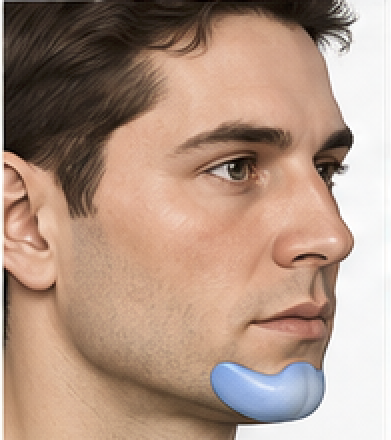
Custom chin implants are indicated when chin augmentation requires changes beyond simple horizontal projection. While standard chin implants are effective for selected cases of mild to moderate chin retrusion, they offer limited control over vertical length, transverse width, shape, and asymmetry.
The principal indications for custom chin implants include:
- Vertical chin lengthening: Increasing lower facial height while providing appropriate horizontal projection.
- Chin widening or narrowing in appearance: Creating a broader, squarer, or more tapered chin contour through augmentation design.
- Chin asymmetry: Correcting differences in projection, height, or contour between the right and left sides.
- Complex three-dimensional augmentation: Combining horizontal, vertical, and transverse changes in a single implant.
- Revision chin augmentation: Correcting deficiencies or contour irregularities following previous implant placement or genioplasty.
Custom chin implants are especially valuable in male facial augmentation, where chin width, squareness, and vertical height may be as important as anterior projection. They are also useful for achieving a defined chin shape that is not obtainable with commercially available implants.
However, significant skeletal retrusion, malocclusion, or functional dentofacial deformity may be better treated with sliding genioplasty or orthognathic surgery rather than implant augmentation alone.
2. Custom Jaw Angle Implants
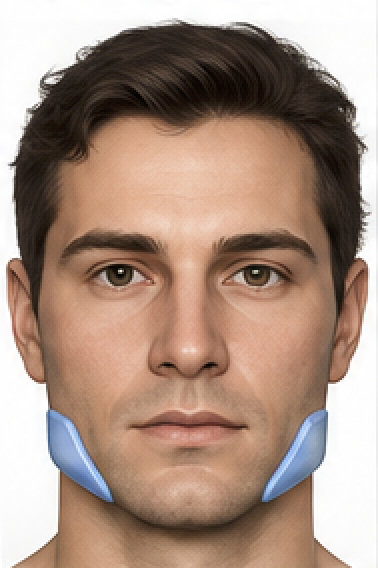
The primary indication for custom jaw angle implants is insufficient development or definition of the posterior mandible. Jaw angle deficiencies may involve inadequate lateral width, insufficient vertical length, poor posterior projection, or combinations of these anatomical characteristics.
Common indications include:
- Jaw angle widening: Increasing bigonial width and posterior lower facial definition.
- Vertical jaw angle lengthening: Extending the gonial region inferiorly to improve posterior facial height.
- Combined width and vertical augmentation: Creating a larger and more distinctly defined posterior mandibular angle.
- Jaw angle asymmetry: Correcting congenital or developmental differences between the two sides.
- Revision of standard jaw angle implants: Improving implant position, symmetry, or overall contour.
Custom jaw angle implants offer a particular advantage because the desired augmentation must be considered in relation to the gonial angle, posterior mandibular border, masseter muscle, and overlying soft tissues.
The ability to independently control lateral and inferior augmentation is one of the most important indications for using a custom rather than a standard jaw angle implant.
3. Custom Jawline Implants
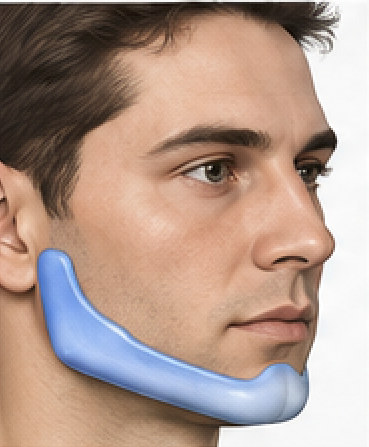
Custom jawline implants represent a more comprehensive form of mandibular augmentation. They are indicated when the aesthetic objective involves changing the entire lower facial skeletal framework rather than augmenting the chin or jaw angles independently.
A custom jawline implant typically extends from one posterior mandibular angle across the mandibular body and chin to the opposite angle, creating a continuous augmentation of the lower jaw.
Major indications include:
- Global jawline deficiency: Inadequate chin projection, jaw angle width, and mandibular border definition.
- Male jawline enhancement: Creating a stronger, wider, more angular lower facial framework.
- Mandibular border augmentation: Improving the visibility and continuity of the jawline between the chin and jaw angles.
- Lower facial asymmetry: Correcting complex skeletal differences involving several mandibular regions.
- Revision of multiple standard implants: Replacing separate chin and jaw angle implants with a unified, continuous design.
- Complex congenital mandibular contour deficiencies: Improving external symmetry and skeletal shape in appropriately selected patients.
The principal advantage of a custom jawline implant is the ability to control the relationship between the chin, mandibular body, and jaw angles as a single aesthetic unit. It avoids the contour discontinuities and positional variability that may occur when multiple standard implants are used independently.
Custom jawline implants are most appropriate when the objective is skeletal contour augmentation rather than correction of a significant occlusal or jaw-position abnormality.
4. Custom Infraorbital-Malar Implants
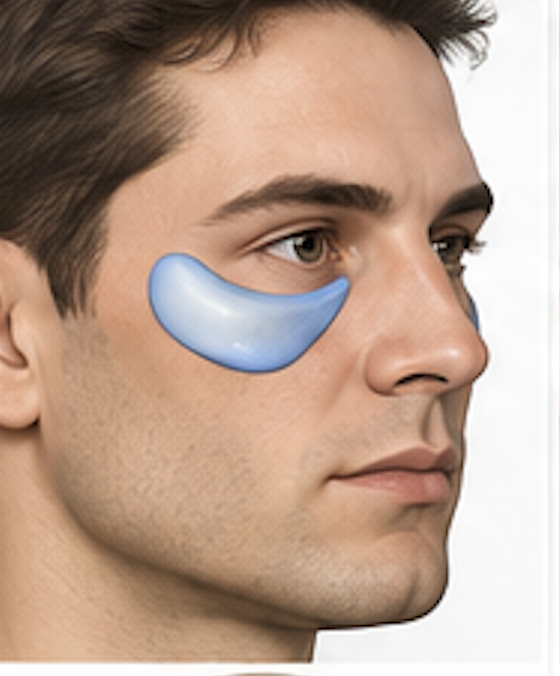
Custom infraorbital-malar implants are indicated for skeletal deficiencies involving the lower orbital rim and adjacent upper cheek. These regions are anatomically continuous, and deficiencies commonly involve both the infraorbital rim and the anterior malar surface.
The principal indications include:
- Infraorbital rim retrusion: Insufficient bony support beneath the lower eyelid.
- Skeletal contributions to under-eye hollowing: Improving the underlying contour of a deficient infraorbital rim.
- Negative orbital vector: Selected cases in which the globe projects anterior to the deficient infraorbital rim and malar support.
- Flat upper cheeks: Insufficient anterior projection of the upper malar region.
- Infraorbital-malar asymmetry: Correcting differences in lower orbital rim and upper cheek projection.
- Combined lower eyelid and upper cheek skeletal deficiency: Creating a more continuous transition between the orbital rim and malar eminence.
Unlike conventional cheek implants, custom infraorbital-malar implants can extend superiorly to the infraorbital rim and medially toward the nasomaxillary region when indicated.
Their greatest value is in patients whose under-eye and upper cheek concerns have a substantial skeletal component rather than being caused exclusively by skin laxity, fat redistribution, or soft tissue volume loss.
Skeletal augmentation may improve support and contour but should not be considered a substitute for lower eyelid surgery when significant soft tissue or eyelid-position abnormalities are present.
5. Custom Cheek Implants
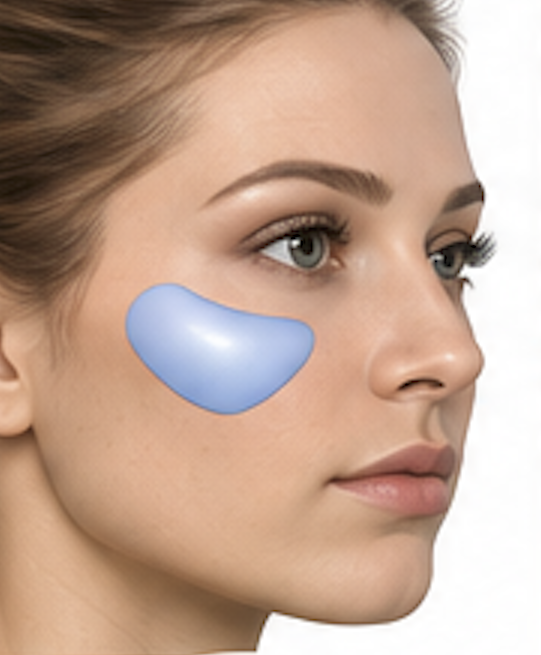
Custom cheek implants are indicated when the objective is to change the size, projection, shape, or position of the malar eminence. They are particularly useful when the desired augmentation does not correspond to the dimensions or positioning of standard malar and submalar implants.
Common indications include:
- Anterior cheek projection: Increasing forward prominence of the malar eminence.
- Lateral cheek widening: Increasing bizygomatic width and upper facial definition.
- High cheekbone enhancement: Creating greater prominence along the superior and lateral malar regions.
- Cheek asymmetry: Correcting differences in malar projection or position.
- Extended zygomatic augmentation: Augmenting the lateral cheek and selected portions of the zygomatic arch.
- Revision cheek augmentation: Correcting excessive, insufficient, or improperly distributed augmentation from previous implants.
The key indication for a custom cheek implant is the need to precisely control where cheek projection occurs.
This is particularly important in male facial augmentation, where lateral and high malar prominence may be preferable to excessive lower submalar fullness. In female facial augmentation, the aesthetic objective may involve a different distribution of anterior and lateral cheek projection, depending on the patient’s facial proportions and desired appearance.
Custom cheek implants allow the augmentation to be designed around these individualized aesthetic objectives rather than relying on a predetermined cheek implant configuration.
6. Custom Midface Implants
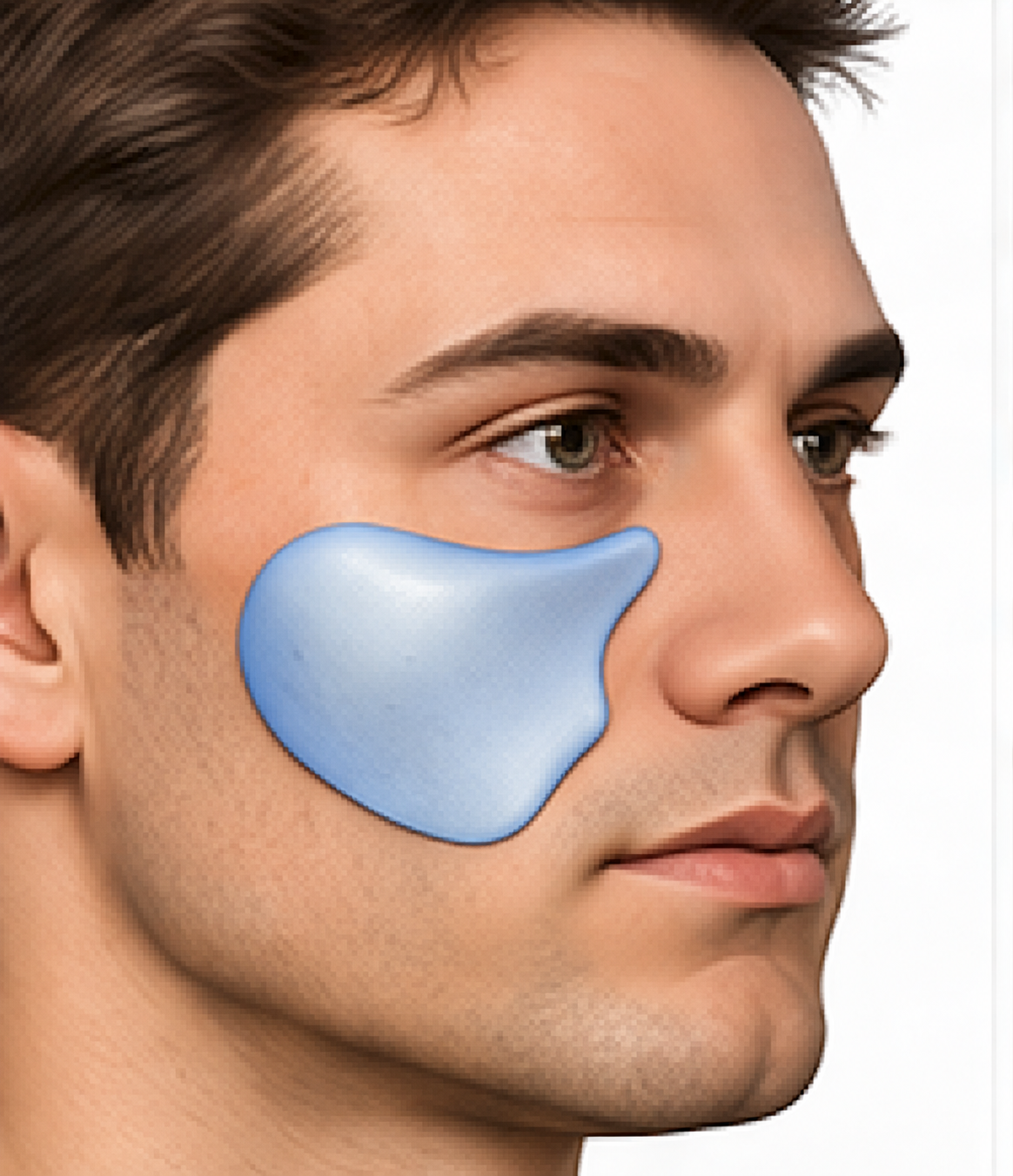
Custom midface implants are indicated for more extensive deficiencies of the central facial skeleton. While cheek implants primarily address the malar region, custom midface implants may incorporate the infraorbital rims, anterior maxilla, paranasal regions, pyriform aperture margins, and portions of the zygomatic complex.
The principal indications include:
- Central midfacial retrusion: Insufficient anterior projection of the anterior maxilla and adjacent skeletal regions.
- Paranasal deficiency: Inadequate skeletal projection alongside the nasal base.
- Premaxillary deficiency: Insufficient skeletal support beneath and around the nasal base.
- Combined cheek and central midface flattening: A broader deficiency extending across multiple facial skeletal regions.
- Midfacial asymmetry: Complex differences in projection or contour involving the maxilla and zygomatic regions.
- Revision or reconstructive skeletal contour augmentation: Restoring selected areas of deficient midfacial projection.
A custom midface implant is particularly useful when several adjacent skeletal regions require different amounts of augmentation. It allows the anterior maxilla, paranasal region, and malar areas to be treated as a coordinated anatomical complex.
An important distinction is that custom midface implants provide external skeletal augmentation but do not advance the dental arches or correct significant maxillary malocclusion. Patients with major maxillary hypoplasia and associated occlusal abnormalities may require orthognathic surgery instead.
7. Custom Brow Bone Implants
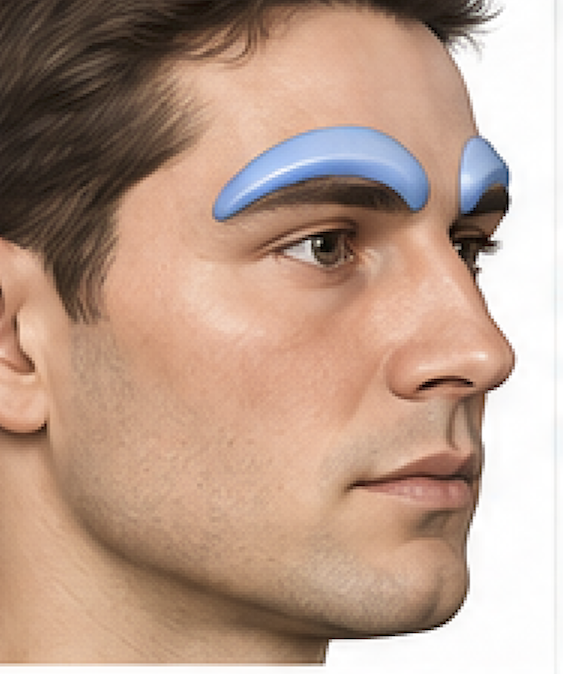
Custom brow bone implants are indicated for aesthetic enhancement or restoration of the supraorbital rims and adjacent frontal bone contours. They are particularly useful when the desired change involves the size, projection, or shape of the brow ridge.
Major indications include:
- Brow ridge augmentation: Increasing supraorbital projection and prominence.
- Male brow bone enhancement: Creating a stronger and more defined supraorbital ridge.
- Supraorbital asymmetry: Correcting differences in brow bone projection or shape.
- Brow bone reduction reversal: Restoring projection following previous frontal sinus setback or brow bone reduction procedures.
- Combined brow and glabellar augmentation: Improving the continuity between the central glabella and lateral supraorbital ridges.
- Congenital or post-traumatic brow contour deficiencies: Restoring deficient skeletal projection.
Custom brow bone implants are especially advantageous because the supraorbital region has a complex curvature that varies considerably between patients.
Implant design must account for the frontal sinus, supraorbital neurovascular structures, orbital margins, and transition into the forehead. The desired amount and distribution of brow projection should also be evaluated in relation to eye position, upper eyelid anatomy, and forehead slope.
8. Custom Forehead Implants
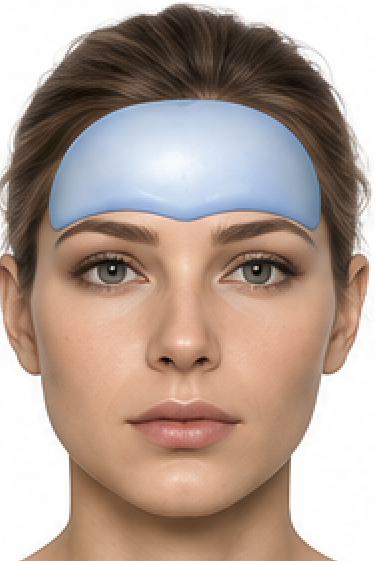
Custom forehead implants are indicated for deficiencies or aesthetic concerns involving the frontal bone’s shape, projection, slope, width, and overall convexity.
Unlike standard facial implants, custom forehead implants are individually designed because the forehead is a broad skeletal surface with considerable anatomical variation.
Common indications include:
- Forehead retrusion: Increasing anterior forehead projection.
- Excessive backward forehead slope: Creating a more vertical or appropriately convex forehead profile.
- Forehead flattening: Improving insufficient frontal convexity.
- Forehead widening: Increasing transverse frontal contour and reducing the appearance of a narrow forehead.
- Forehead asymmetry: Correcting differences in frontal bone shape or projection.
- Contour irregularities: Improving congenital, developmental, traumatic, or postoperative surface deformities.
- Combined forehead and brow bone augmentation: Creating a continuous aesthetic transition between the supraorbital ridges and frontal bone.
Custom forehead implants are particularly valuable because forehead augmentation often requires broad, thin, smoothly tapered implant designs rather than a localized area of projection.
The desired forehead contour must be evaluated in relation to the brow bones, temporal lines, hairline, and overall craniofacial shape. In selected cases, a combined forehead-brow implant may be more appropriate than separate implants.
9. General Principles of Patient Selection
While the anatomical indications differ among facial regions, several principles apply to all custom facial implants.
The first is the identification of a skeletal contour problem that can be improved through augmentation. Not every aesthetic facial concern is caused by deficient bone projection, and the contribution of overlying soft tissues must be carefully assessed.
The second consideration is whether the desired change requires individualized three-dimensional control. Custom implants provide their greatest advantage when multiple dimensions must be altered simultaneously, when asymmetry exists, or when the augmentation must extend beyond the coverage of standard implants.
The third consideration is the relationship between the proposed skeletal change and its external aesthetic effect. Implant thickness does not necessarily translate into an equivalent change in facial surface projection because the overlying soft tissues influence the final visible result.
Finally, the procedure must be evaluated in relation to adjacent anatomical structures, implant fixation, surgical access, soft tissue accommodation, and the patient’s aesthetic expectations. Custom design improves anatomical precision but does not eliminate the risks of infection, implant malposition, nerve injury, contour dissatisfaction, or revision surgery.
Conclusion
Custom facial implants are indicated when the desired aesthetic improvement requires a level of skeletal augmentation, anatomical coverage, or three-dimensional contour control that cannot be reliably achieved with standard implant designs.
Each region has its own primary aesthetic purpose: custom chin implants control anterior lower facial shape; jaw angle implants enhance posterior mandibular dimensions; jawline implants create comprehensive lower facial definition; infraorbital-malar implants address upper cheek and lower orbital rim deficiencies; cheek implants modify malar prominence; midface implants augment central facial projection; brow bone implants enhance supraorbital definition; and forehead implants modify frontal contour, projection, and slope.
The fundamental indication for a custom facial implant is not simply the desire for greater augmentation, but the need to place the appropriate amount of augmentation in precisely the correct anatomical location. This individualized distribution of skeletal volume is what distinguishes custom implant surgery from conventional facial implant augmentation.