
Custom Facial Implants: The Complete Guide
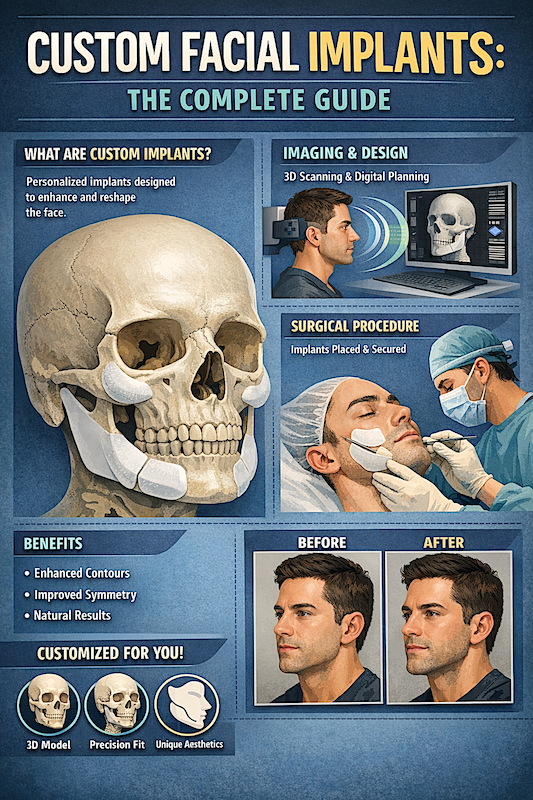
Custom facial implants represent one of the most advanced approaches in modern facial plastic surgery, offering a level of precision and personalization that standard, off-the-shelf implants simply cannot match. Designed specifically for each patient using 3D imaging and digital modeling, custom facial implants provide tailored solutions for enhancing facial structure, correcting asymmetry, and addressing complex aesthetic or reconstructive concerns.
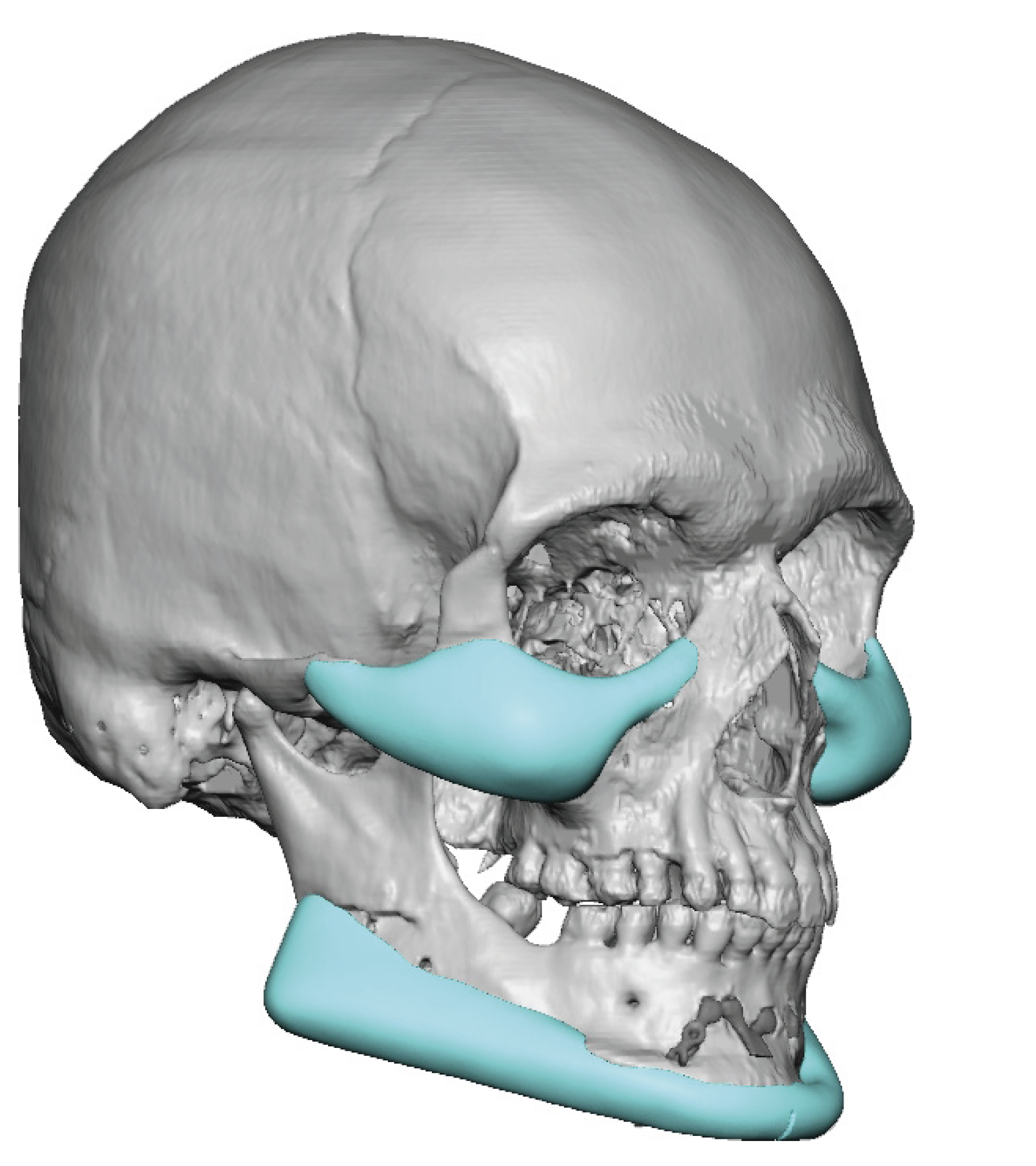
Unlike traditional implants that come in pre-made shapes and sizes, custom facial implants—also known as patient-specific implants—are created to fit the exact contours of an individual’s facial anatomy. This personalized design process allows for highly accurate results, particularly in areas of the face where subtle differences in shape and proportion can have a significant impact on overall appearance.
Patients considering custom facial implants are often looking for more than basic augmentation. Many seek correction of facial asymmetry, enhancement of underdeveloped skeletal features, or refinement of previous surgical results. Others are interested in achieving a specific aesthetic outcome that cannot be reliably accomplished with standard implants or non-surgical treatments. In these situations, a custom-designed implant offers a level of control and predictability that is not otherwise possible.
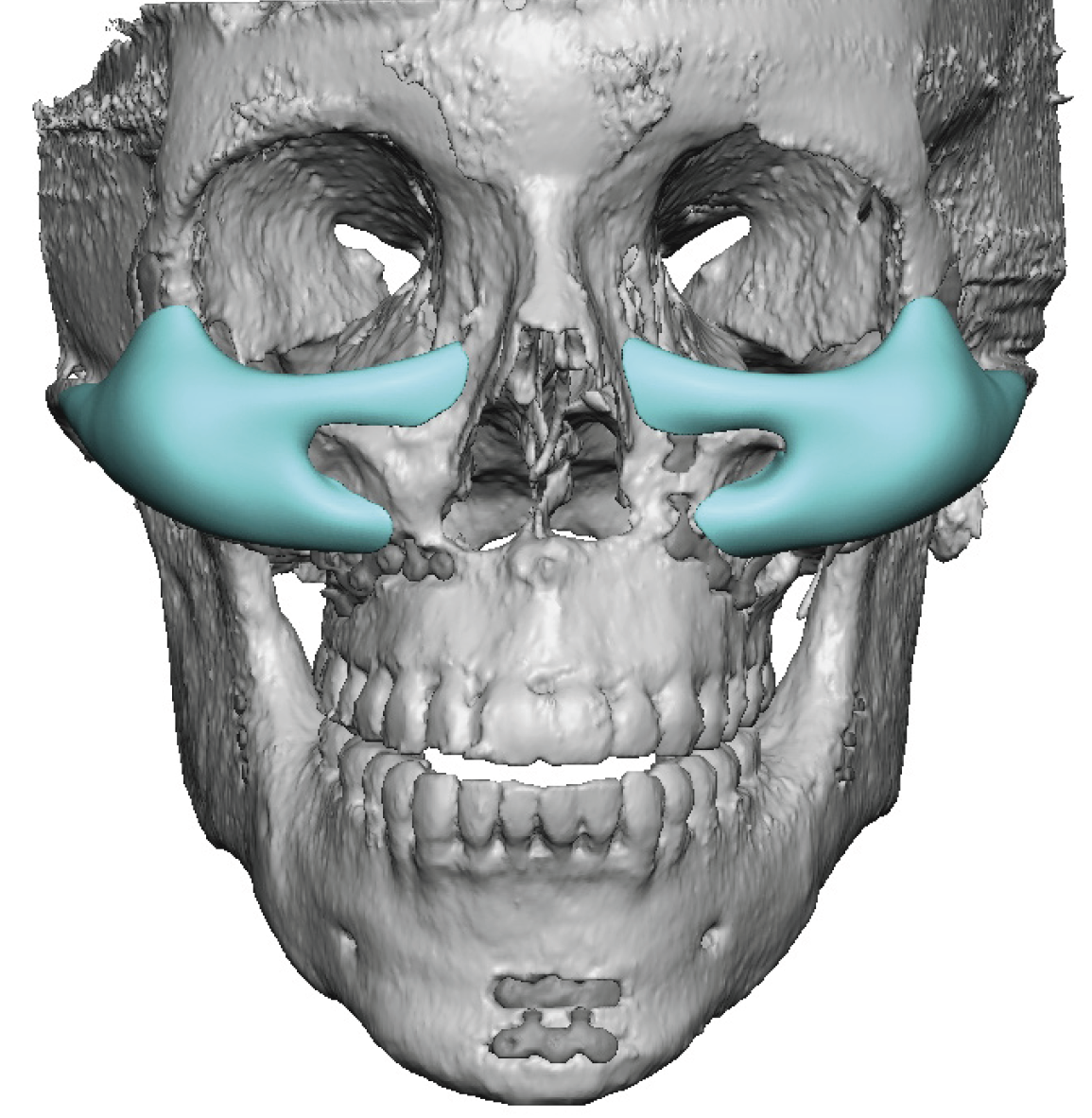
One of the key advantages of custom facial implants is their ability to address complex or unique anatomical concerns. Because the implant is designed from a patient’s own CT scan data, it can be shaped to match the underlying bone structure with a high degree of accuracy. This is particularly beneficial in procedures involving the jawline, chin, cheeks, orbital and forehead regions, where precise contouring is essential for achieving natural-looking results.
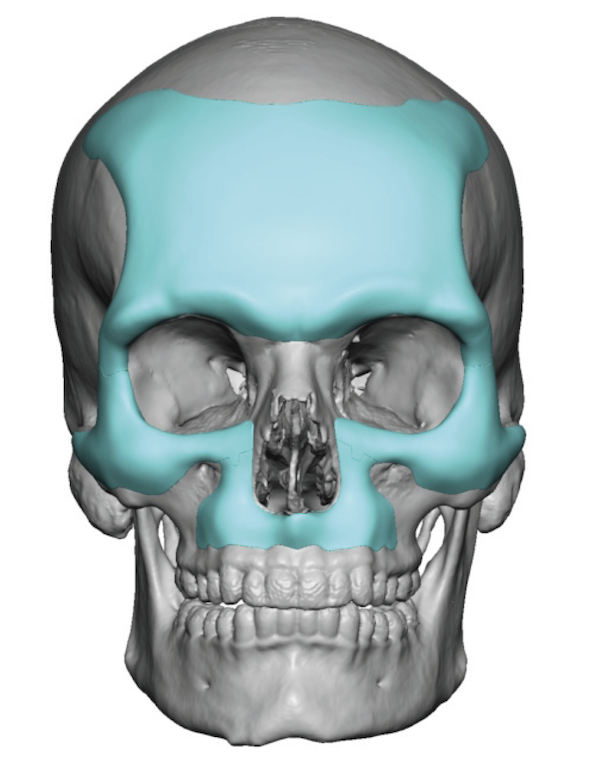
The process of creating custom facial implants begins with detailed imaging, typically using a CT scan. This imaging data is then converted into a 3D digital model of the patient’s facial skeleton. Using specialized software, the implant is designed to achieve the desired structural changes while maintaining harmony with the surrounding anatomy. Once finalized, the implant is manufactured using biocompatible materials and prepared for surgical placement.
From an aesthetic standpoint, custom facial implants offer several important benefits. They allow for smoother transitions between augmented and non-augmented areas, reduce the likelihood of visible edges or irregularities, and provide a more natural integration with the patient’s existing facial structure. In many cases, this leads to results that are both more refined and more predictable than those achieved with standard implant options.
Custom implants are also particularly valuable in revision surgery, where previous procedures may not have produced the desired outcome. In such cases, a patient-specific approach can correct asymmetries, improve contour irregularities, and restore balance to the face in ways that standardized solutions cannot.
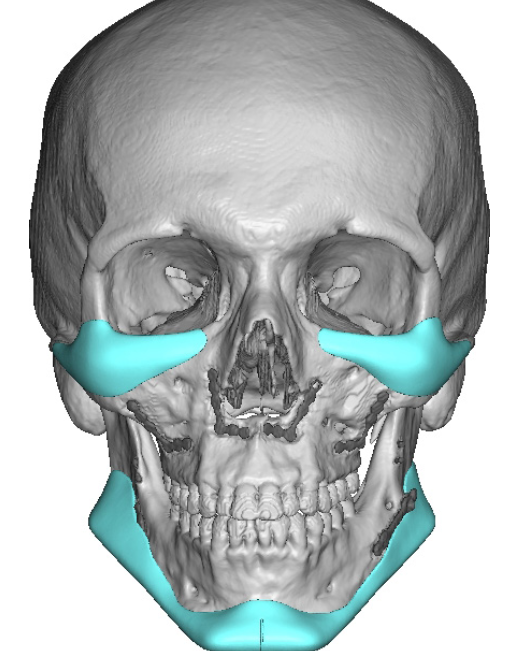
It is important to understand that while custom facial implants offer significant advantages, they are not necessary for every patient. Many individuals can achieve excellent results with traditional implant options. However, for those seeking a higher level of precision, customization, and control over their outcome, custom facial implants represent a powerful and increasingly popular option.
As interest in personalized aesthetic procedures continues to grow, custom facial implants have become an important part of advanced facial surgery. They reflect a broader shift toward individualized treatment planning, where surgical solutions are tailored not just to a general goal, but to the specific anatomy and aesthetic preferences of each patient.
In the sections that follow, this guide will explore how custom facial implants are designed, what areas of the face they can address, how they compare to standard implants and other treatment options, and what patients can expect in terms of recovery, risks, and long-term results.
Custom Facial Implants vs Standard Facial Implants
Core difference (simple way to think about it)
- Standard implants = “off-the-shelf” shapes
- Custom implants = “designed specifically for your face”
Side-by-side comparison
| Feature | Standard Implants | Custom Implants |
| Design | Pre-made shapes & sizes | Designed from your 3D CT scan |
| Fit to bone | Approximate (“best match”) | Exact, patient-specific fit |
| Anatomy coverage | Usually one area (chin, cheek, jaw angle) | Can span multiple areas seamlessly |
| Precision | Depends on surgeon positioning | Built-in precision before surgery |
| Ability to correct asymmetry | Limited | Excellent |
| Customization of shape | Limited to available styles | Fully customizable (width, projection, contour) |
| Cost | Lower | Higher |
| Surgical planning | Simpler | More complex (digital planning, fabrication) |
| Best for | Simple, predictable enhancements | Complex, unique, or high-precision goals |
Standard (stock) facial implants
What they are
- Pre-manufactured implants (chin, jaw, cheek, etc.)
- Come in preset shapes and sizes
Pros
- ✔ Less expensive
- ✔ Widely available
- ✔ Good for routine cosmetic enhancement
- ✔ Shorter planning time
Limitations
- ❌ Not tailored to your exact anatomy
- ❌ May require intraoperative adjustment
- ❌ Limited ability to fix asymmetry or complex deficiencies
- ❌ Sometimes produce a “generic” look if mismatch occurs
Think: “best fit from a catalog”
Custom facial implants
What they are
- Designed using 3D CT imaging + CAD modeling
- Manufactured specifically for your bone structure
Pros
- ✔ Exact anatomical fit → better symmetry & stability
- ✔ Can create very specific shapes and contours
- ✔ Better for:
- Facial asymmetry
- Complex skeletal deficiencies
- Revision (failed prior implants)
- ✔ More natural, blended results
Limitations
- ❌ Higher cost
- ❌ Requires imaging + planning time
- ❌ More complex surgical workflow
Think: “engineered like a custom puzzle piece for your face”
When each is typically used
Standard implants → best for:
- Mild to moderate enhancement
- Symmetrical faces
- First-time cosmetic procedures
- Patients prioritizing cost & simplicity
Custom implants → best for:
- Noticeable asymmetry or irregular bone structure
- Complex midface/jawline deficiencies
- Very specific aesthetic goals
- Revision surgeries after poor results
Important nuance (most people miss this)
Even custom implants are not “perfect and final”:
- Surgeons can still trim or adjust implants during surgery
- But you cannot add volume intraoperatively
So planning matters more than the label “custom vs standard”
Bottom line
- Standard implants → reliable, simpler, cost-effective
- Custom implants → precise, tailored, and better for complex cases
The “better” option depends on:
- Your anatomy
- Your goals
- How exact the result needs to be
Custom Facial Implant vs Facial Bone Surgery
Custom facial implants and facial bone surgery (osteotomy-based procedures) can both change facial structure, but they work very differently and are suited to different goals.
Custom Facial Implants
What they are:
Solid implants designed to augment existing bone structure. “Custom” means they’re designed from your CT scan to fit your anatomy exactly.
Best for:
- Adding projection or volume
- Enhancing:
- Jawline
- Chin
- Cheekbones
- Orbital rims
- Camouflage of mild asymmetry
Advantages:
- Highly predictable (you can preview results with 3D planning)
- Less invasive than bone cutting
- No bone healing required
- Can achieve very sharp, aesthetic contours
- Reversible/removable
Limitations:
- Doesn’t reposition bones—only adds on top
- Limited for functional issues (bite problems, airway, etc.)
- Extreme size increases can look unnatural if overdone
Facial Bone Surgery (Orthognathic / Osteotomy)
What it is:
Surgical cutting and repositioning of facial bones (e.g., Le Fort, BSSO, genioplasty).
Best for:
- Functional problems:
- Malocclusion (bad bite)
- Sleep apnea
- Jaw misalignment
- Major structural changes:
- Moving jaws forward/backward
- Vertical changes (long/short face)
- Rotations and asymmetry correction
Advantages:
- Changes the foundation, not just surface appearance
- Can dramatically improve:
- Facial balance
- Bite function
- Airway
- More natural integration since it’s your own bone
Limitations:
- Much more invasive
- Longer recovery (weeks to months)
- Requires orthodontics in many cases
- Less “fine sculpting” capability compared to implants
Key Differences
| Feature | Custom Implants | Bone Surgery |
| Purpose | Add shape/volume | Reposition skeleton |
| Invasiveness | Moderate | High |
| Recovery | 1–3 weeks (initial) | 6–12+ weeks |
| Precision shaping | Excellent | Limited (macro changes) |
| Functional improvement | No | Yes |
| Reversibility | Yes | No (permanent) |
How to Choose
Choose custom implants if:
- Your bite is normal
- You want cosmetic enhancement only
- You need more projection/definition (jawline, cheekbones, chin)
- You want a less invasive option
Choose bone surgery if:
- You have a bite problem or jaw misalignment
- Your face needs large positional changes
- There are airway or functional issues
Important Insight (Most People Miss This)
They are not mutually exclusive.
Many advanced cases use a hybrid approach:
- Bone surgery → fixes position and function
- Custom implants → refine aesthetics (angles, contours, symmetry)
This is often how the most dramatic and natural-looking results are achieved.
Real-World Example
- Weak jawline but normal bite → Custom jaw implant
- Recessed lower jaw + overbite → BSSO (bone surgery)
- After jaw surgery but still lacking definition → Add custom implants
Custom Facial Implants vs Injectable Fillers
Custom facial implants and dermal fillers both enhance facial structure—but they’re fundamentally different in longevity, precision, invasiveness, and purpose. Here’s a clear, practical breakdown:
Custom Facial Implants
What they are:
Solid implants designed specifically for your anatomy using 3D imaging.
Pros
- Permanent (no ongoing maintenance)
- Highly precise — tailored to your exact facial structure
- Best for structural changes (jawline, chin, cheekbones)
- No “fading” over time
Cons
- Requires surgery (incisions, anesthesia, recovery)
- Higher upfront cost
- Small risks: infection, shifting, need for revision
Best for:
- Weak chin or jawline needing strong definition
- Facial asymmetry
- Patients wanting a one-time, definitive result
Dermal Fillers
What they are:
Injectable gels (like hyaluronic acid) used to add volume or contour.
Pros
- Non-surgical, minimal downtime
- Immediate results
- Adjustable and reversible (for HA fillers)
- Lower upfront cost
Cons
- Temporary (6–18 months typically)
- Less precise for structural augmentation
- Can require frequent maintenance → adds up over time
- Risk of overfilling or migration if poorly done
Best for:
- Mild contouring (cheeks, lips, under-eyes)
- Trying out a “look” before committing
- Subtle refinements rather than major structural change
Key Differences
| Feature | Custom Implants | Fillers |
| Longevity | Permanent | Temporary |
| Invasiveness | Surgical | Non-surgical |
| Precision | Very high (custom-fit) | Moderate |
| Cost (long-term) | Often cheaper over time | Repeated costs |
| Recovery | 1–3 weeks | Minimal (1–3 days) |
| Best Use | Structural enhancement | Volume + subtle contour |
How to Think About It
- If you want true skeletal enhancement (stronger jawline, chin projection, cheekbone structure) → implants are usually superior.
- If you want soft volume or subtle shaping, or you’re unsure → fillers are a good starting point.
- Many patients actually do both:
- Implants for structure
- Fillers for fine-tuning
Bottom Line
Fillers can simulate implants—but only to a point.
For significant changes in projection or definition, they often become:
- Less effective
- More expensive long-term
- Potentially unnatural if overused
Custom Facial Implants vs Fat Injections
Like synthetic fillers fat injections are often used to perform facial augmentations. Besides the differing compositions and methods of placement, their indications and aesthetic effect are also different.
Big-picture difference
- Custom implants = structure (bone-level change)
- Fat grafting = volume (soft tissue change)
Think of it like:
- Implants = “build the framework”
- Fat = “fill and smooth the surface”
Custom Facial Implants
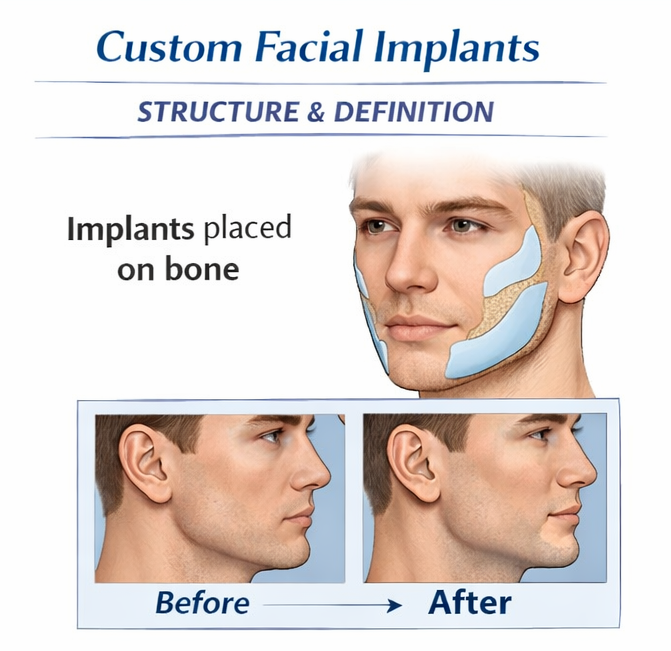
What they do
- Add projection, width, and definition (jawline, chin, cheekbones)
- Sit on bone → change facial shape permanently
Pros
- Very precise & predictable
- Permanent result
- Best for strong definition (jawline, chin, cheekbones)
- Can create dramatic structural change
Cons
- Surgery required
- Harder to adjust/remove later
- Small risks: infection, shifting, revision
👉 Best for:
- Weak chin / jaw / cheekbones
- Wanting sharp, angular, defined look
Fat Grafting (Fat Transfer)
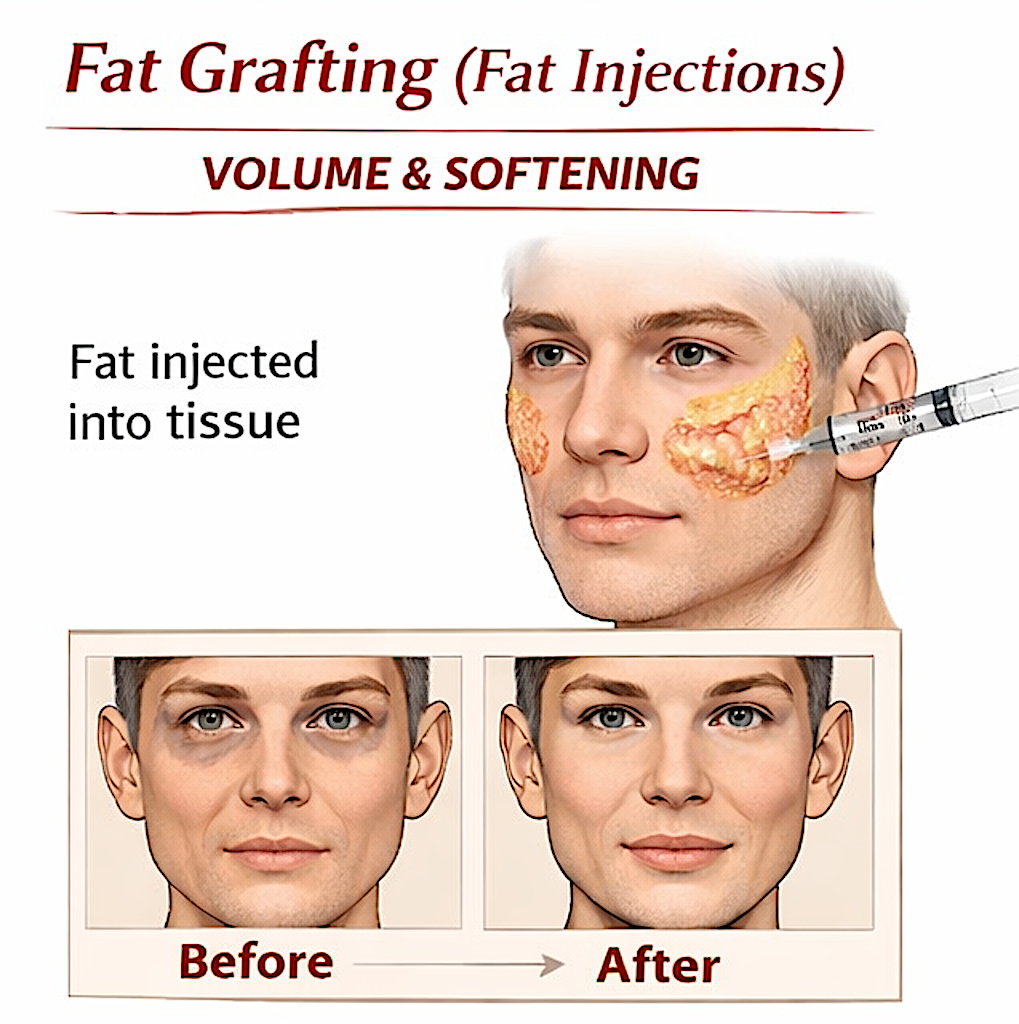
What it does
- Uses your own fat to restore volume and soften contours
- Injected into soft tissue (not bone)
Pros
- Natural tissue (no implant)
- Softer, more natural look
- Improves skin quality
- Can treat multiple areas (under eyes, cheeks, temples)
Cons
- Unpredictable survival (often ~50–70% remains)
- May need repeat sessions
- Cannot create strong structure or projection
👉 Best for:
- Hollowing, aging, volume loss
- Subtle contouring / refinement
- Patients avoiding implants
Side-by-side comparison
| Feature | Implants | Fat Grafting |
| Purpose | Structure & projection | Volume & smoothing |
| Look | Sharper, defined | Softer, natural |
| Predictability | High | Variable |
| Longevity | Permanent | Partially permanent (some resorbs) |
| Adjustability | Difficult | Easier (repeatable) |
| Best areas | Jawline, chin, cheekbones | Under eyes, cheeks, temples |
| Invasiveness | Surgical placement | Less invasive (liposuction + injections) |
When each wins
Choose implants if:
- You want strong facial definition
- You lack bone projection (flat cheeks, weak chin)
- You want a one-time, stable result
Choose fat grafting if:
- You want natural fullness
- You’re treating aging or hollowness
- You prefer no foreign material
A hybrid approach is sometimes done:
- Implants → create structure
- Fat → refine, soften, and blend edges
👉 This gives the most “natural but defined” result in some patients.
Bottom line
- Implants = sculpt the skeleton
- Fat = polish the result
Neither is “better”—they’re tools for different goals.
Who Are Good Candidates For Custom Facial Implants
Good candidates for custom facial implants are patients who want precise, structural changes to their facial skeleton that can’t be reliably achieved with standard (off-the-shelf) implants or soft-tissue procedures. The key factor is that the issue is bone shape/volume, not just skin or fat.
Here’s how to think about it:
Ideal Candidates
1. Patients with Facial Asymmetry
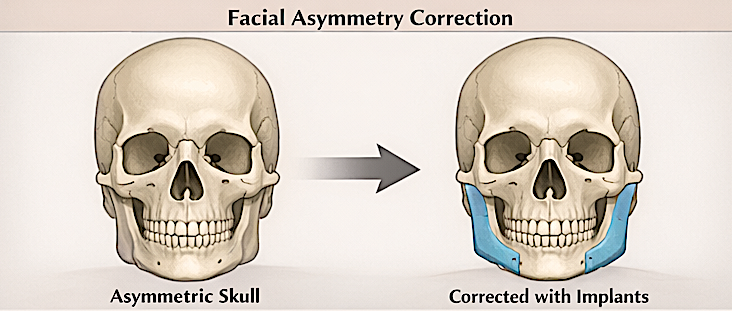
- Congenital asymmetry (jaw, cheek, chin differences)
- Post-traumatic deformities (fractures that healed unevenly)
- Prior surgery with residual imbalance
Custom implants allow millimeter-level correction tailored to each side of the face.
2. Patients Seeking Strong Structural Enhancement
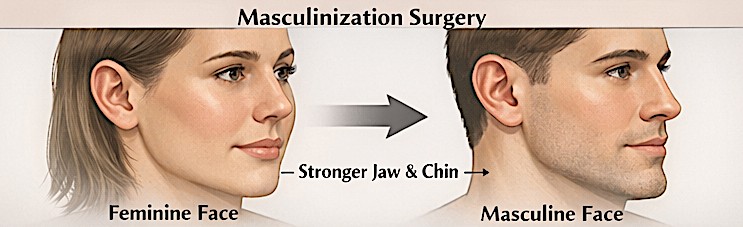
- Weak chin, jawline, or cheekbones
- Flat midface or lack of projection
- Desire for a more defined or masculine/feminine facial contour
Especially useful for when:
- Standard implants don’t match anatomy well
- Larger or more complex augmentations are needed
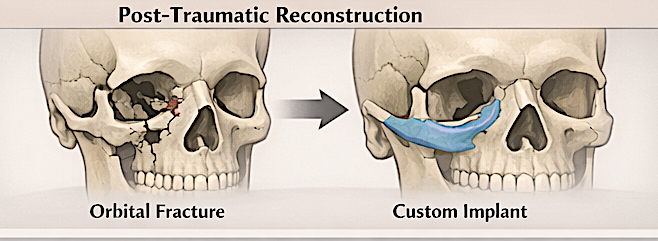
3. Revision Surgery Patients
- Unsatisfactory results from prior implants or fillers
- Malpositioned or poorly fitting standard implants
- Over- or under-correction issues
- Secondary reconstruction of facial fractures/trauma
Custom implants can “fix” what stock implants cannot.
4. Patients with Congenital or Developmental Conditions
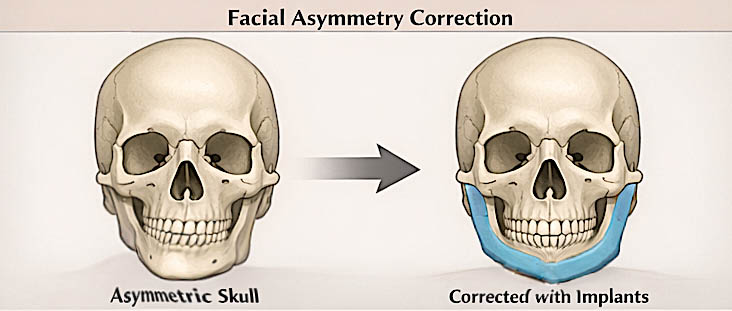
- Congenital facial asymmetries
- Facialsyndromes
- Jaw growth deficiencies
Custom design helps restore normal anatomy rather than just augment.
5. Patients Wanting a Permanent Alternative to Fillers
- Repeated filler use for cheeks/jaw/chin
- Desire for a one-time structural solution
- Important distinction: implants change bone contour, not just volume.
Less Ideal Candidates
- Patients whose concerns are mainly:
- Skin laxity (better treated with lifting procedures)
- Fat distribution (better treated with fat grafting or liposuction)
- Those expecting subtle, temporary, or easily reversible changes
- Patients unwilling to accept:
- Surgical recovery
- Higher cost vs standard implants
Psychological & Practical Considerations
Good candidates also:
- Have realistic expectations
- Understand 3D planning limitations (simulation ≠ exact outcome)
- Are comfortable with CT-based design process
- Are seeking precision over simplicity
Common Areas for Custom Implants
- Chin
- Jawline (angle + body implants)
- Cheeks (malar/submalar)
- Paranasal-Premaxillary
- Orbital rims / infraorbital region
- Forehead and brow bone
Bottom Line
The best candidates are those who need precise, structural, and often asymmetric skeletal changes—especially when standard implants or non-surgical options fall short.
When Custom Facial Implants Aren’t Ideal
Custom facial implants (like patient-specific chin, jawline, cheek, or orbital implants) can be very effective—but they’re not a good fit for everyone or every situation. The downsides usually fall into a few categories: medical, aesthetic, and practical.
1. Patients with higher risk of complications
They’re generally not ideal if someone has:
- Poor wound healing (e.g., uncontrolled diabetes, heavy smoking)
- Active infections or dental issues (especially for jaw/chin implants)
- Compromised soft tissue coverage
These factors increase risks like infection, implant exposure, or poor integration.
2. Situations where simpler options would work just as well
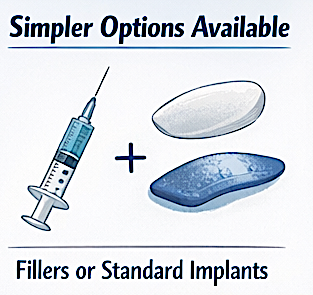
Custom implants can be overkill if:
- The change needed is small (fillers or fat grafting may be enough)
- Standard (off-the-shelf) implants would achieve the same result
- The patient isn’t sure about committing to a permanent structural change
They’re more justified for complex asymmetry or major aesthetic skeletal augmentations.
3. Patients with unrealistic expectations

Because these are precisely designed, people sometimes expect perfect symmetry or dramatic transformation. That’s not always achievable due to:
- Soft tissue limitations
- Healing variability
- Natural facial asymmetries
If expectations aren’t grounded, dissatisfaction is more likely.
4. People unwilling to accept revision risk
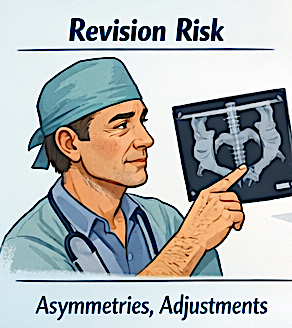
Even with custom design, revisions can happen:
- Minor asymmetries
- Edge visibility or palpability
- Position adjustments
If someone wants a “one-and-done, zero-risk” procedure, this isn’t it.
5. Cost-sensitive situations
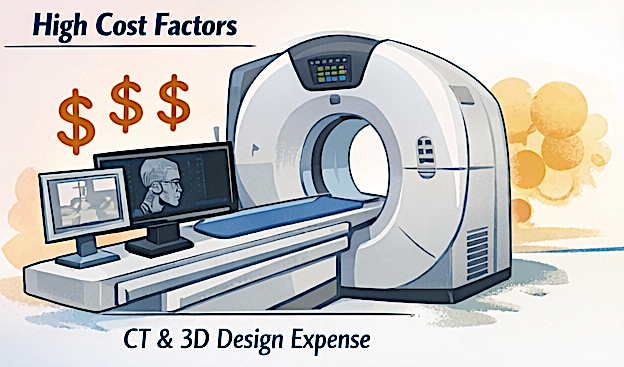
Custom implants are significantly more expensive because they involve:
- CT imaging
- 3D design and manufacturing
If budget is a concern, standard implants or non-surgical options may be more appropriate.
6. Cases needing functional correction rather than augmentation
If the issue is structural/functional (like bite problems or airway issues), orthognathic surgery may be the correct treatment—not implants.
Bottom line:
Custom facial implants are best for precise, structural changes—especially asymmetry or complex contouring. They’re not ideal for minor cosmetic tweaks, high-risk medical profiles, or patients expecting perfection without trade-offs.
What Are The Most Commonly Performed Custom Facial Implants
Custom facial implants are typically used to enhance or reconstruct specific skeletal features of the face, especially when standard (off-the-shelf) implants aren’t sufficient. In practice, a few areas account for the majority of custom implant cases:
1. Jawline / Mandibular Implants (most common)
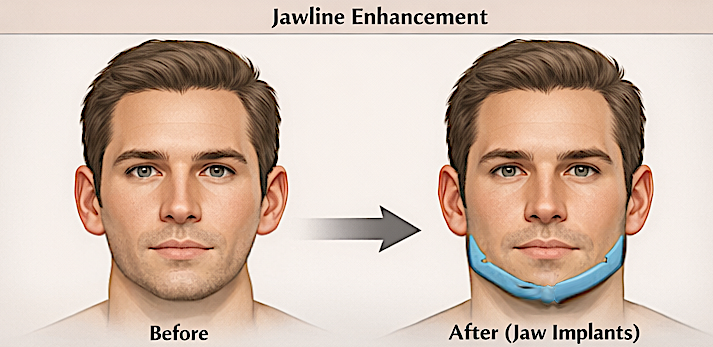
- Includes: Jaw angle, body, and extended wraparound implants
- Why common: Strong demand for a more defined, wider, or more masculine lower face
- Custom advantage: Precise control of width, projection, and symmetry across the entire mandible
- Often used in cosmetic masculinization or facial balance cases
2. Chin (Mentum) Implants
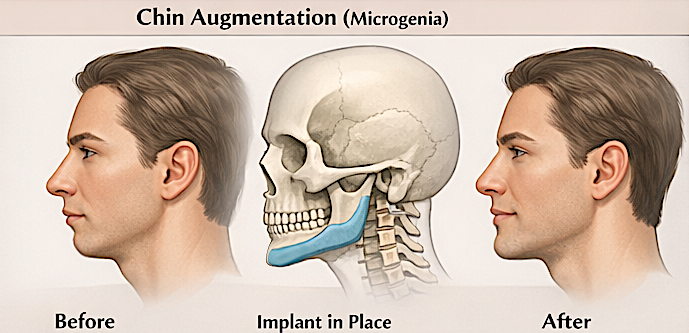
- Includes: Vertical lengthening, projection, asymmetry correction
- Why common: Chin position heavily affects facial harmony
- Custom advantage: Ability to correct vertical deficiencies and asymmetries that standard implants can’t address well
- Frequently combined with jaw implants
3. Cheek / Malar Implants
- Includes: Malar (lateral cheek), submalar, or combined designs
- Why common: Enhances midface projection and contour
- Custom advantage: Tailored augmentation (e.g., more lateral vs anterior projection depending on aesthetic goal)
- Common in both cosmetic enhancement and post-trauma reconstruction
4. Orbital / Infraorbital Rim Implants
- Includes: Under-eye rim, tear trough, orbital floor augmentation
- Why common: Addresses hollow eyes, negative vector orbit, or congenital deficiencies
- Custom advantage: Extremely precise fit is critical in this complex anatomy
- Growing in popularity for aesthetic eye rejuvenation
5. Paranasal / Pyriform Implants
- Includes: Base of nose / upper jaw region
- Why common: Improves midface retrusion and nasal-labial angle
- Custom advantage: Subtle but powerful improvement in facial balance, especially in profile
- Often combined with rhinoplasty
6. Temporal Implants
- Includes: Temple hollowing correction
- Why common: Aging or naturally concave temples
- Custom advantage: Smooth contour restoration without overfilling
- Less common than jaw/chin/cheek but still a regular niche use
Less Common but Important Custom Implants
- Forehead / brow bone implants (augmentation or contouring)
- Maxillary (Le Fort-based) implants for midface advancement
- Asymmetry correction implants (very common indication for going custom)
- Post-traumatic or congenital reconstruction
Big Picture
- Most common overall:
👉 Jawline → Chin → Cheeks - Fastest growing aesthetic areas:
👉 Orbital rim and full wraparound jawline systems - Main reason to go custom:
👉 Need for precise fit, symmetry correction, or multi-dimensional augmentation
Male vs Female Differences In Custom Facial Implants
Male vs female facial implant trends are actually very systematic—almost everything comes down to structure vs softness, width vs projection, and angles vs curves. Here’s a clear breakdown based on how aesthetic goals differ and how that directly changes implant design and selection.
Core Philosophy Difference
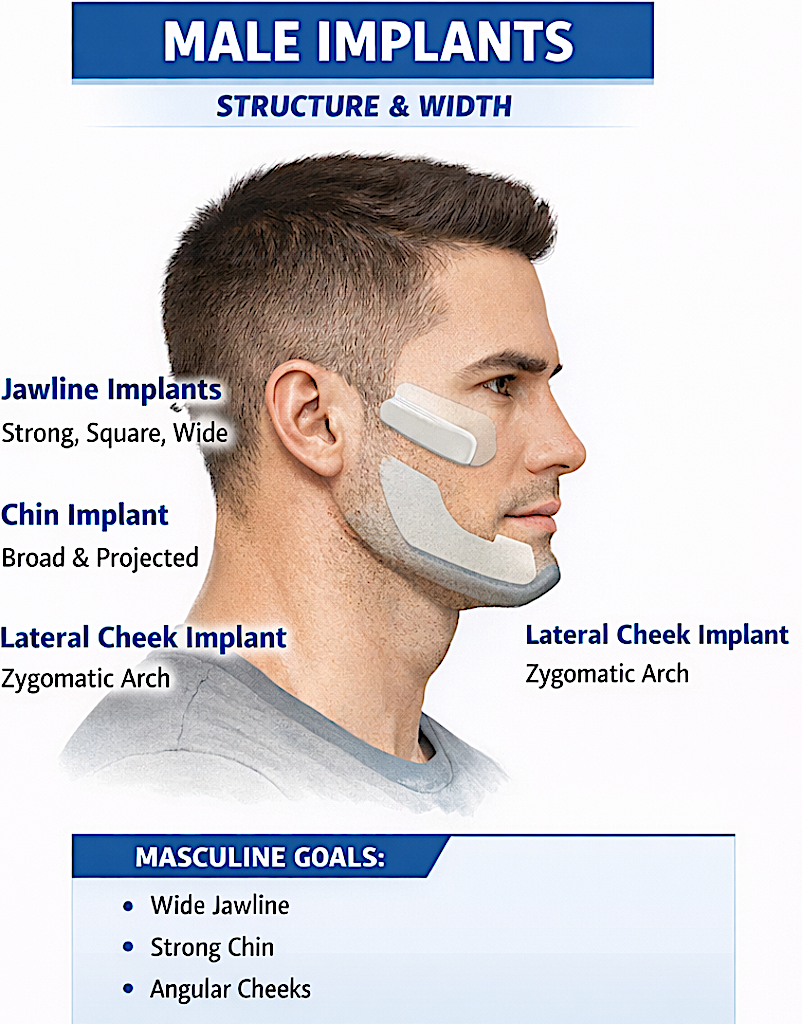
- Male aesthetics: emphasize strength, width, angularity, and structure
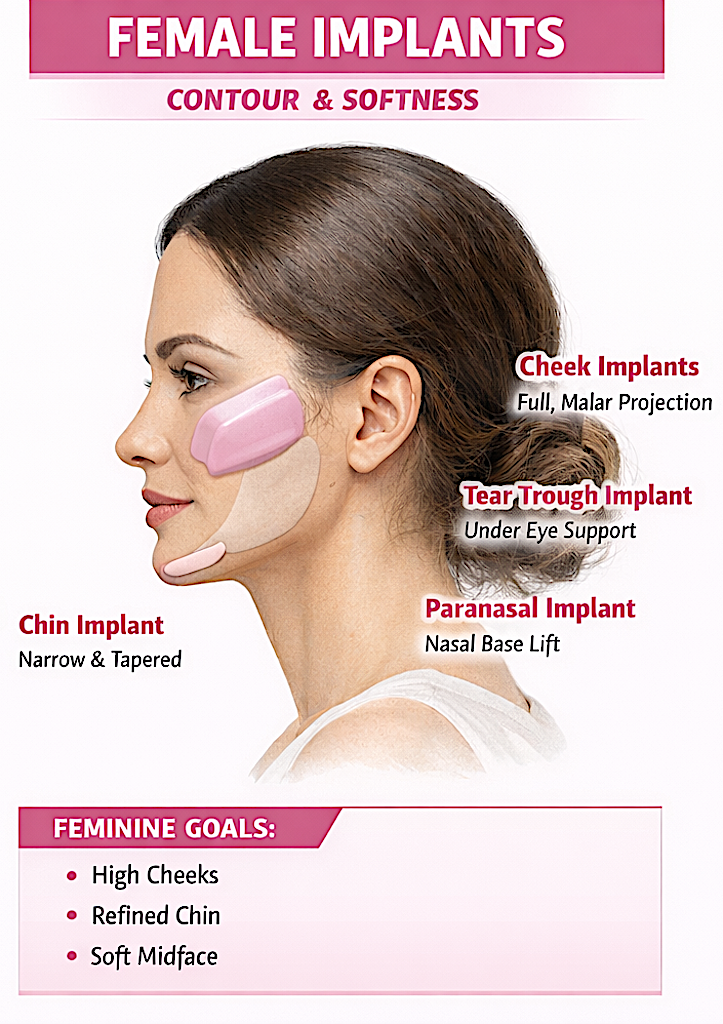
- Female aesthetics: emphasize softness, contour, projection, and smooth transitions
This is rooted in real anatomical dimorphism—men have larger, more angular bones (jaw, brow, chin) while women have smaller faces with fuller cheeks and softer contours
1. Jawline (BIGGEST divergence)
Male trend
- Wide, square jaw
- Strong posterior angle flare
- Goal: frame the face
- Implants: wraparound / angle + body widening
👉 Masculinity is strongly tied to a broad, angular mandible
Female trend
- Narrow, tapered jaw
- Soft angle, less flare
- Goal: avoid heaviness in lower face
- Implants: rare; often reduction > augmentation
✅ Key takeaway:
- Men → add width
- Women → preserve taper / reduce bulk
2. Chin
Male trend
- Wide, square, projected
- Often vertically longer
- Goal: strong profile + jaw continuity
Female trend
- Narrower, more pointed or oval
- Less projection
- Goal: delicacy and facial balance
👉 Male chins are typically broader and more prominent, while female chins are smaller and more tapered
3. Cheeks (most misunderstood difference)
This is where implant design differs the most technically.
Male trend
- Emphasis on lateral width (zygomatic arch)
- Flat or minimal anterior projection
- Goal: facial frame, not fullness
Female trend
- Emphasis on anterior projection (malar/submalar)
- Rounded “apple cheek”
- Goal: youthful fullness + light reflection
👉
- Female: projection without width
- Male: width without fullness
4. Orbital / Under-eye Region
Male trend
- Lower, straighter brow
- Slightly deeper-set eyes
- Goal: stronger skeletal look
Female trend
- Higher brow, smoother lid-cheek junction
- Fuller under-eye support
- Goal: youthfulness and openness
👉 Female faces tend to have higher brows and fuller cheeks around the eyes
5. Midface / Paranasal
Male trend
- Subtle augmentation (avoid overfilling)
- Maintain flatter midface
Female trend
- More common use
- Goal: soft convexity and support of nasal base
6. Overall Facial Shape
- Male: square / rectangular, angular
- Female: heart-shaped, tapered, rounded
How This Translates to Custom Implants
Male Implant Patterns
- Larger, wraparound designs
- Emphasis on horizontal expansion
- Continuous transitions (jaw → chin → angle)
- Less “focal” projection, more structural enlargement
Female Implant Patterns
- Smaller, targeted implants
- Emphasis on anterior projection
- Avoid widening the face
- Focus on highlight points (cheek apex, chin refinement)
Clinical Pattern (What You Actually See in Practice)
Men
- Jawline (dominant)
- Chin
- Lateral cheek / arch
- Orbital rim (increasing)
Women
- Cheek (malar/submalar)
- Chin (refinement, not widening)
- Orbital / tear trough
- Paranasal
Subtle but Important Insight
- Increasing femininity almost always increases attractiveness in women
- Increasing masculinity in men is more variable in effect
👉 That’s why:
- Female procedures tend to be conservative and refinement-focused
- Male procedures are often bolder and structure-driven
Bottom Line
- Men = build the frame (jaw, chin, width)
- Women = shape the contours (cheek projection, softness, taper
What Are The Most Common Male Masculinization Custom Facial Implants
For male facial masculinization with custom facial implants, the most commonly requested implants are those that enhance the skeletal features associated with a stronger male facial structure. In approximate order of frequency:
1. Jaw Angle Implants (Bigonial Augmentation)
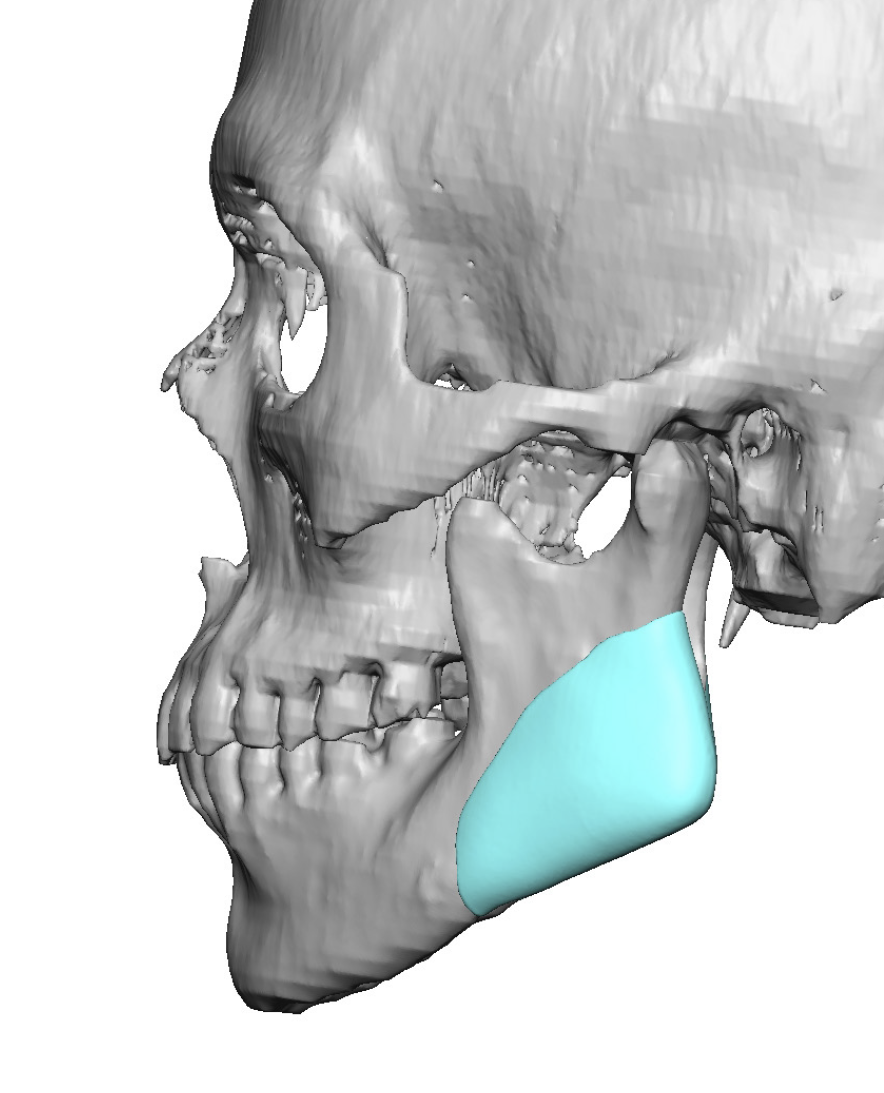
Most common masculinization implant.
Purpose:
- Increase lower facial width
- Create a more square jaw
- Add posterior jaw angle projection
- Improve jawline definition from the front and side
Typical male goals:
- Wider, stronger mandibular angles
- More vertical and lateral flare
- Improved jaw-neck transition
2. Chin Implants (Alloplastic Genioplasty)
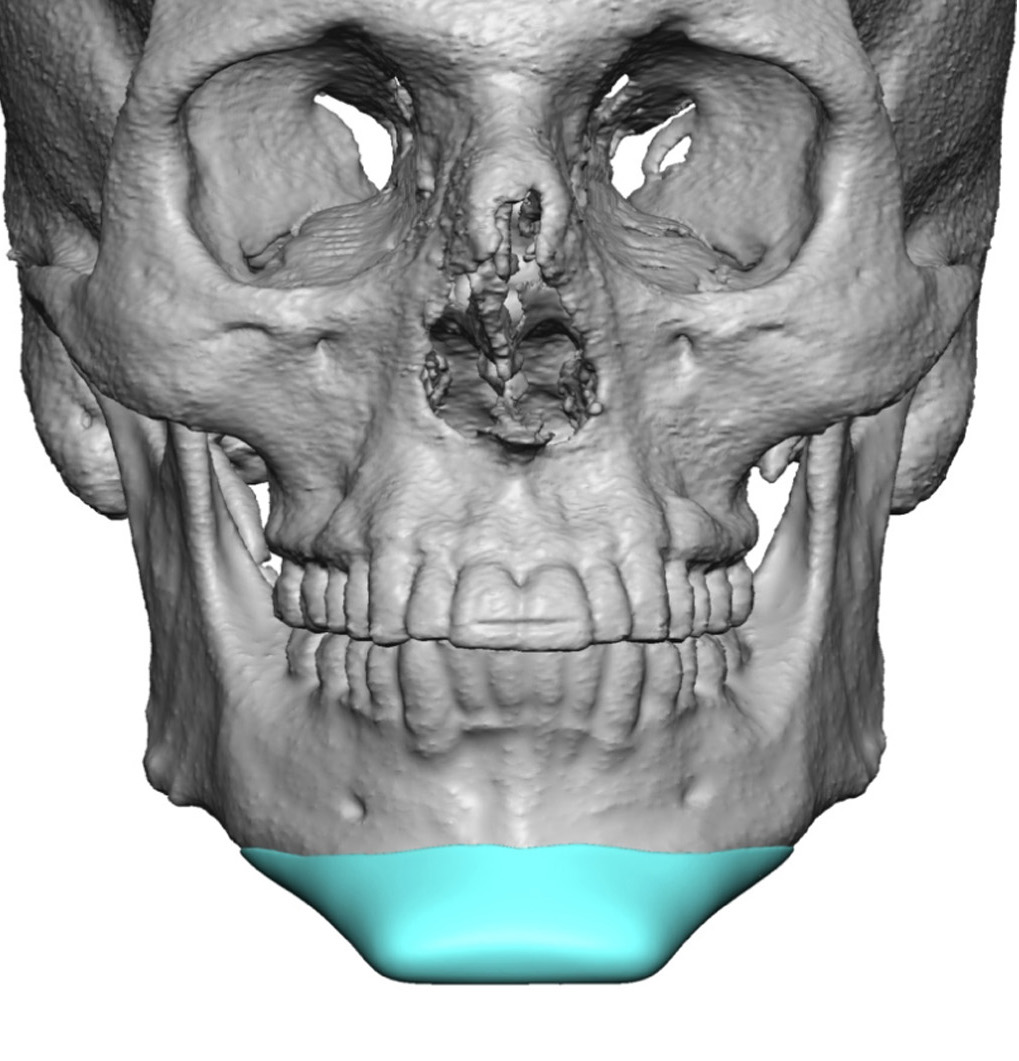
Purpose:
- Increase chin projection
- Increase chin width
- Create a more square chin shape
Typical male goals:
- Broader, squarer chin
- Greater horizontal projection
- Better balance with a larger jaw
Custom chin implants are often combined with jaw angle implants as a jawline augmentation system.
3. Extended or Wraparound Jawline Implants
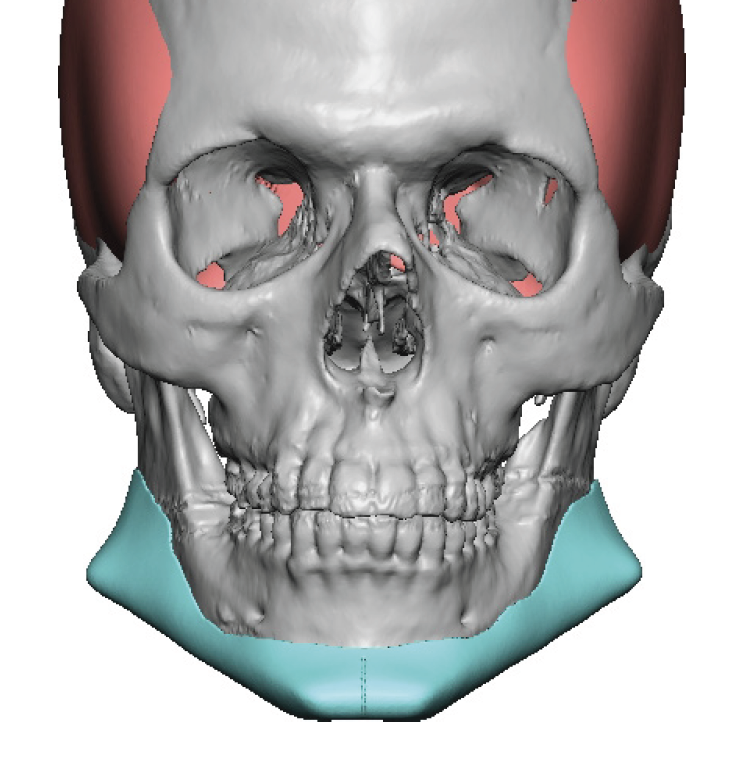
Purpose:
- Connect the chin and jaw angles with a continuous implant
- Create a complete lower-third redesign
Typical male goals:
- Strong uninterrupted mandibular border
- Increased facial width
- More angular lower face
This has become increasingly popular because it creates a more natural, comprehensive masculine jawline than separate implants.
4. Cheek Implants (Malar/Submalar)
Purpose:
- Increase cheekbone prominence
- Enhance midface skeletal structure
Typical male goals:
- Lateral cheekbone projection
- Stronger zygomatic arches
- Less emphasis on high anterior “feminine” cheeks
Male cheek augmentation usually focuses on:
- Lateral width
- Zygomatic arch prominence
rather than high anterior fullness.
5. Infraorbital-Malar and Midface Implants
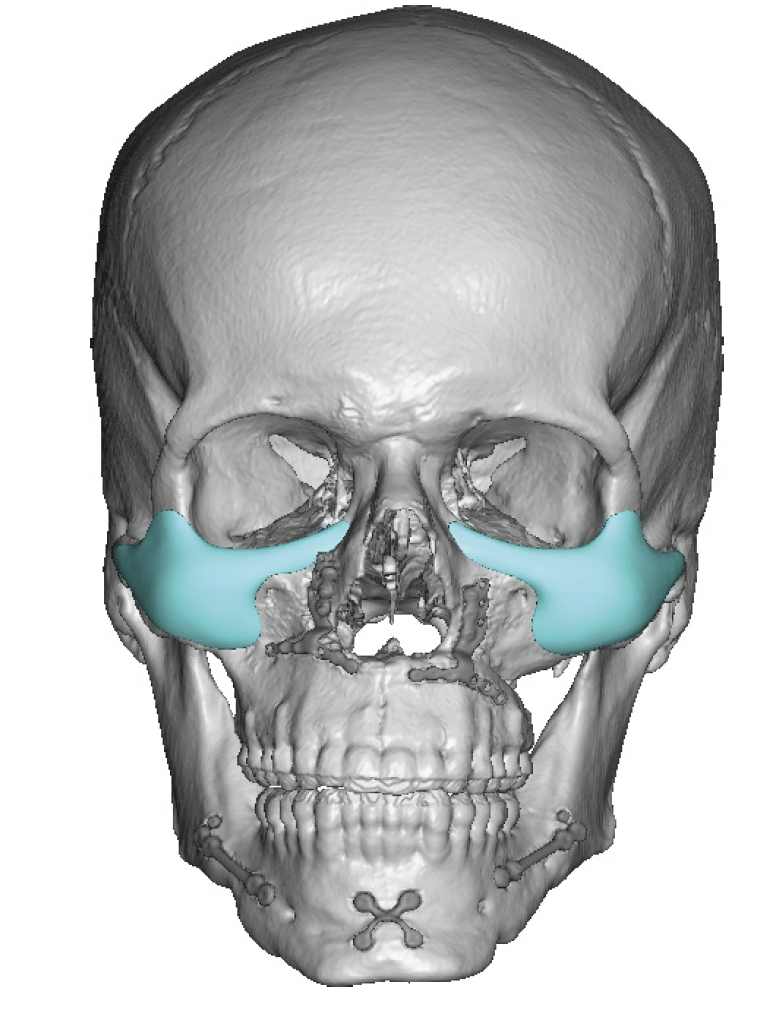
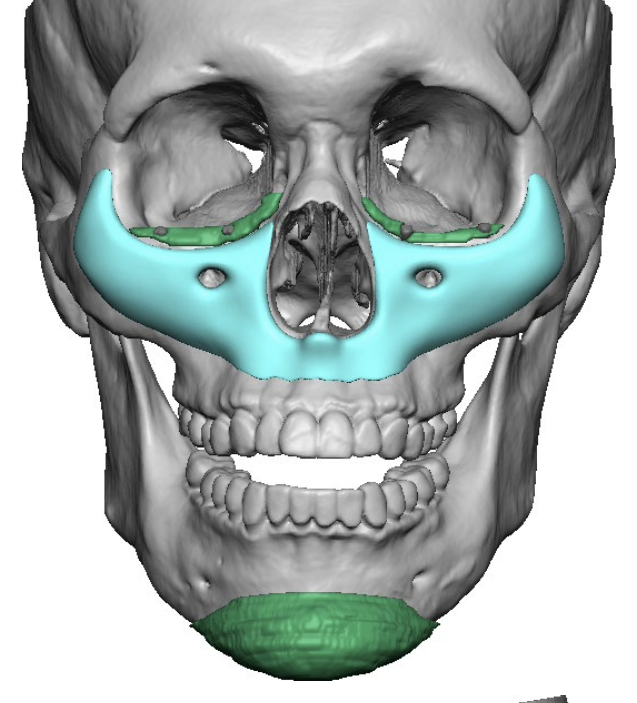
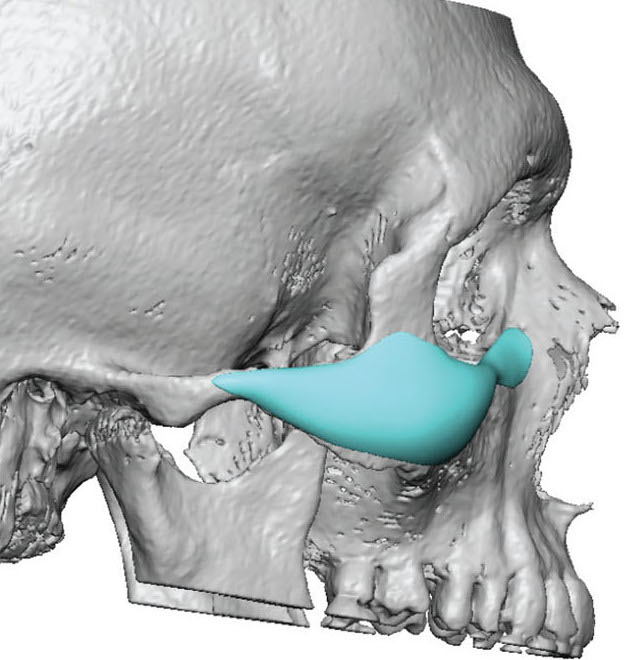
Purpose:
- Strengthen the area beneath the eyes
- Improve midface projection
Typical male goals:
- More skeletal definition
- Reduction of flat midface appearance
- Stronger orbital-rim support
Frequently combined with cheek implants in advanced facial masculinization.
6. Forehead / Brow Bone Implants
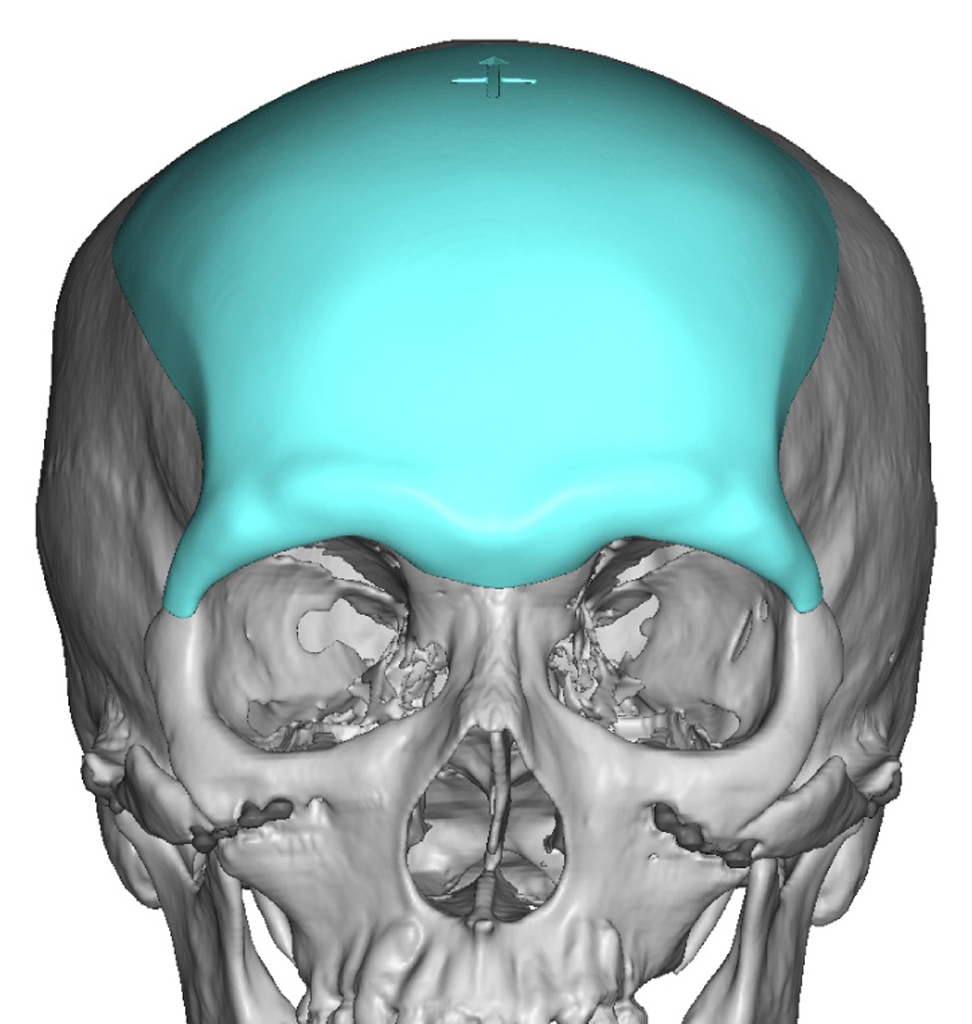
Purpose:
- Increase supraorbital bossing
- Create a stronger brow ridge
- Widen the forehead/decrease backward slope
Typical male goals:
- More prominent brow projection
- Deeper-set eye appearance
- Stronger transition between forehead and orbit
- Forehead masculinization
These are among the most technically complex custom implants.
7. Temporal Implants
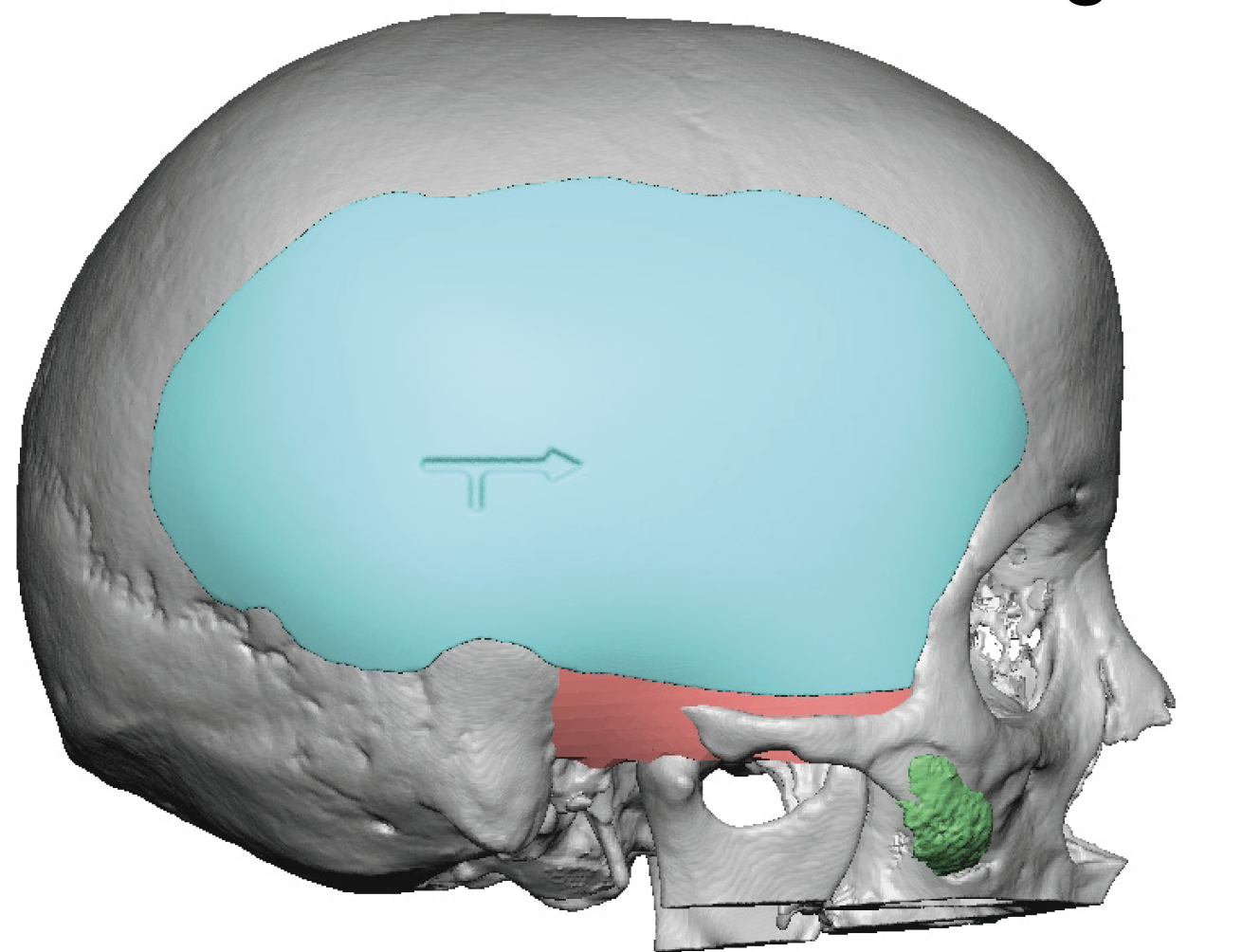
Purpose:
- Increase side-of-head width
Typical male goals:
- Broader upper face
- More balanced craniofacial proportions
- Less temporal hollowing
Less common than jaw/chin augmentation but often used in comprehensive male facial enhancement.
8. Paranasal Implants
Purpose:
- Increase support around the nasal base
Typical male goals:
- Stronger central facial skeleton
- Improved profile balance
- Better support for nasal projection
Usually a secondary adjunct procedure.
Most Common Masculinization Combinations
Basic Masculinization
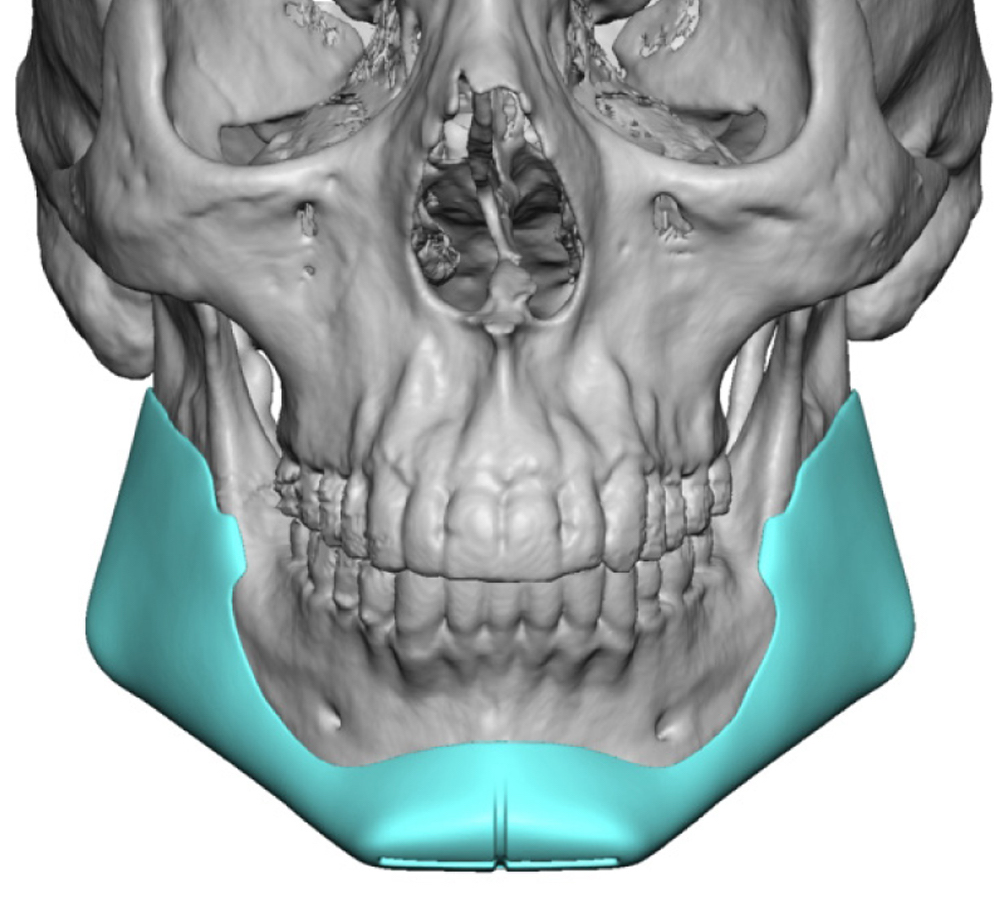
- Custom chin implant
- Custom jaw angle implants
Lower Two-Third of Face Masculinization
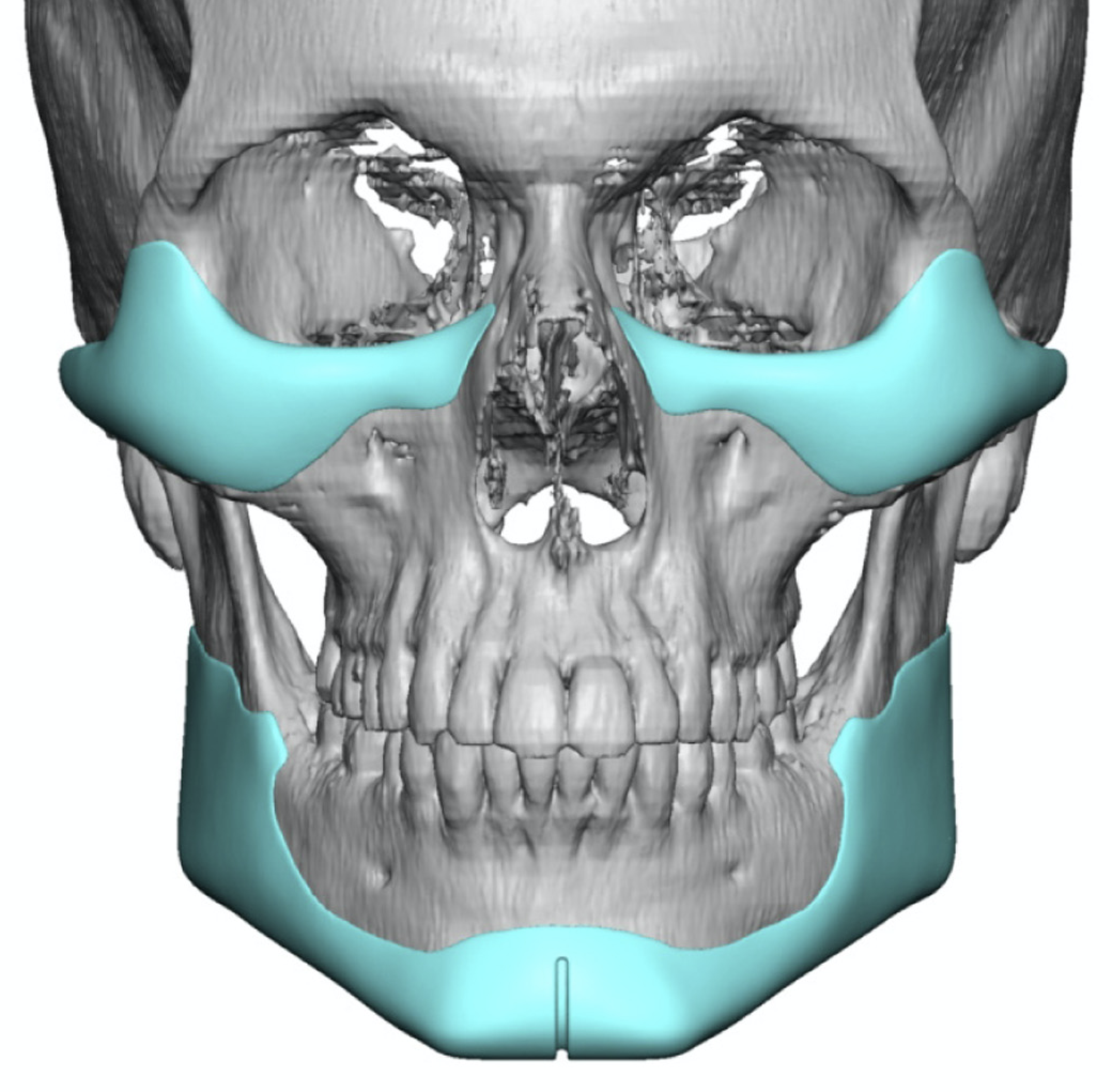
- Extended jawline implant
- Infraorbital-malar implants
- Most common custom facial implant combination
Full (Three Level) Facial Masculinization
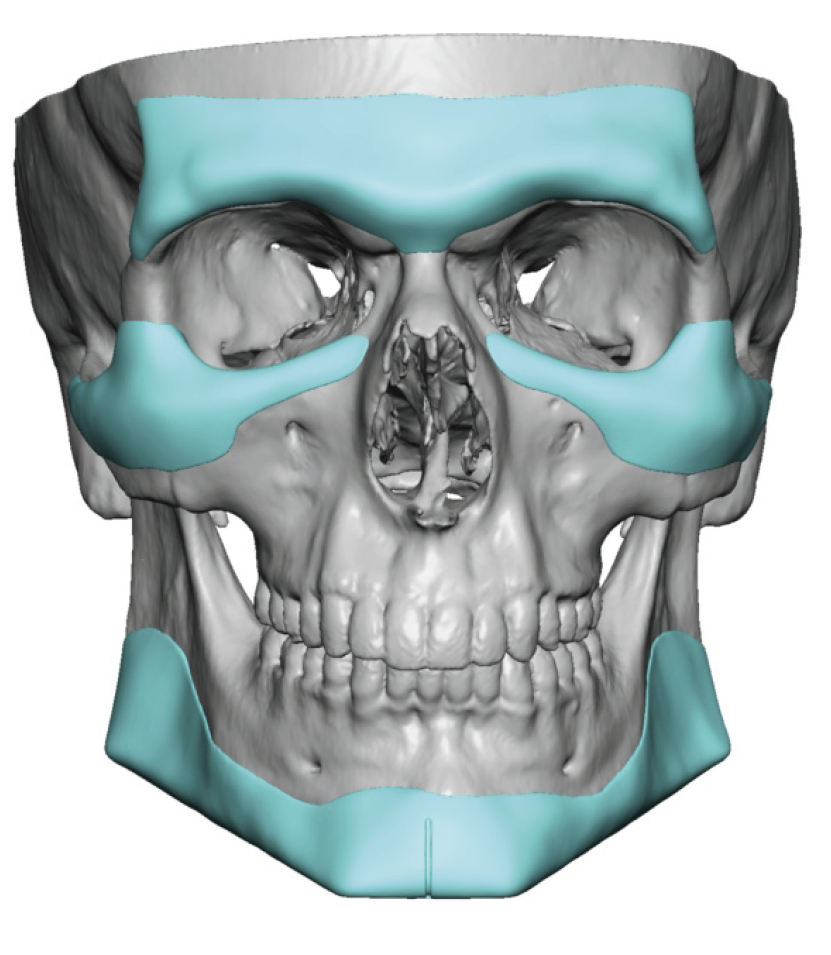
- Infraorbital-malar implants
- Brow bone implant
- wraparound jawline implant
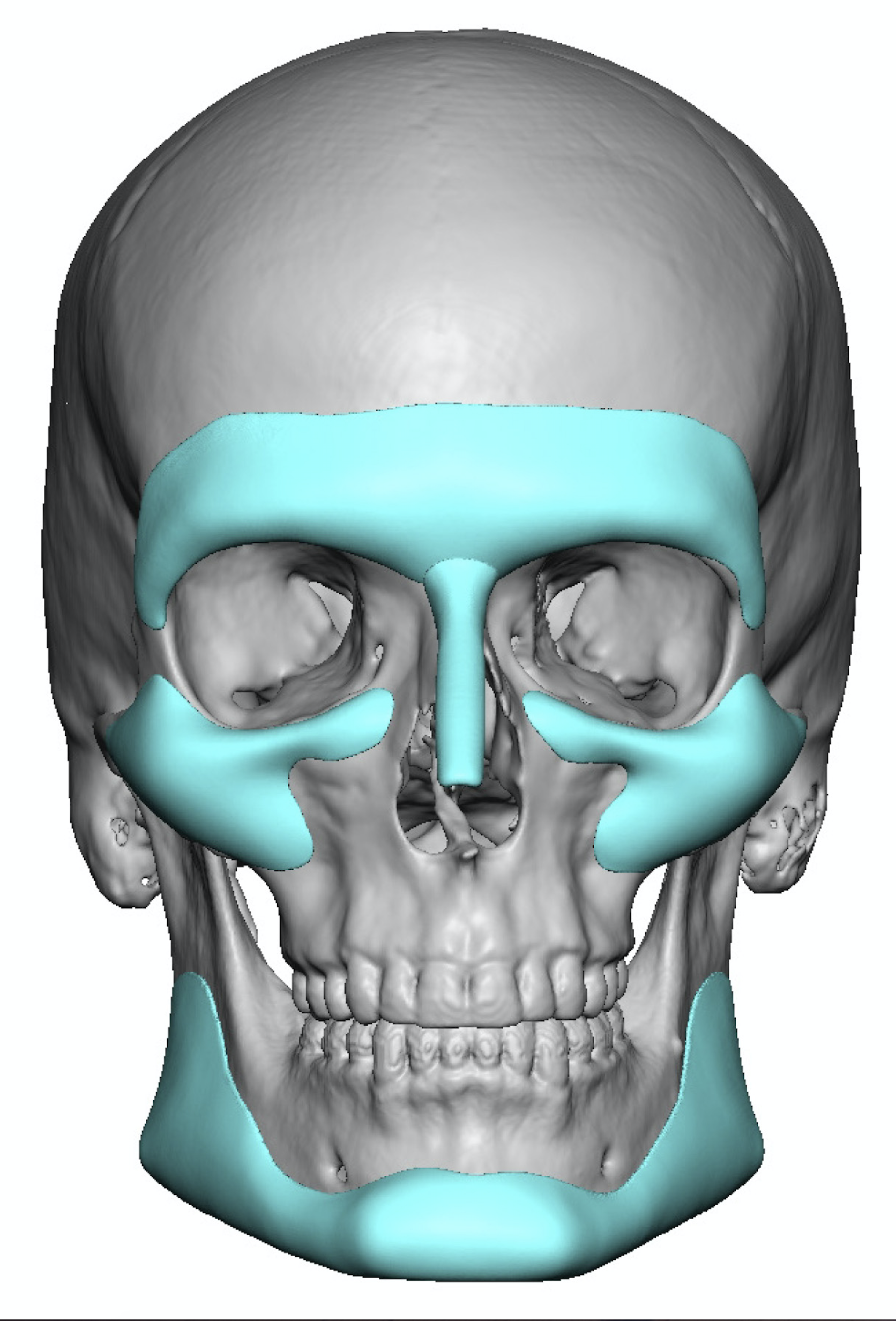
- Extended jawline implant
- Cheek/zygomatic implants
- Infraorbital implants
- Brow bone implants
- Temporal implants
From a custom implant surgeon’s perspective, over 50% of male facial masculinization requests center on the jawline (jaw angles and chin). The jawline produces the largest perceived increase in facial masculinity per millimeter of augmentation. Once those areas are adequately enhanced, patients often find that additional cheek, infraorbital, or brow augmentation becomes ‘necessary’ for optimal aesthetic balance and enhancement.
What Are The Most Common Female Custom Facial Implants
The most common custom facial implants in women are generally those used to create better facial balance, restore skeletal deficiency, or enhance femininity while maintaining natural contours. In my experience in female custom facial implant cases, the frequency tends to be
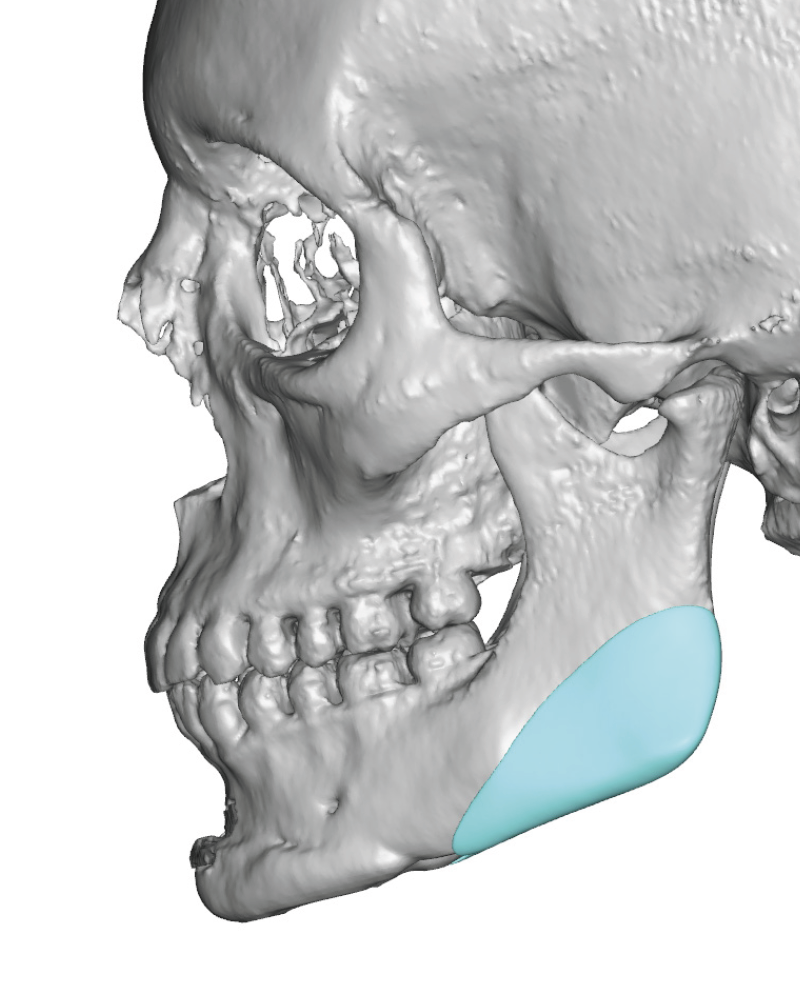
Chin and Jaw implants
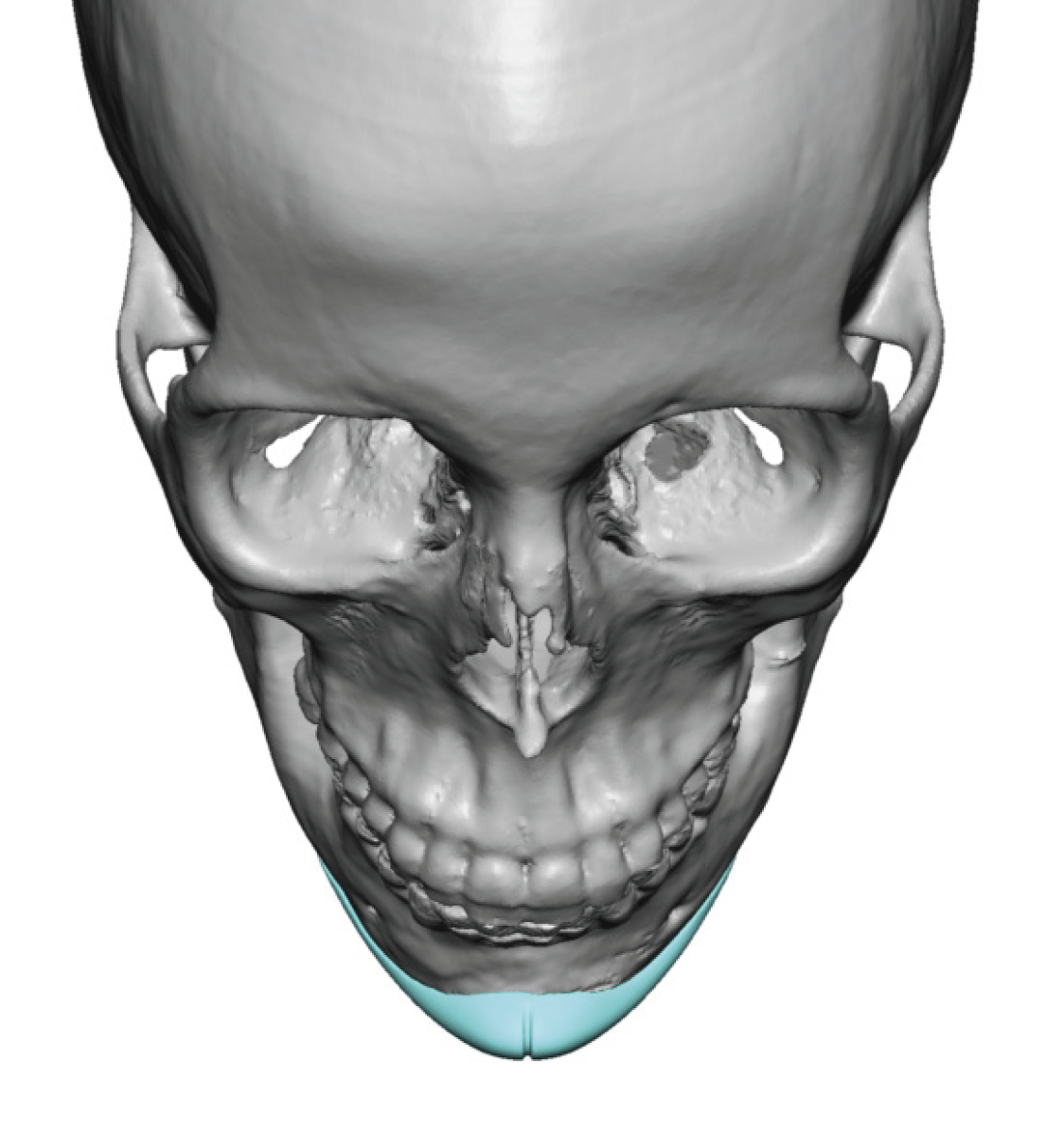
-
- Most commonly custom jaw angle or wraparound jawline implants.
- Used to improve lower facial definition without creating an excessively masculine appearance.
- Often designed to subtly widen or lengthen the posterior jawline.
-
- Custom chin implants remain very common in women with microgenia or chin asymmetry.
- Frequently done to improve a prior standard chin implant procedure that was too wide or big
- Custom designs allow precise control of chin implant shape which is needed in female chin augmentations in which standard chin implants tend to create more of a masculine chin shape.
- Cheek (malar) implants
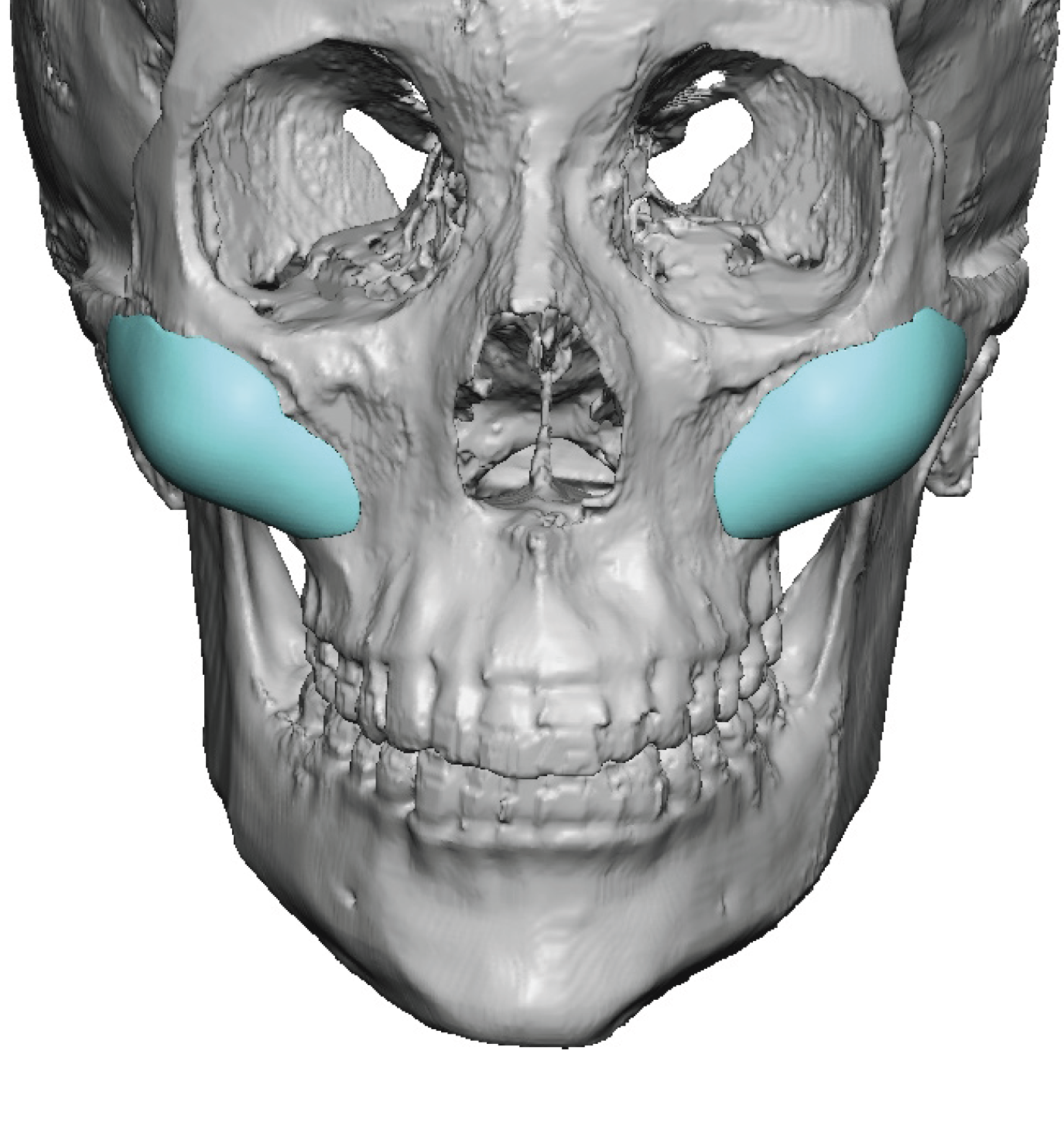
-
- Particularly popular in women seeking greater midface projection.
- Custom implants can enhance the cheekbones while avoiding the “round apple cheek” appearance associated with fillers.
- Orbital rim/infraorbital implants
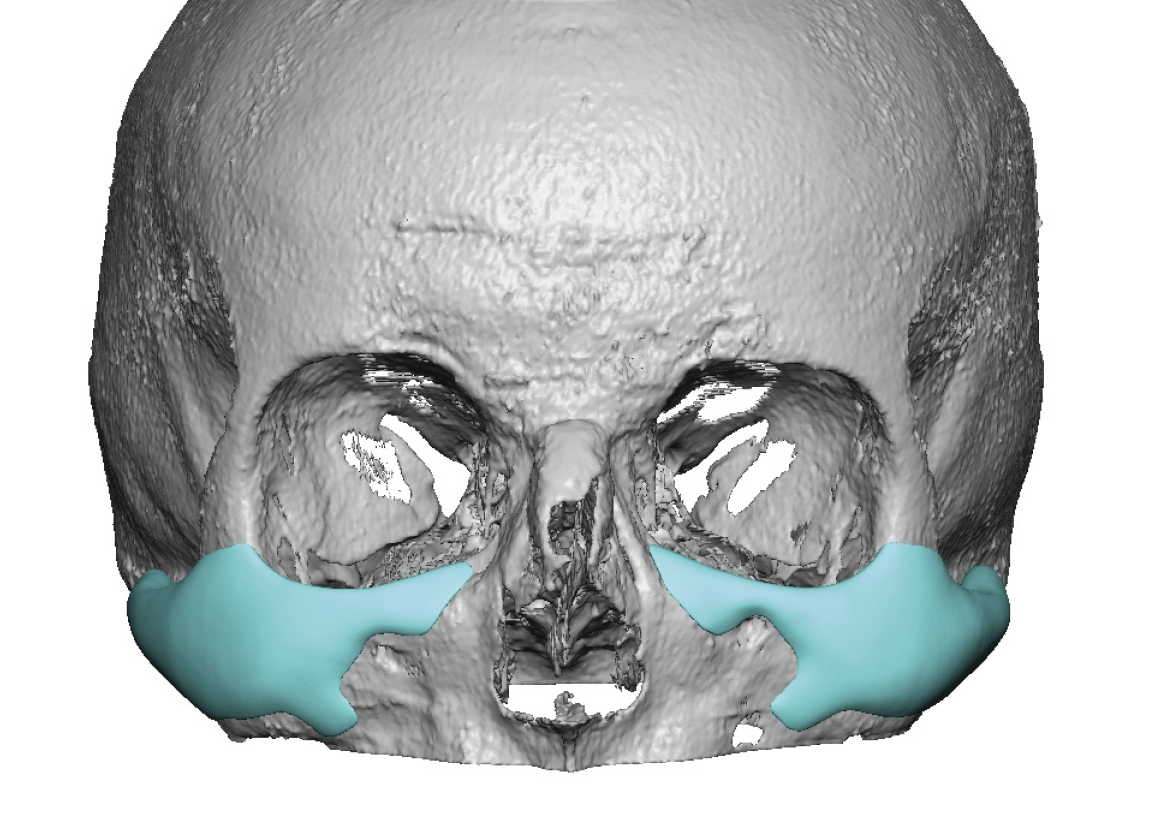
-
- Increasingly common with custom implant technology.
- Used to improve under-eye support, negative vector anatomy, tear trough deformities, and midface deficiency.
- Often combined with cheek augmentation.
- Paranasal implants/midface implants
-
- Used to augment the area beside the nose and improve central facial projection.
- Particularly useful in patients with maxillary deficiency or a flat midface.
- Temporal Implants
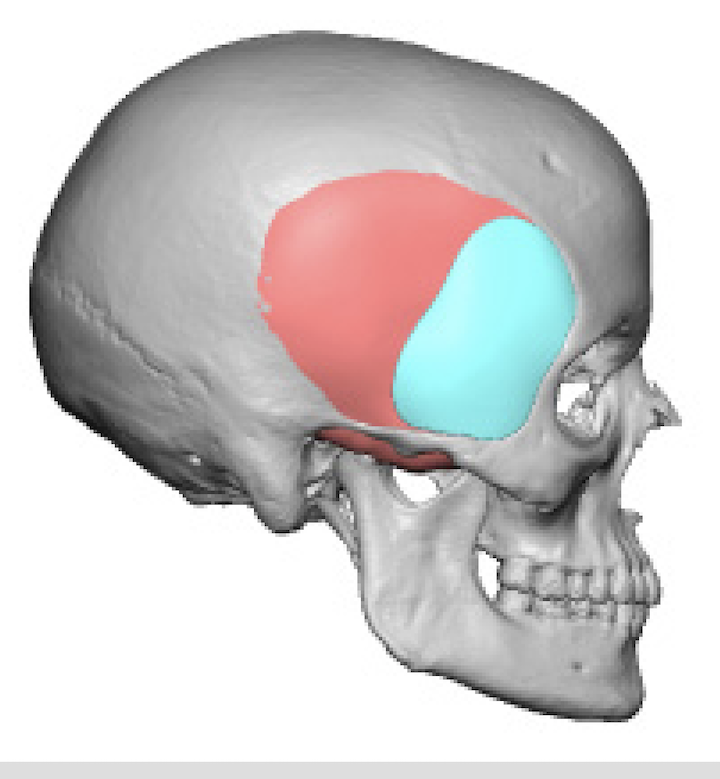
-
- Frequently performed in women with temporal hollowing and/or narrow forehead shapes.
- Can provide a more youthful upper facial contour.
- In larger custom temporal implants the goal is forehead/wide of head widening
- Forehead Implants
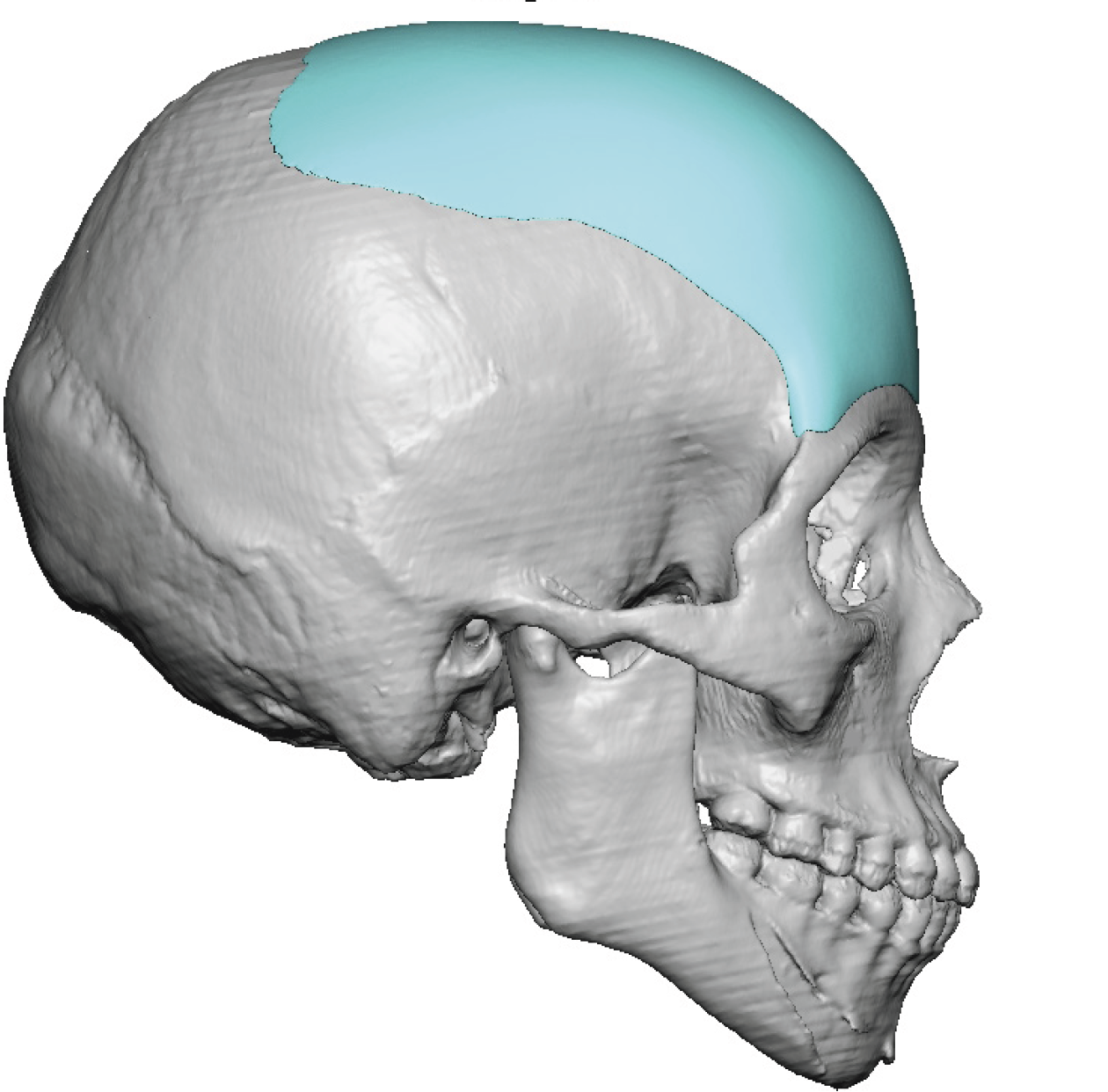
-
- Common in select patients seeking forehead augmentation or correction of contour deficiencies.
- More frequently seen in East Asian populations and facial feminization procedures.
Typical Female Custom Implant Combinations
The most common combinations are:
- Cheek + chin
- Jaw angle + Chin
- Paranasal + Infraorbital + Cheek (complete midface augmentation)
- Temporal + Forehead (upper face enhancement)
Differences from Male Implant Requests
Compared with men, women more often seek:
- Midface enhancement (cheeks, infraorbital rims)
- Softer jawline enhancement
- Forehead contouring
- Temporal augmentation
Men more commonly request:
- Larger jaw angle augmentation
- Stronger chin projection
- Gonial width expansion
If you’re asking from a facial implant surgery perspective, I’d rank current custom implant demand in women approximately as:
Jawline/Chin > Cheek/Midface > Infraorbital > Paranasal > Temporal > Forehead
although the infraorbital category has grown substantially over the last decade due to custom implant design capabilities.
What Are Some Of The Most Unique Custom Facial Implants
Among custom facial implants, many designs follow improvements to standard chin, jaw angle, and malar (cheek) implants that most facial implant surgeons use. But in my experience the designs tend to be larger, more anatomically complex implants created for aesthetic goals that cannot be achieved with stock implants or osteotomies.
Some of the most commonly designed and unique custom facial implants in my practice include:
1. Complete Mandibular Wraparound Implants
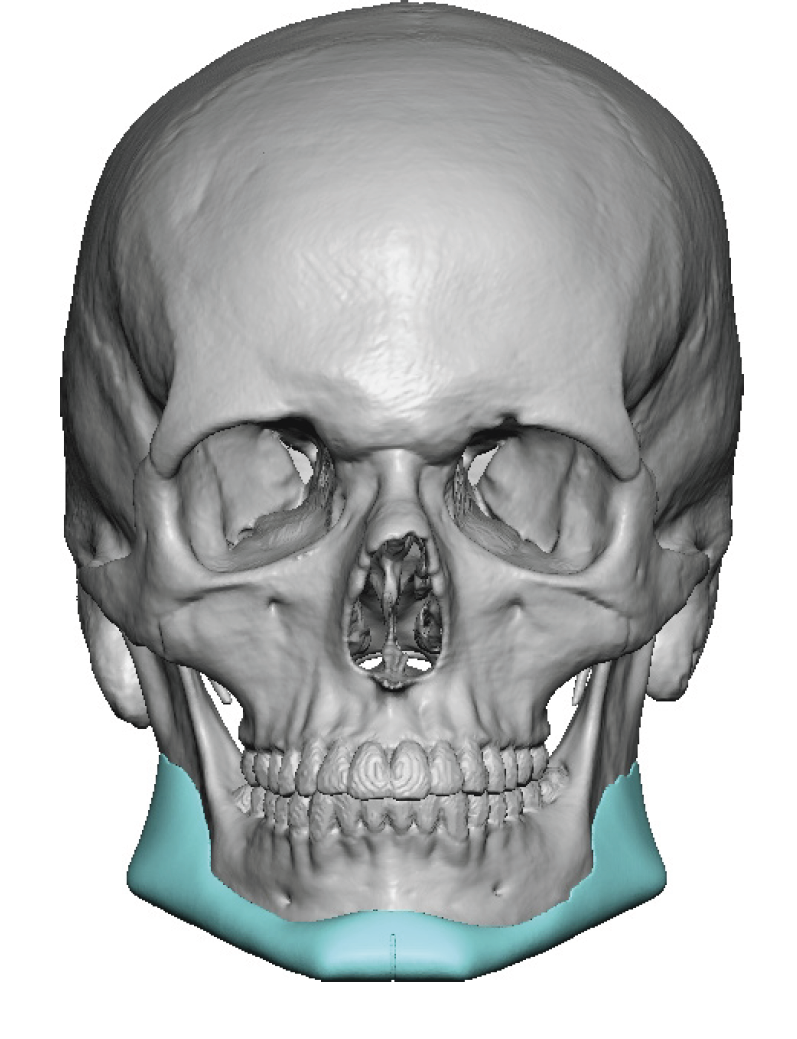
A single implant (or multi-piece system) extending from one gonial angle, across the chin, to the opposite angle.
Typical use:
- Maximal lower-third augmentation.
- Creation of a “hypermasculine” jawline.
2. Infraorbital-Malar Composite Implants
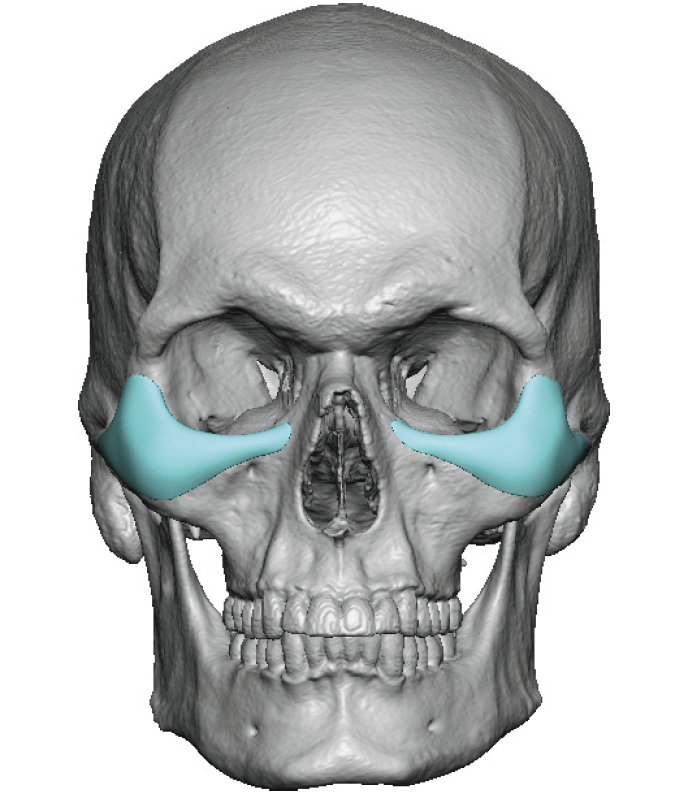
Typical use
- Augments the entire undereye and cheek complex rather than just the zygomatic prominence
- Undereye hollowing correction
- Negative orbital vector correction
3. Custom Pyriform Aperture Implants
Designed around the nasal base and pyriform rim.
Typical use:
- Flat central midface.
- Deep nasolabial folds.
- Weak nasal base support.
4. Custom Midface Mask Implant
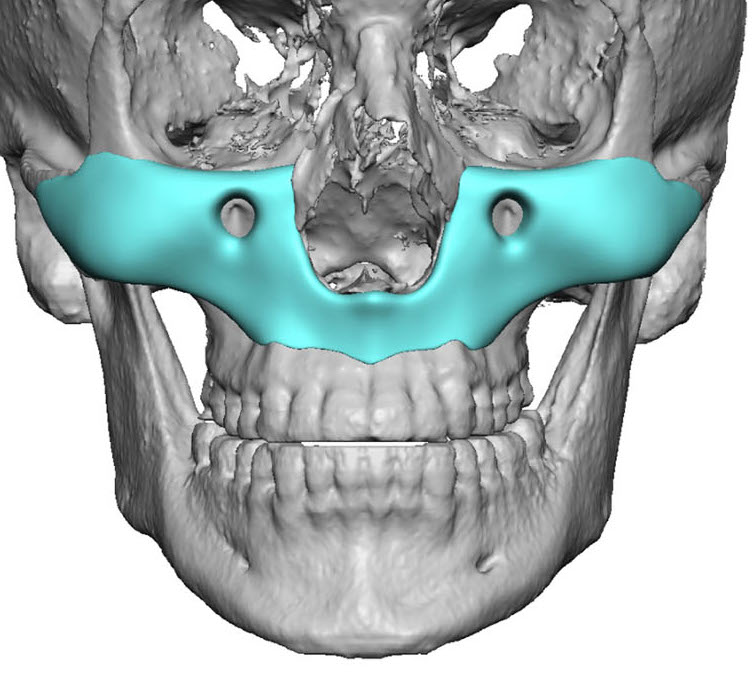
One or two piece custom implant augmenting:
- Pyriform aperture
- Paranasal region
- Infraorbital rim
- Malar body
- Maxilla
Designed to pull most of the midface forward, has a Lefort like effect
Typical use:
- Severe maxillary deficiency.
- Flat midface projection.
5. Temporal Head Widening Implants
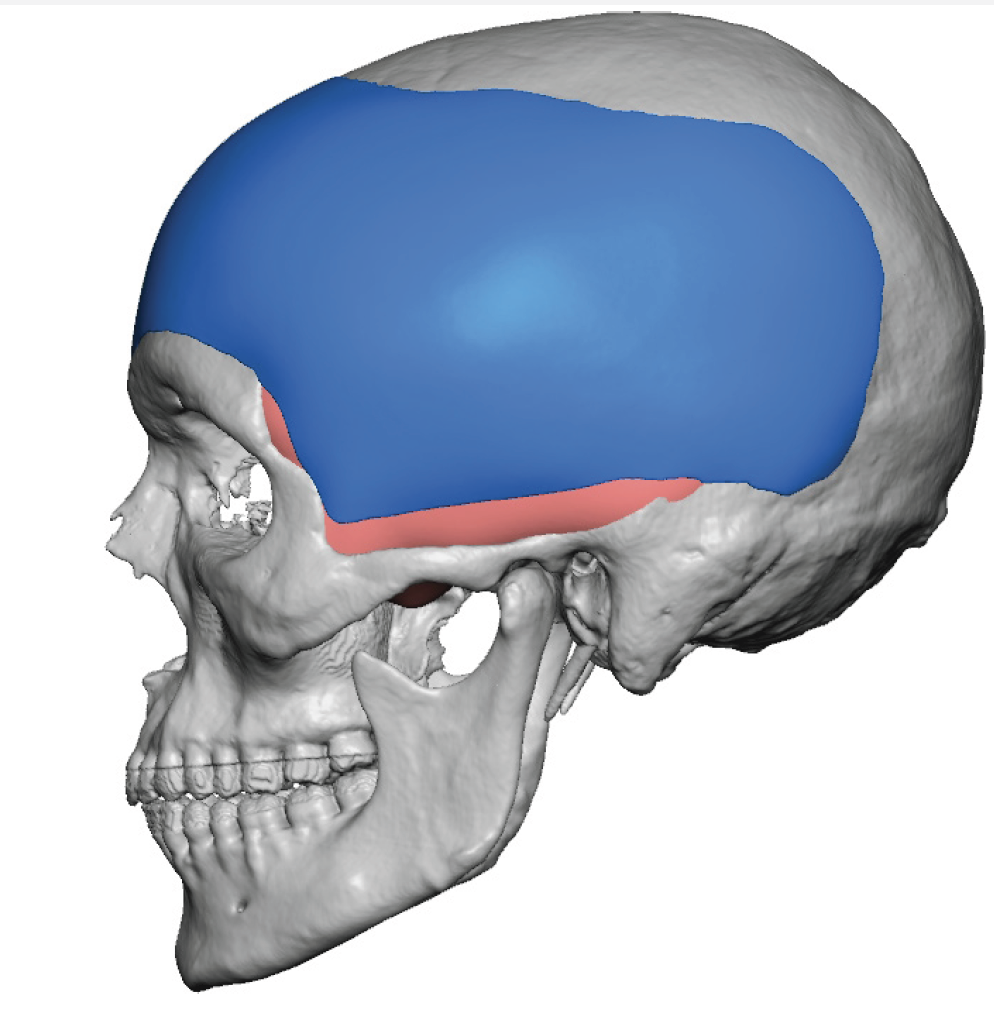
Designed to fill hollow temples and increase the width of the side of the head.
Typical use:
- Congenital narrow head shape
- Significant unilateral or bilateral temporal hollowing
6. Supraorbital Rim / Brow Bone Implants
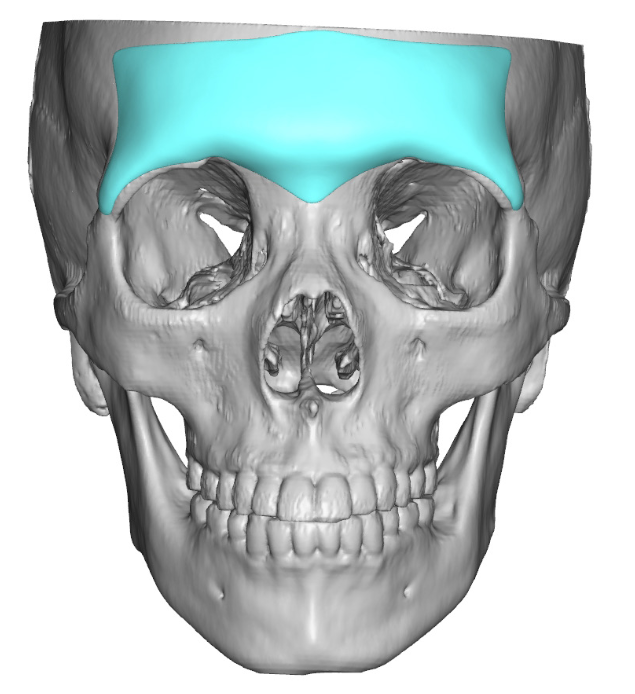
Custom implants augmenting the superior orbital rim and forehead transition.
Typical use:
- Male facial masculinization.
- Trying to achieve the Hunter Eye look.
7. Complete Forehead Augmentation Implants
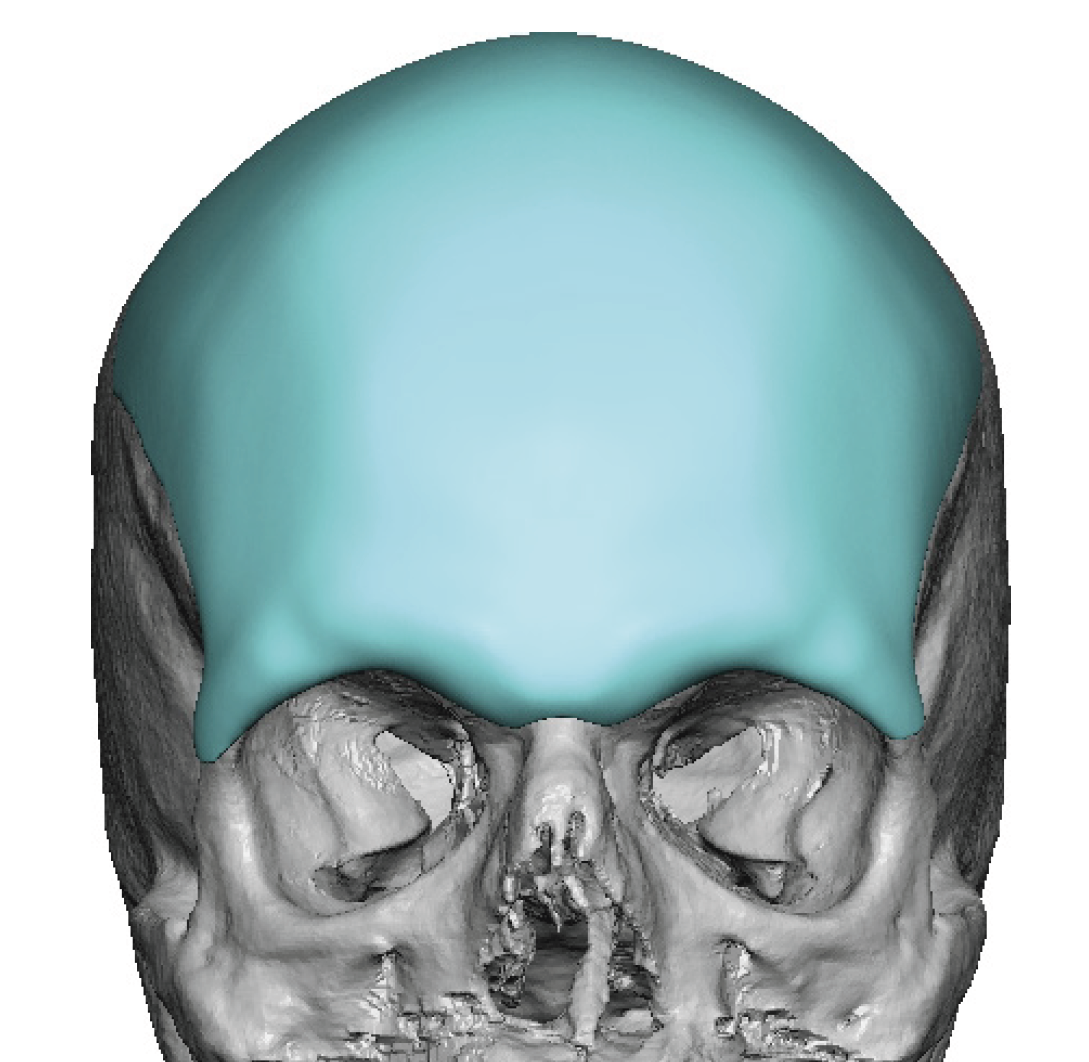
Custom implant covering most or all of the frontal bone. May to may not include the brow bone area.
Typical use:
- Forehead flattening correction.
- Forehead widening.
- Gender-affirming facial surgery.
8. Zygomatic Arch Implants
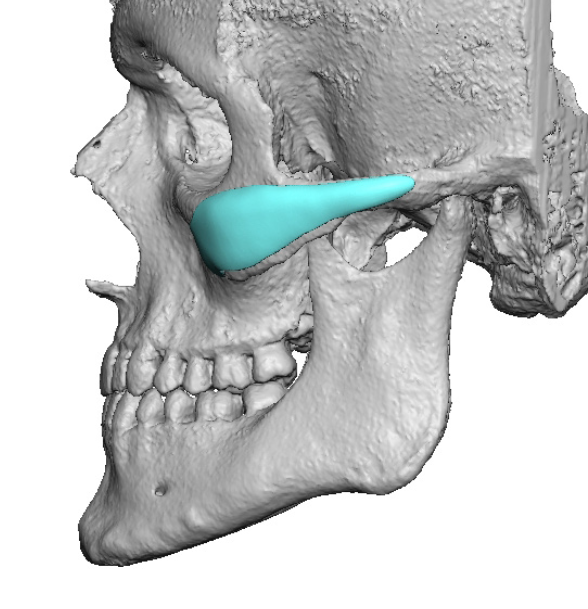
Designed specifically for lateral cheek width rather than anterior cheek projection.
Typical use:
- Facial widening.
- High-fashion facial contouring.
9. Periorbital (Eyemask) Implants
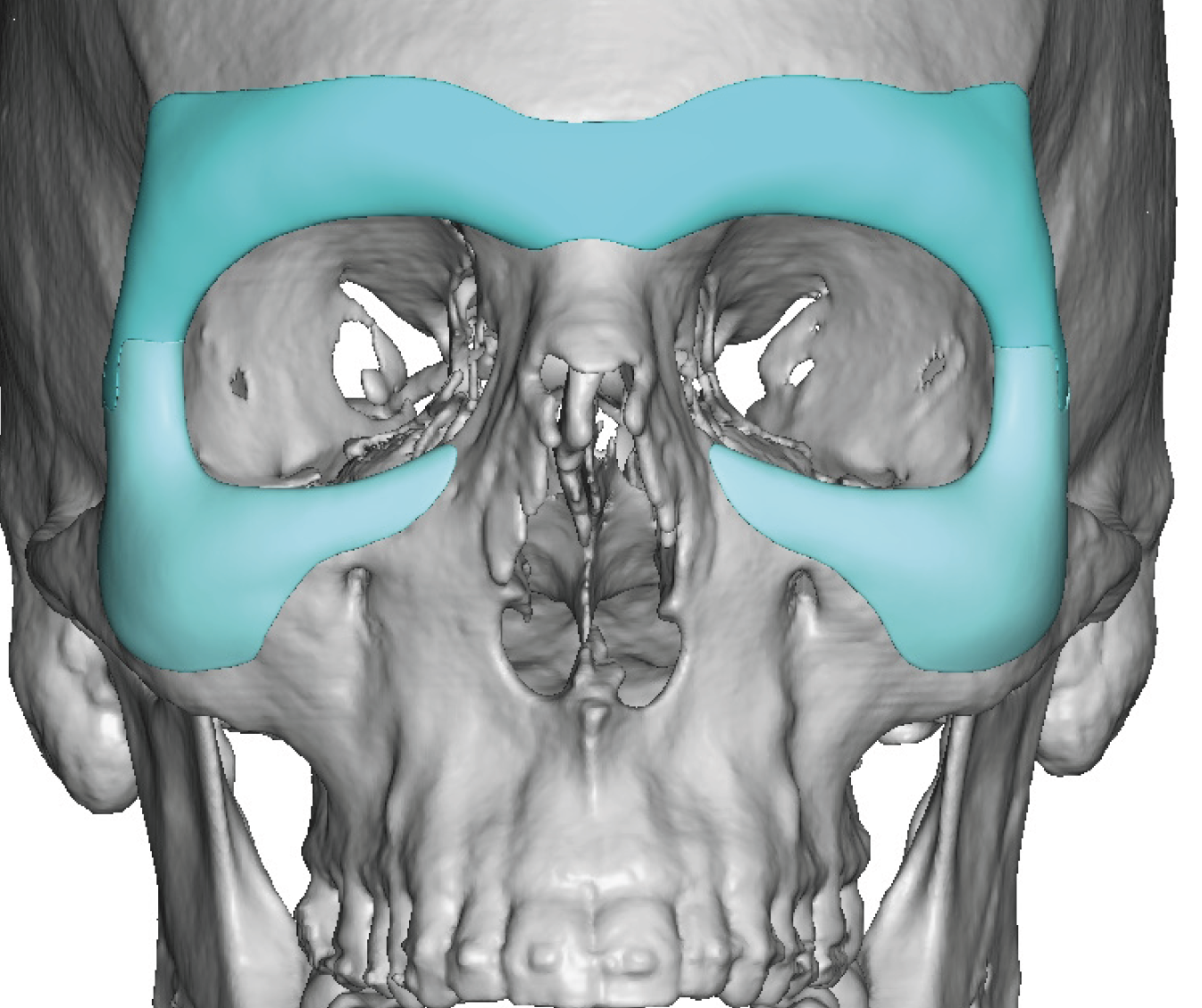
Custom implants that wrap around the eye area
- brow bone implant
- infraorbital-malar implant
- Connects at the lateral orbital rim
Typical use:
- To make the euyes more deep set
- Pseudoproptosis correction (the eyes appesr bulging but it is the bone that is deficient)
- Periorbital masculinization
9. Total Facial Skeletal (Three Level)
Custom implants for multiple facial zones simultaneously:
- Forehead
- Orbital rims
- Cheeks
- Midface
- Jawline
- Chin
Why uncommon:
- Among the rarest cosmetic implant procedures performed.
- Requires multiple custom implants designed as a coordinated system.
- Usually only done in extreme facial masculinization.
From a purely custom-implant perspective, the greatest aesthetic lies in this collection of implant categories whose effects are unobtainable by any other surgical method.
What is the Most Difficult Custom Facial Implant to Design and Surgically Place
Among all custom facial implants, the most difficult to both design and surgically place is generally the midface mask implant (also called a pan-midface implant). It combines the greatest engineering complexity with the greatest surgical exposure requirements. Several other implants are technically challenging for different reasons, but none require as many simultaneous design considerations.
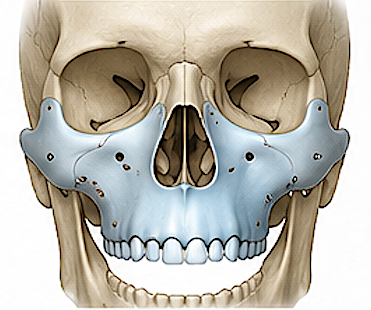
1. Midface Mask Implant (Most Difficult Overall)
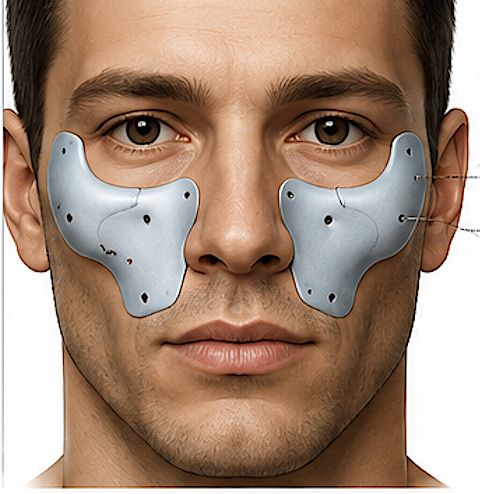
This implant spans multiple anatomic regions, typically including:
- Infraorbital rims
- Medial infraorbital area
- Maxillary/paranasal region
- Malar eminence
- Anterior zygoma
- Occasionally the lateral orbital rim
Design challenges
The implant must simultaneously:
- Restore proper orbital support
- Improve the negative vector relationship
- Create aesthetically pleasing cheek projection
- Blend into the surrounding skeleton without palpable edges
- Preserve natural facial transitions
- Avoid impinging on the infraorbital nerve
- Fit through limited surgical access
Unlike a chin implant, where increasing projection mainly affects one area, every millimeter of change in a midface mask influences:
- lower eyelid support
- cheek prominence
- nasal base appearance
- nasolabial fold
- midfacial width
- smile dynamics
- perceived age
A small design error may produce:
- overprojected cheeks
- an unnatural “apple cheek”
- widened face
- excessive lower eyelid fullness
- asymmetry visible from oblique views
Surgical challenges
Placement usually requires:
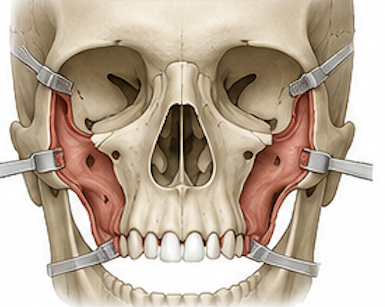
- bilateral intraoral incisions
- lower eyelid (transconjunctival or subciliary) incisions
- extensive subperiosteal dissection
- accurate seating over several curved bony surfaces
- fixation with multiple screws
Unlike a jaw implant, the surgeon cannot simply “feel” whether it fits.
Instead, the implant must simultaneously seat correctly on:
- infraorbital rim
- maxilla
- zygoma
- orbital floor transition
A rotational error of only a few degrees may create visible asymmetry.
2. Custom Jawline Implant
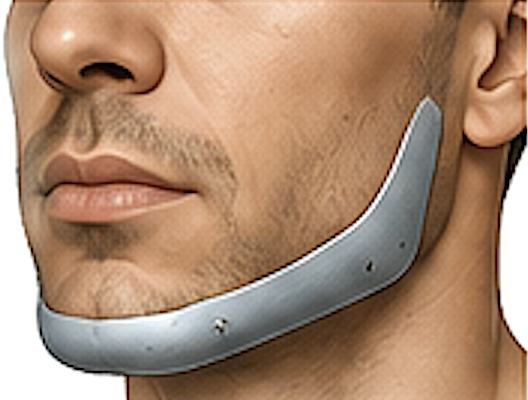
Probably the second most difficult.
Design
Challenges include maintaining:
- chin symmetry
- mandibular width
- gonial flare
- inferior border continuity
- neck definition
The implant frequently extends 20–30 cm from angle to angle.
Problems include:
- masseter interference
- mental nerve location
- mandibular border irregularities
- avoiding excessive bulk
Surgical placement
Requires:
- long intraoral dissection
- protection of both mental nerves
- correct seating around both mandibular angles
- avoiding rotation
Large implants sometimes behave like a flexible bridge and can be difficult to seat simultaneously along their entire length.
3. Custom Forehead–Brow Implant
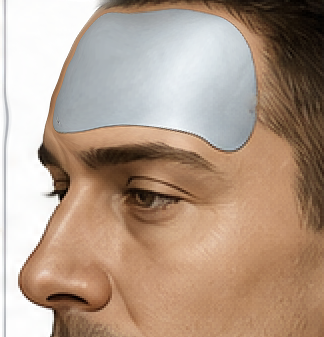
Very difficult because aesthetics dominate.
Tiny differences of:
- 1–2 mm
- curvature
- brow transition
can dramatically alter facial appearance.
Design requires understanding:
- forehead curvature
- frontal bossing
- temporal transitions
- masculine vs feminine contours
- brow shape
Placement is technically easier than a midface implant because exposure is excellent.
4. Infraorbital Rim Implant
Much more difficult than many surgeons realize.
Problems include:
- extremely thin overlying soft tissue
- visible lower eyelid
- infraorbital nerve
- transition into the orbital floor
- lower eyelid support
One millimeter can noticeably affect lower eyelid contour.
5. Infraorbital-Malar Arch Implant
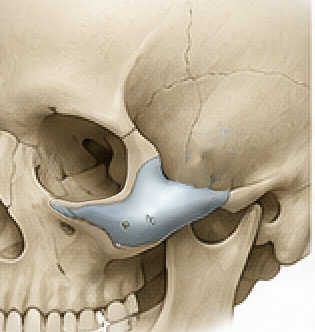
Mechanically difficult because:
- the arch is thin
- curved in three dimensions
- covered by thin tissue
- adjacent to the temporalis muscle and facial nerve branches
Fixation can be challenging.
6. Temporal Implant
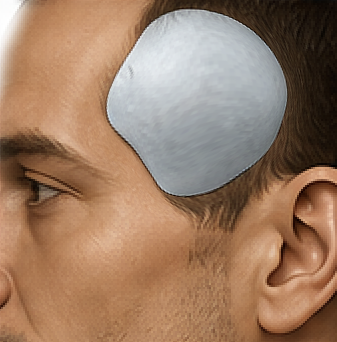
Design is deceptively difficult.
The surgeon must predict:
- temporal muscle thickness
- soft tissue compression
- transition into forehead
- transition into parietal skull
The implant itself is usually straightforward to insert.
Difficulty Ranking
|
Implant |
Design Difficulty |
Surgical Difficulty |
Overall |
|
Midface mask |
★★★★★ |
★★★★★ |
★★★★★ |
|
Jawline |
★★★★★ |
★★★★☆ |
★★★★★ |
|
Forehead–brow |
★★★★★ |
★★★☆☆ |
★★★★☆ |
|
Infraorbital rim |
★★★★★ |
★★★★☆ |
★★★★☆ |
|
Zygomatic arch |
★★★★☆ |
★★★★☆ |
★★★★☆ |
|
Temporal |
★★★★☆ |
★★★☆☆ |
★★★☆☆ |
|
Chin |
★★★☆☆ |
★★★☆☆ |
★★★☆☆ |
|
Occipital skull |
★★★☆☆ |
★★☆☆☆ |
★★☆☆☆ |
Why the Midface Mask Implant Stands Apart
The midface mask implant is unique because it is the only custom facial implant that must satisfy three demanding objectives at once:
- Functional support: It influences lower eyelid support and orbital projection, so errors can affect both appearance and function.
- Complex three-dimensional anatomy: It spans several curved skeletal regions with varying contour, requiring an exceptionally precise fit to avoid visible transitions or asymmetry.
- High aesthetic sensitivity: Even small changes in projection or contour can alter the perceived width of the face, cheek prominence, lower eyelid contour, and overall facial balance.
From a surgical perspective, it also requires some of the most extensive exposure, often combining intraoral and lower eyelid approaches, meticulous protection of the infraorbital nerves, and accurate fixation across multiple facial buttresses. A custom jawline implant may be larger, but a midface mask implant generally allows less margin for error because of the thin soft tissues and the visual prominence of the periorbital region.
For these reasons, many surgeons who routinely perform custom chin or jaw implants do not routinely perform full custom midface mask implants. They demand extensive experience in three-dimensional facial analysis, CAD/CAM implant design, orbital and midfacial anatomy, and advanced craniofacial surgical techniques.
How Do Custom Facial Implants Improve Facial Proportions
Custom facial implants are designed to bring balance and harmony to the face by adjusting the underlying skeletal structure—something that fillers or soft-tissue procedures can’t fully achieve.
At a basic level, facial proportions are about how different regions of the face relate to each other (forehead, midface, jawline, chin, etc.). When one area is underdeveloped or out of balance, it can make the whole face look disproportionate. Custom implants address that by precisely augmenting specific areas.
Here’s how they help:
1. Restore structural balance
If a chin is too small or set back, for example, it can make the nose look larger or the neck less defined. A custom chin implant can bring the lower face forward, improving the overall profile and making other features appear more proportional.
2. Improve symmetry
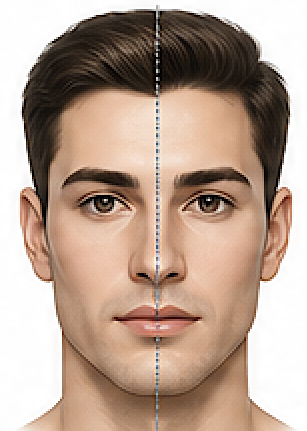
Many faces have natural asymmetries—uneven jawlines, cheek differences, or contour irregularities. Custom implants are designed from your own CT scan, so they can correct those asymmetries in a very targeted way.
3. Enhance key aesthetic ratios
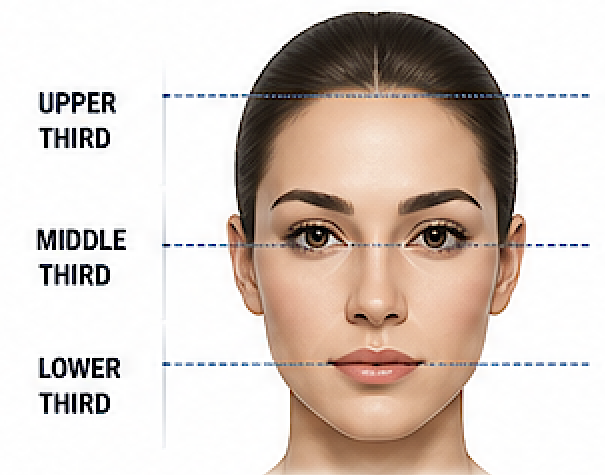
Surgeons often look at proportions like:
- Upper, middle, and lower facial thirds
- Width of the jaw vs. cheekbones
- Projection (how far features come forward in profile)
Custom implants can adjust these relationships—for example, widening the jaw to better match cheekbone width, or adding cheek projection to balance a longer lower face.
4. Create definition and contour
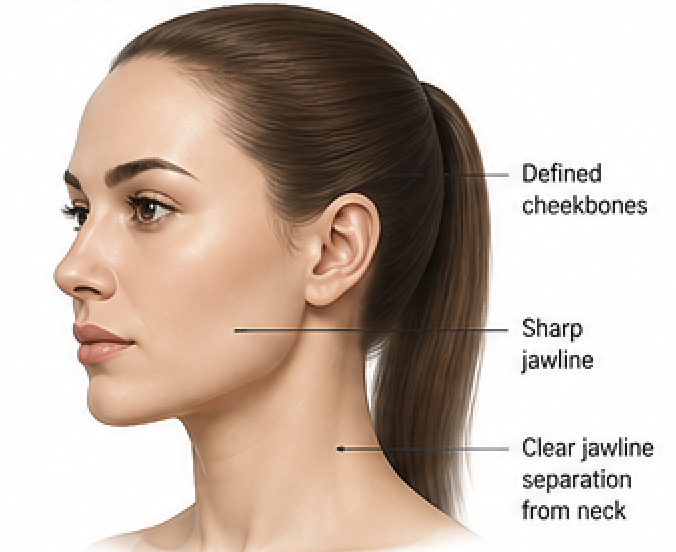
A weak jawline or flat cheeks can make the face look less structured. Implants add permanent definition, giving clearer transitions between facial regions (e.g., jawline separation from the neck, cheekbone prominence).
5. Tailored precision vs. standard implants
Off-the-shelf implants come in limited shapes and sizes. Custom implants are digitally designed for your anatomy, so they:
- Fit exactly to your bone
- Address multiple dimensions (height, width, projection)
- Blend smoothly with surrounding structures
6. Long-term, stable results
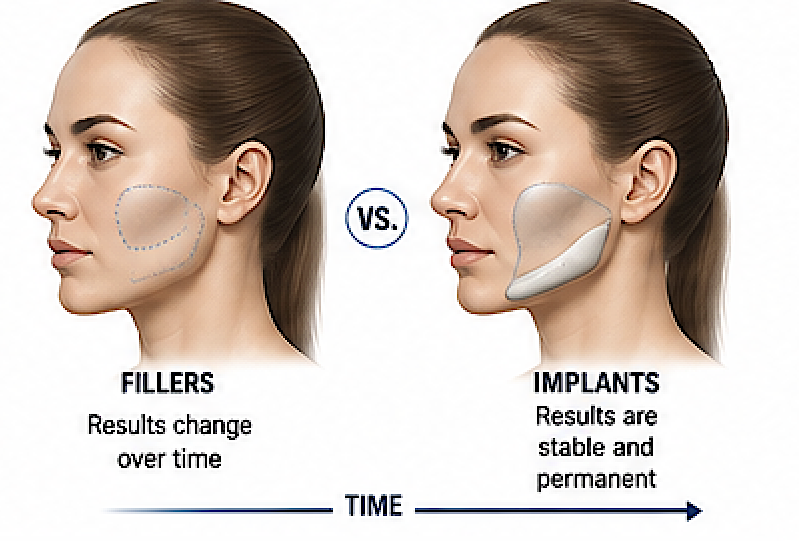
Because implants are fixed to the bone, they don’t shift like fillers can over time. That makes them a reliable way to maintain improved proportions.
In short, custom facial implants act like “architectural adjustments” to the face—modifying the foundation rather than just the surface—so the overall proportions look more balanced and intentional
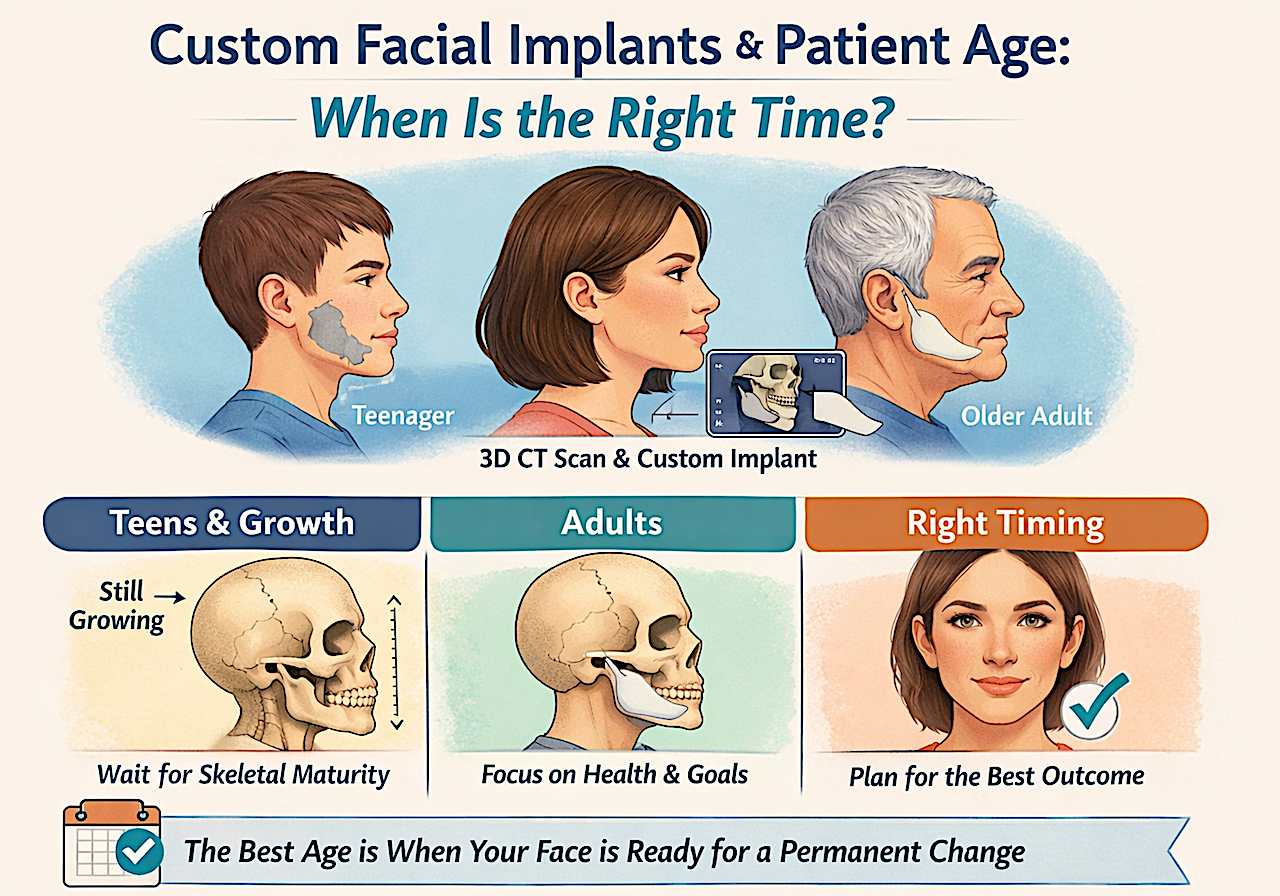
Custom Facial Implants and Patient Age – When Is The Right Time?
One of the most common questions patients ask about custom facial implants is simple: “Am I the right age for this?”
The answer isn’t based on a specific number. Instead, it depends on how developed your facial structure is and whether your goals are appropriate for a permanent implant.
Why Age Matters
Custom facial implants are designed from a 3D CT scan to fit your exact anatomy. They create a permanent change to your facial structure, not just a temporary enhancement.
Because of that, timing is important—especially in younger patients whose facial bones may still be growing.
For Younger Patients (Teens)
In teenagers, the key issue is skeletal maturity—whether the facial bones have finished growing.
- Facial growth typically finishes earlier in females than males
- Many girls are close to full facial maturity by the mid-teens
- Boys often continue growing into the late teens
If an implant is placed too early, future growth of the jaw or midface could change the overall facial balance and affect the final result.
For this reason, most cosmetic facial implants are delayed until growth is complete. In select cases—such as congenital conditions or facial asymmetry—earlier treatment may be considered, but this is individualized.
For Adult Patients
Once facial growth is complete, age becomes much less of a limiting factor.
There is no strict upper age limit for custom facial implants. Instead, candidacy is based on:
- Overall health
- Bone structure and anatomy
- Skin quality and soft tissue support
- Healing ability and lifestyle factors (such as smoking)
Many adults seek implants to enhance facial definition, restore volume, or improve balance—and these procedures can be very effective across a wide age range.
Why “Right Time” Matters More Than “Right Age”
The best time for custom facial implants is when:
- Your facial bones are fully developed
- Your aesthetic goals are stable and well-defined
- You understand that the result is long-lasting
Because these implants are custom-designed and permanent, careful planning and timing help ensure the most natural and lasting outcome.
The Bottom Line
There’s no universal “perfect age” for custom facial implants.
- Teens: Usually need to wait until facial growth is complete
- Young adults and beyond: Evaluated based on anatomy and health, not age alone
The most important factor is not your age—it’s whether your facial structure is ready for a permanent change.
Are Custom Facial Implants Worth It
Short answer: custom facial implants can absolutely be “worth it” — but only for the right person, with the right expectations, and a very skilled surgeon.
Here’s a clear, no-BS breakdown so you can judge it realistically:
When custom facial implants are worth it
1. You want precise, structural changes
Custom implants are designed from your CT scan, so they fit your anatomy exactly. That means:
- Better symmetry correction (especially for asymmetry or deformities)
- More controlled shaping (jawline, cheekbones, chin)
- More “engineered” results vs guesswork
👉 This is the biggest advantage over standard implants or fillers.
2. You want a permanent solution
- Implants are long-lasting (often lifelong) vs fillers that wear off
- Over time, they can actually be more cost-effective than repeated injections
3. You care about natural-looking results
Custom designs:
- Match your bone contours exactly
- Reduce the risk of “off” or generic-looking outcomes
- Can look much more subtle and anatomical
4. You have a specific structural problem
They’re especially “worth it” if you have:
- Weak jaw/chin projection
- Facial asymmetry
- Prior surgery that needs correction
- Complex aesthetic goals
👉 In these cases, fillers or standard implants often fall short.
👎 When they’re not worth it
1. You’re unsure about the look
This is a permanent, surgical change.
If you’re still experimenting → fillers are safer.
2. You want subtle tweaks only
For small changes:
- Fillers or fat grafting are usually enough
- Surgery may be overkill
3. You’re risk-averse
Even though generally safe, risks include:
- Infection, implant shifting, nerve issues
- Need for revision surgery
- unnatural appearance if oversized or poorly designed
4. You’re expecting perfection
Even custom implants:
- Don’t fix skin quality or aging
- Won’t make you look like a different person
- Still depend heavily on surgeon skill
⚖️ The real trade-off
Custom implants = higher precision + permanence
BUT
also = surgery + cost + commitment
Think of it like this:
| Option | Best for | Downsides |
| Fillers | Trying looks, subtle changes | Temporary, less precise |
| Standard implants | Simpler cases | Less customized |
| Custom implants | Complex, high-end results | Surgery, cost, irreversible |
💡 My honest take
Custom facial implants are “worth it” if:
- You’ve already tried fillers or know exactly what you want
- You’re aiming for structural, not superficial change
- You’re okay with surgery and permanence
- You choose a surgeon who specializes in them (this matters a LOT)
They’re not worth it if:
- You’re chasing trends (sharp jawline, etc.)
- You haven’t tested the look first
- You expect zero risk or perfection
Does A Custom Facial Implant Design Make The Surgery Easier
Short answer: it can make the surgery easier in some ways, but more complex in others.
A custom facial implant (designed from your CT scan) changes the workflow quite a bit compared to using a standard, off-the-shelf implant.
Where it makes surgery easier
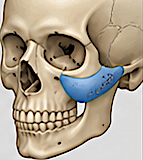
- Better fit: Since The implant is designed to match your anatomy on its underside, there is a better understanding of where it is to be positioned.
- Shorter operating time (maybe): Less time spent carving or adjusting the implant during surgery as may be necessary for placing some standard implant materials.
- Less reliance on surgeon estimation: The design phase does a lot of the “decision-making” ahead of time rather than relying on intraoperative ‘guiesses’
Where it can make things more complex
- Preoperative planning is more involved: Requires imaging, design sessions, and sometimes multiple design changes before surgery.
- Most custom facial implants have a larger surface area of bone coverage (standard implants are usually smaller) requiring greater pocket dissection and difficulties for placement. Simply put a bigger implant takes more time do during surgery.
- Less flexibility during surgery: If something unexpected is found, a custom implant is harder to modify than a standard one.
- Higher stakes for accuracy: The implant design is more exacting for placement and getting it into that exact spot may be more challenging
- Cost and logistics: Manufacturing time and expense are higher.
Bottom line
- For straightforward augmentations, standard implants are often simple and efficient.
- For larger or non-standard aesthetic effects with greater bone coverage, custom implants can actually make the overall process smoother and more predictable, even if the planning phase and surgical placement is more demanding.
If you’re considering one, the real question isn’t just “is it easier,” but whether your specific anatomy benefits from customization.
Can More Than One Custom Facial Implant Be Done At The Same Time
Yes—it’s very common to place more than one custom facial implant in the same surgery.
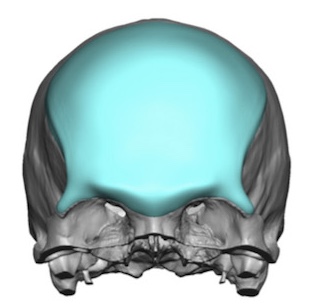
In fact, many patients benefit from combining implants to create better overall facial balance rather than improving just one area in isolation. For example:
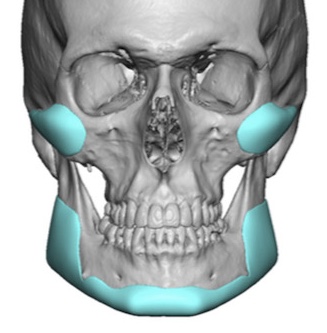
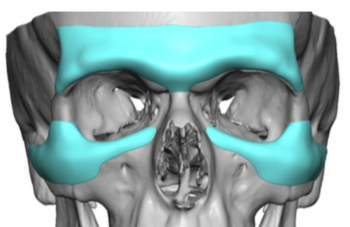
- Jawline + Cheek implants → enhances lower face definition
- Brow Bone + Undereye/cheek implants → improves orbital-midface proportions
- Forehead + Brow Bone implants → creates upper facial enhancements
Why surgeons often combine them
- Facial harmony: The face is a system—changing one area alone can sometimes look incomplete.
- Single recovery period: Doing multiple implants at once avoids separate surgeries and healing times.
- Better customization: Custom implants (designed from CT scans) can be planned together for precise fit and proportion.
Considerations
- Surgical time is longer, but still typically done safely in one session.
- Swelling will be more extensive when multiple areas are treated.
- Experience matters a lot—this is where a surgeon who specializes in custom implants is critical.
When it might not be done together
- If the surgical plan is complex and staged procedures are safer
- If you’re unsure about committing to multiple changes at once
If you’re thinking about this, the key question isn’t “can it be done together?” (it usually can), but rather:
“Which combination gives the most natural, balanced result for your face?”
How Many Custom Facial Implants Can Be Done During One Surgery
There is no strict upper limit, but in practical terms most surgeons keep it to 2–5 custom facial implants in a single operation. In select cases, more can be done safely if the patient is healthy, the anatomy allows it, and the surgical plan is carefully staged.
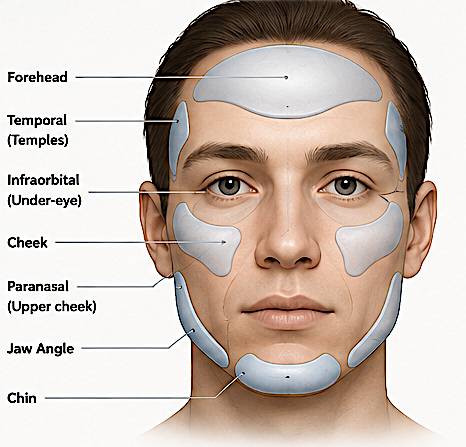
The real limiting factors are:
- Operative time — longer surgeries increase swelling, infection risk, anesthesia exposure, and recovery difficulty.
- Blood supply and soft tissue tension — too many implants in adjacent areas can overstretch tissues and impair healing.
- Swelling management — multiple implants make postoperative swelling more severe and can temporarily distort results.
- Fixation overlap — screws and implant pockets must not interfere with each other.
- Airway and recovery considerations — especially when combining jawline, chin, paranasal, orbital, or cheek implants.
Common combinations that are routinely done together include:
- Chin + jaw angle implants
- Cheek + paranasal implants
- Infraorbital + cheek implants
- Total custom jawline systems (chin + body + angle as one integrated implant set)
Very extensive full-face augmentation cases may involve:
- Forehead implant
- Temporal implants
- Infraorbital implants
- Cheek implants
- Paranasal implants
- Chin implant
- Jaw angle implants
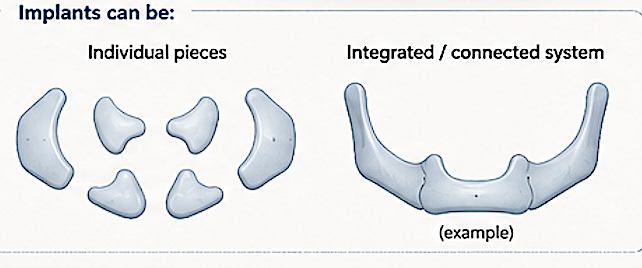
That can total 6–8 implant components, but many of these are designed as interconnected systems and are usually reserved for highly selected patients.
From a recovery standpoint:
- 1–2 implants → moderate recovery
- 3–5 implants → significant swelling/bruising for several weeks
- 6+ implants → prolonged swelling, more difficult assessment of symmetry early on

The key issue is not simply the number of implants, but whether the overall surgical plan preserves soft tissue health, vascularity, and facial balance. In some patients it is smarter to stage procedures into two surgeries rather than doing everything at once.
Custom Facial Implant Material Options
Custom facial implants today are made from a small group of well-established biomaterials. The key point—often misunderstood—is that no material is biologically “better” in the body; differences are mainly about handling, stability, imaging, and revision characteristics.
Here’s a clear breakdown of the main options used in modern custom facial implant surgery:
🔹 Core Custom Facial Implant Materials
1. Solid Silicone
Most commonly used overall
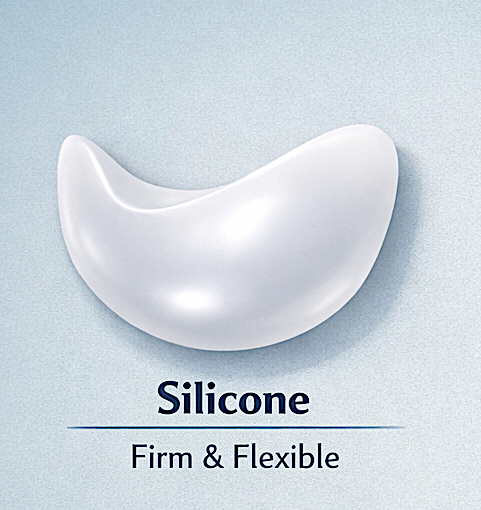
Pros
- Smooth, flexible, and easy to shape
- Easiest to place, adjust, or remove (major clinical advantage)
- Best material over thin tissues to reduce the risk of edge visibility/palpability
- Best mayterial when the implant size is ‘large’
- Long track record in facial surgery
- Most economical implant cost
Cons
- Does not integrate with tissue (forms capsule)
- Potential for slight movement or bone remodeling (imprinting) over time
- Slightly higher risk of implant placement malpositioning
👉 Best for:
- Patients prioritizing reversibility and revision flexibility and larger implant sizes
2. Porous Polyethylene (Medpor / Omnipore)
Tissue-integrating material
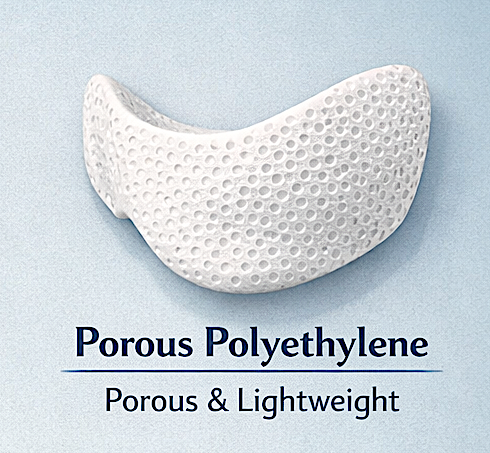
Pros
- Tissue ingrowth → very stable fixation (its sole ‘advantage’)
Cons
- Difficult to remove or revise (major drawback)
- Requires very precise placement
- Less forgiving if outcome needs adjustment
👉 Best for:
- Patients who perceive that tissue ingrowth is important
3. PEEK (Polyetheretherketone)
Most modern and trendy custom implant material
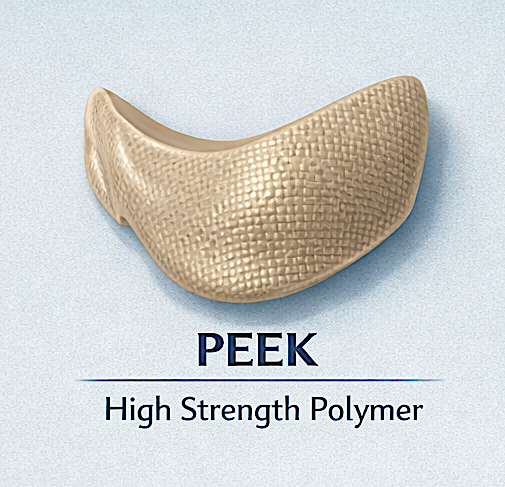
Pros
- Excellent for custom design
- Strong and lightwweight
- Radiolucent → doesn’t interfere with CT/MRI imaging
- Highly accurate symmetry and fit
Cons
- More expensive
- Requires fixation (screws)
- Not tissue-integrating
- Often requires segmenting the implant into multiple pieces for placement
- Designs are often smaller recognizing the difficulty with placing larger implants
👉 Best for:
- Chin, jawline and cheek implant designs
4. Titanium
Primarily reconstructive, usually not aesthetic-first
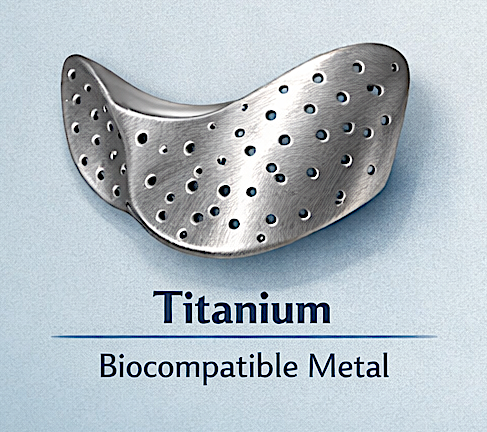
Pros
- Extremely strong and biocompatible
- Ideal for structural reconstruction (trauma, defects)
- Long-term durability
Cons
- Can interfere with imaging (radiopaque)
- Larger designs are difficult to placed
- May be considered overkill for cosmetic augmentation
👉 Best for:
- Reconstructive or load-bearing cases, not routine cosmetic augmentation
🔹 Key Clinical Insight (Important)
- All implants are foreign bodies → none is biologically “superior” in healing response
- The real differences come down to:
- Ease of revision/removal
- Stability vs flexibility
- Customization capability
- Cost
🔹 Practical Comparison
| Material | Tissue Integration | Ease of Removal | Custom Capability | Stability |
| Silicone | ❌ | ⭐⭐⭐⭐ (easy) | ⭐⭐⭐⭐ | High |
| Medpor | ✅ | ⭐ (very difficult) | ⭐⭐⭐ | High |
| PEEK | ❌ | ⭐⭐⭐ | ⭐⭐⭐⭐ | High |
| Titanium | ❌ | ⭐⭐ | ⭐⭐⭐ | Very high |
🔹 Bottom Line
- Silicone → best for any type design or implant size and revisions
- Medpor → best for biologic fixation (but hard to revise)
- PEEK → best for lightweight and strong modern material
- Titanium → best for reconstruction, not ideal for cosmetic shaping
The Chemistry of Facial Implant Materials
Custom facial implants are usually alloplastic materials: engineered, nonliving substances shaped from CT-based designs. The key chemistry is how the material’s polymer chain, metal oxide layer, porosity, surface energy, and stiffness interact with soft tissue, bone, bacteria, and imaging.
Main materials
| Material | Chemistry | Biological behavior |
| Solid silicone / PDMS | Inert siloxane polymer, repeating Si–O backbone | Flexible, smooth, easy to remove; encapsulates rather than integrates. Can shift if not fixed. |
| Porous polyethylene / Medpor | High-density polyethylene, –CH₂– chains, with interconnected pores | Tissue ingrowth into pores increases fixation but makes removal harder. Reviews note low infection rates and host incorporation. |
| PEEK | Aromatic thermoplastic: poly-ether-ether-ketone | Strong, radiolucent, CT/MRI friendly, chemically stable; biologically inert unless surface-modified. |
| Titanium | Metal with spontaneous TiO₂ oxide surface | Excellent osseointegration and strength; can be 3D printed porous; more radiopaque and thermally conductive. |
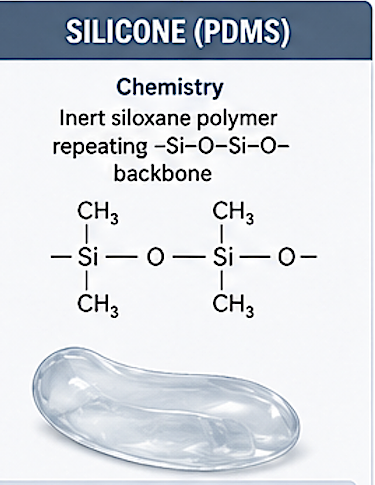
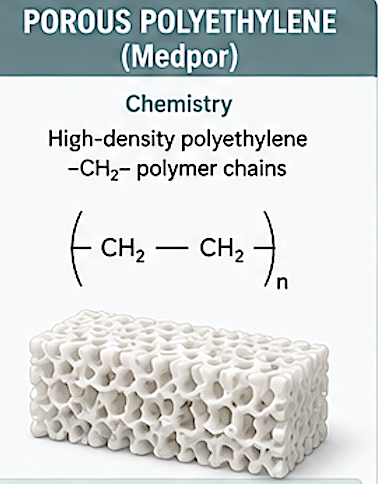
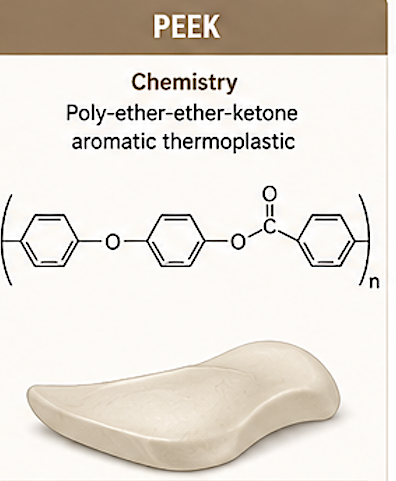
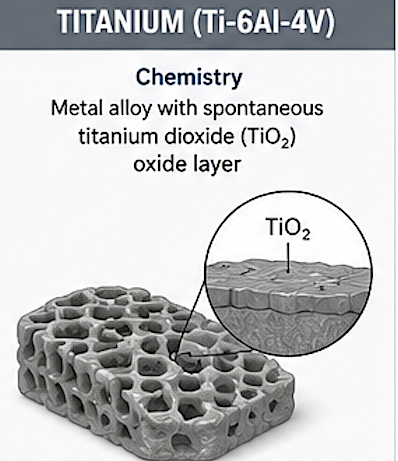
The central tradeoff:
Smooth/inert materials like silicone are easier to remove but rely on capsule formation. Porous or bioactive surfaces like porous polyethylene and roughened/porous titanium encourage tissue or bone ingrowth, giving stronger fixation but making revision more difficult.
Why PEEK is popular for custom implants:
PEEK has a modulus closer to cortical bone than metal, is lightweight, stable, and compatible with imaging. Its weakness is surface bioinertness, so current research focuses on coatings, roughening, porosity, hydroxyapatite, plasma treatment, or antibacterial surface modification to improve integration.
In short: silicone = inert/removable, polyethylene = tissue ingrowth, PEEK = stable radiolucent polymer, titanium = osseointegrating metal.
How Do Surgeons Decide What Custom Facial Implant Material To Use
In theory surgeons pick implant materials based on an understanding of the patient’s aesthetic goals, anatomy, surgical approach, and long-term behavior of the material. Unfortunately many surgeon’s have a preference which doesn’t change regardless of the individual patient variables. Here is how the four facial implant materials, silicone, porous polyethylene (Medpor), PEEK and titanium, each with very different properties.
Here’s how these implant material differ:
1. Purpose: cosmetic vs reconstructive
Cosmetic (aesthetic augmentation)
- Goal: enhance shape (chin, jawline, cheeks)
- Common choice: silicone
- Easy to place
- Can be removed or revised easily
- Good for predictable contouring
Reconstructive (trauma, congenital defects, asymmetry)
- Goal: restore anatomy, often with complex shapes
- Common choices: PEEK or Medpor
- Better for precise, custom structural restoration
2. Need for precision and customization
Highly customized, complex anatomy
- PEEK is often preferred
- Designed exactly from CT data
- Rigid and holds precise shape
- Ideal for orbital rims, large jaw defects, or skull reconstruction
Moderate customization or standard shapes
- Silicone or Medpor can work
- Silicone: easier, faster
- Medpor: better tissue integration
3. Tissue integration vs removability
This is one of the biggest trade-offs:
Silicone
- Does not integrate with tissue (forms a capsule)
- Pros:
- Easy to remove or revise
- Lower risk if future changes are likely
- Cons:
- Slightly higher risk of shifting (though fixation reduces this)
Medpor (porous polyethylene)
- Tissue grows into it (vascular ingrowth)
- Pros:
- Very stable long-term
- Lower migration risk
- Cons:
- Harder to remove if there’s a problem
PEEK
- Minimal tissue ingrowth (like silicone in that sense)
- But usually rigidly fixed with screws, so movement isn’t an issue
- Removal is possible but more involved than silicone
4. Location on the face
Different areas favor different materials:
- Chin / jawline (cosmetic) → Silicone most common
- Cheek (malar) → Silicone or Medpor
- Orbital / midface reconstruction → Silicone or PEEK
- Large skeletal defects → PEEK (custom, structural)
5. Soft tissue thickness
- Thin soft tissue (e.g., around eyes)
→ Prefer materials that can be precisely contoured with feathered edging (silicone) - Thicker areas (jaw, chin)
→ Silicone/PEEK/Medpor all work well
6. Risk tolerance and revision likelihood
- If a patient may want changes later → silicone is favored
- If the goal is permanent, one-time reconstruction → Medpor or PEEK
7. Infection considerations
- Silicone: easier to remove if infected
- Medpor: infection is less common due to vascularization, but harder to treat if it occurs
- PEEK: behaves more like a rigid implant—managed similar to other alloplasts
8. Surgeon experience and preference
This matters more than people expect:
- Some surgeons specialize heavily in custom PEEK implants
- Others prefer silicone for aesthetic work because of flexibility and reversibility
- Familiarity with a material often drives better outcomes than theoretical advantages
Bottom line (simplified)
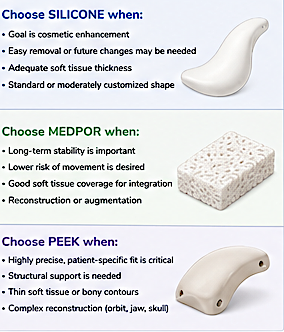
- Silicone → best for cosmetic, flexible, reversible augmentation
- Medpor → best for stable, integrated, long-term implants
- PEEK → best for structural reconstruction
Does The Custom Facial Implant Material Make A Difference in the Aesthetic Result?
The most common materials for modern custom facial implants are:
- Solid silicone
- Porous polyethylene (Medpor)
- PEEK (polyetheretherketone)
- Titanium
While these material options are all biocompatible they are quite different chemically. But do these differences translate to differences in the aesthetic outcome?
The science:
The rigidity (stiffness or elastic modulus) of an implant material has a major effect on how it displaces and shapes the overlying soft tissues.
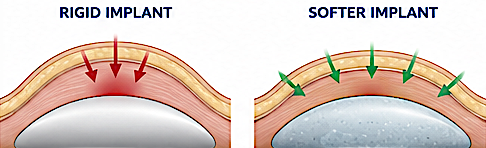
In general:
- More rigid implants transmit force more directly to the soft tissue envelope.
- Softer or more flexible implants deform themselves instead of fully displacing the tissue (e.g., breast implants).
Thus how an implant’s surface behaves under pressure (deformation or no deformation) determines the overlying soft tissue effects. A rigid implant maintains its shape under soft tissue pressure, so it pushes tissues outward more predictably creating sharper definition and long term contour maintenance.
But how the material responds to the soft tissue pressure over time will also effect how its shape is seen. In resisting deformation from the surrounding soft tissues a rigid implant can also mechanically expand them over time, leading to some soft tissue thinning and better implant shape show.
Rigidity vs Flexibility
This material property difference is what confuses most people. Material rigidity has a spectrum, some rigid materials are more stiff while others less so. A less stiff or more flexible implant property does not mean it has a lesser effect on soft tissue displacement. As long as the material stiffness exceeds the soft tissue pressure from displacement the type of implant material does not matter.
Implant Rigidity Is Important But Not The Only Variable
The effect of an implant on overlying soft tissue displacement also depends on:
- Implant shape
- Implant design
- Pocket location
- SoftTissue thickness
- Dynamic muscle forces
For example the higher implant volume the greater the soft tissue displacement. So implant rigidity does not have its effects in isolation.
Key Takeaways
While there may be differences in the feel of various implants outside the patient and less so biologically in the patient, the ability to cause overlying soft tissue displacement when placed on a bone surface (onlay) are not significantly different. This is because even the least rigid facial implant material (silicone) is not soft nor can its surface be indented or compressed. It flexible charactistic is negated when it ispalced and secured on the bone.
In choosing an implant material the belief that any one of the materials creates a better aesthetic outcome because of it physical properties should be dispelled.
What is the Best Custom Facial Implant Material?
The best implant material depends on anatomy, fixation needs, revision risk, and whether the implant can be easily removable.
The best overall custom facial implant material is usually solid silicone for aesthetic onlay facial augmentation.
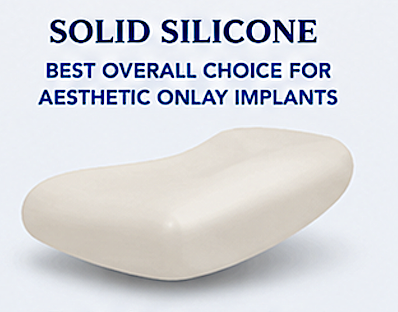
Why:
Solid silicone
Best for most custom facial implants because it is:
- flexible enough for insertion through smaller incisions
- smooth-edged and easy to feather into bone
- easily screw-fixated
- biologically inert
- removable or revisable if needed
- allows the design to control the result, not the material
PEEK
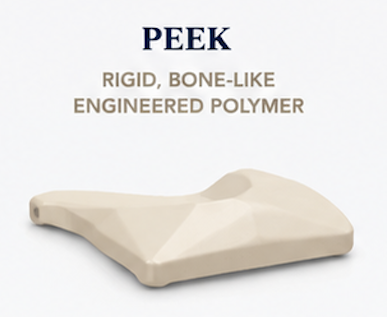
Excellent for rigid craniofacial reconstruction or when a hard, bone-like implant is desired, but it is less forgiving, more expensive, harder to insert in large wraparound designs, and less easily modified.
Porous polyethylene / Medpor
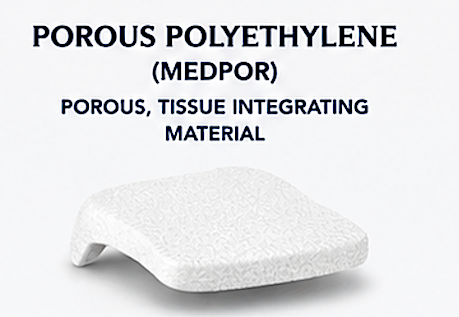
Stable because of tissue ingrowth, but that same ingrowth makes it harder to remove or revise. Better for select smaller implants than large custom aesthetic designs.
Titanium
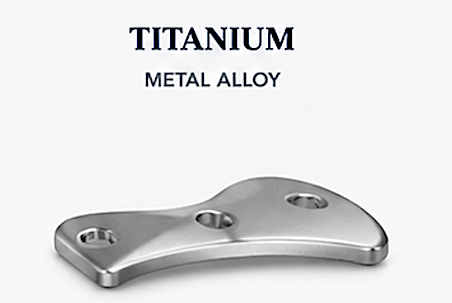
Strong and thin, but usually better for plates, meshes, orbital reconstruction, or structural fixation than aesthetic facial augmentation. It can be palpable or visible in thin tissues.
The key point: the aesthetic result comes from the implant design, not the material hardness. A well-designed silicone implant will create just as much jawline, cheek, chin, or infraorbital definition as a harder material if its shape and thickness are correct. Current reviews describe silicone, porous polyethylene, PEEK, and titanium as commonly used facial implant materials, each with different tradeoffs rather than one universal winner.
Do All Custom Facial Implant Materials Cost The Same
No. While the design and manufacturing process accounts for part of the cost of a custom facial implant, the implant material itself does not cost the same. The differences can be substantial depending on the material and manufacturing method.
Here’s how the common materials compare:
|
Material |
Relative Material Cost |
Manufacturing Method |
|
Solid silicone |
$ |
Poured into a 3D generated mold |
|
Porous polyethylene (Medpor) |
$$ |
CNC milled from a porous block |
|
PEEK |
$$$ |
CNC milled from a PEEK block |
|
Titanium |
$$$$ |
3D printed (additive manufacturing) |
Solid Silicone
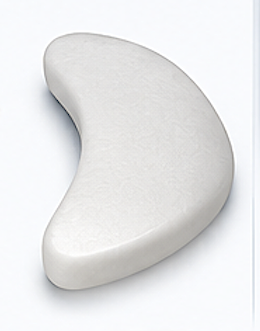
Silicone is generally the least expensive custom facial implant material. Medical-grade silicone implants are created from a liquid material being poured into a mold printed from the implant’s design from which it solidifies into a solid implant. Since facial implants are non-load-bearing devices, silicone provides more than adequate strength while retaining enough flexibilityto simplify insertion and removal if needed.
Porous Polyethylene (Medpor)
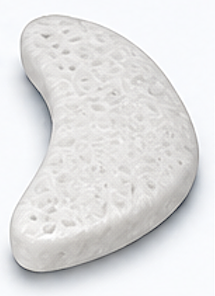
Porous polyethylene costs a little more than silicone because the raw material is more expensive and machining the porous structure is slower and creates greater waste. Despite its higher price, it has not demonstrated superior aesthetic outcomes for most facial augmentation procedures.
PEEK
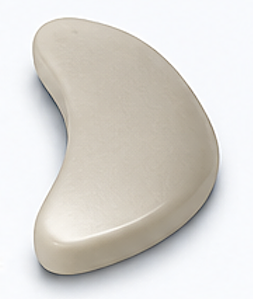
PEEK (polyetheretherketone) is significantly more expensive. The polymer itself is costly, and machining requires specialized equipment. While PEEK has excellent mechanical properties and is widely used in craniofacial reconstruction, its advantages for cosmetic facial augmentation over other materials is not proven .
Titanium
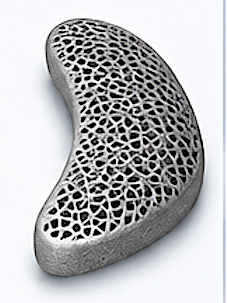
Custom titanium implants are usually the most expensive option. They are typically manufactured by selective laser melting or electron beam melting, both sophisticated additive manufacturing technologies. Titanium powder, printer time, post-processing, polishing, and quality control all contribute to the higher cost.
How Much Does The Material Choice/Cost Affect the Overall Cost of the Surgery?
Usually in the 10 to 15% range, The largest expenses in producing a custom implant are:
- CT scan processing and segmentation
- CAD design by biomedical engineers
- Surgeon review and design modifications
- Manufacturing
- Sterilization and quality assurance
- Regulatory compliance and documentation
These fixed costs are similar regardless of the material, so while titanium implants cost considerably more to manufacture than silicone, the overall price difference to the patient is often only a modest percentage of the total implant surgery cost.
Practical Perspective
For the vast majority of cosmetic facial implant applications, custom solid silicone offers the best balance of cost, ease of implantation, reversibility, and long-term clinical performance. Materials such as PEEK, porous polyethylene, and titanium are generally reserved for patient preference rather than because they have proven superior aesthetic results.
Can Custom Facial Implants Be Seen On X-Rays
Yes. Most custom facial implants can be seen on X-rays and CT scans, but how clearly they appear depends on the implant material.
How Different Implant Materials Appear on Imaging
- Silicone implants

- Usually faintly visible on plain X-rays
- Clearly identifiable on CT scans
- MRI shows them well because of soft tissue contrast
- PEEK (polyetheretherketone) implants

- Commonly used for custom facial implants
- Designed to have bone-like density
- Often only subtly visible on X-rays
- Very well seen on CT scans with excellent edge definition
- Titanium implants

- Extremely radiopaque
- Very obvious on X-rays and CT
- Produce some imaging scatter/artifact on CT
- Porous polyethylene (Medpor)

- Less visible on plain X-rays
- Detectable on CT scans
- Often blends more with surrounding tissues
What Imaging Shows Best
| Imaging Type | Ability to See Facial Implants |
| Plain X-ray | Sometimes visible depending on material |
| CT scan | Best overall method |
| MRI | Good for surrounding soft tissues, variable implant detail |
Why This Matters
Postoperative imaging is commonly used to:
- Confirm implant position
- Evaluate symmetry
- Assess healing
- Investigate trauma or infection
- Plan revisions if needed
Custom implants placed on the jawline, chin, cheekbones, orbital rims, or forehead are usually very easy to identify on a CT scan.
Custom implants placed on the jawline, chin, cheekbones, orbital rims, or forehead are usually very easy to identify on a CT scan.
The most common x-ray that people get and where custom facial implants can be ‘seen’ is on panoramic dental X-rays (panorex films) where have a very characteristic appearance because the image captures the entire jaws, lower face, and portions of the cheekbones in one curved projection.
What they look like depends mostly on the implant material and location.
Common Appearance by Implant Type
Chin Implants

- Seen as a curved structure overlying the chin bone (mandible symphysis)
- Silicone implants may appear as:
- faint outlines,
- subtle soft-tissue shadows,
- or mild contour enlargement
- Titanium chin implants appear bright white and sharply defined
Jaw Angle / Jawline Implants

- Usually visible near the back corners of the lower jaw
- Custom jaw implants often appear:
- symmetrical on both sides,
- hugging the outer border of the mandible,
- extending from the angle forward along the jawline
- Titanium fixation screws are often the most obvious feature
Cheek (Malar) Implants

- Seen higher on the image near the zygomatic arches
- May partially overlap the sinus region
- Silicone or PEEK implants can be subtle on panorex films
Material Differences on Panoramic X-rays
| Material | Appearance on Panorex |
| Silicone | Faint/moderate shadowing |
| PEEK | Mildly visible, bone-like density |
| Titanium | Bright white and extremely obvious |
| Medpor | Often difficult to distinguish |
What Makes Panoramic X-rays Unique
A panorex is:
- 2-dimensional
- slightly distorted geometrically,
- and optimized for teeth/jaws rather than implants.
Because of that:
- implant edges may appear blurred,
- structures overlap,
- and subtle implants may be hard to identify.
CT scans remain much more accurate for evaluating:
- exact implant shape,
- symmetry,
- fixation,
- and bone integration.
Typical Features Surgeons Look For
On a panoramic X-ray, surgeons evaluate:
- implant position,
- screw fixation,
- symmetry,
- relationship to tooth roots and nerves,
- mandibular contour,
- and signs of loosening or infection.
Titanium screws used to secure custom implants are usually the easiest part to recognize because they appear as very bright circular or linear radiopaque structures.
How Custom Facial Implants Are Made (Step by Step)
Here’s the detailed step-by-step workflow for how custom facial implants are typically made, from the first scan to the finished implant and surgery.
The short version is that the process usually goes:
CT scan → 3D bone model → virtual implant design → surgeon review/approval → manufacturing in the chosen material → finishing/sterilization workflow → surgical placement and fixation.
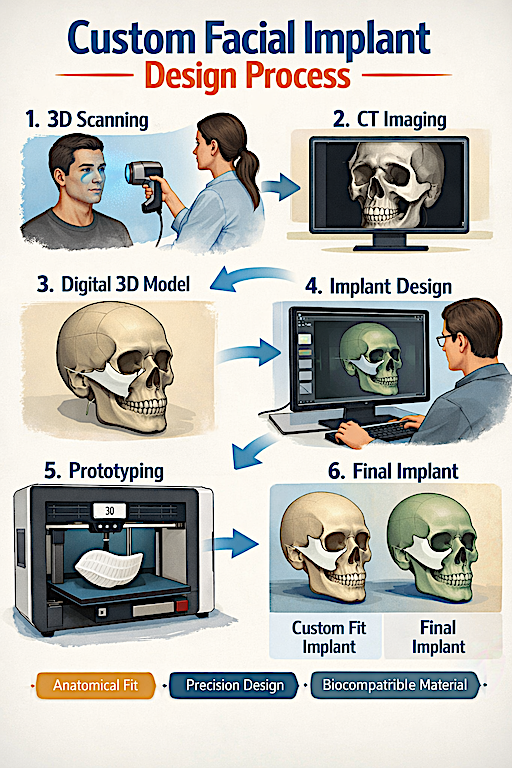
1. The patient gets a high-quality CT scan
Everything starts with imaging. A thin-cut CT scan (1mm or less slices) of the facial skeleton is obtained so the anatomy can be captured accurately in 3D. This scan is the raw data for the implant design. For patient-matched devices what matters are:
- the scan has to include the whole area being augmented or reconstructed
- slice thickness (ideally o.1mm) needs to be fine enough to reproduce surface details
- artifact should be minimal, because bad imaging leads to a bad fit later
For aesthetic facial implants, this is critical because even a small design error can show up as asymmetry once the implant is on the bone.
2. The CT data is converted into a 3D digital skull model
The DICOM files from the CT are imported into segmentation software. The software separates out the bony anatomy from soft tissue and creates a 3D model of the patient’s facial skeleton.
At this stage, the engineer or designer can:
- isolate the mandible, chin, cheekbones, orbital rim, forehead, or other areas
- smooth out scan noise
- mirror one side to the other if asymmetry correction is needed
- define the exact footprint where the implant will sit
- identify and color existing metal hardware and implants
3. The surgeon defines the aesthetic or reconstructive goal
Before any implant is drawn, the intended aesthetic change has to be defined. The surgeon usually decides:
- where augmentation is wanted
- how much projection is safe and looks natural
- how the transition from native bone to implant should blend
This planning phase is one of the biggest differences between custom and standard implants. Standard implants start with a pre-made shape; custom implants start with the patient’s anatomy and the desired endpoint. Which is why custom implants allow better fit, symmetry, and more precise contouring than standard implants.
4. The implant is digitally designed in CAD
Now the actual implant is created in CAD software on top of the 3D facial skeleton.
This is the true design step. The engineer creates a virtual implant shell that matches the bone underneath and produces the intended contour externally.
Typical design decisions include:
- implant borders and footprint
- thickness map across the implant
- maximum projection
- edge taper so no sharp step-off is visible or palpable
- screw-hole locations for fixation
- whether the implant is one piece or multiple pieces
- relief areas around nerves, tooth roots, foramina, or muscle attachments
In facial implants, the undersurface is designed to fit the bone precisely, while the outer surface is shaped to create the desired contour.
For asymmetry cases, the left and right sides may be designed differently.
5. A virtual planning review is done
Once the first design draft is made, the surgeon reviews it on screen.
This usually includes:
- multiple 3D views
- measurements of projection, width, and length
- evaluation of symmetry
- checking implant edges relative to visible facial zones
- confirmation that the design can actually be inserted surgically
At this point, there are often revisions:
- “too strong”
- “needs more posterior width”
- “edge too visible”
- “move away from mental foramen”
- “split it into two pieces for easier insertion”
This review-and-revise cycle may happen more than once before final design approval.
6. The implant material is selected
Custom facial implants are not all made the same way, because the material changes the manufacturing method.
Common materials include:
- solid silicone
- PEEK
- titanium
- porous polyethylene
If the implant is silicone
A silicone implant commonly involves:
- CAD design of the exact shape
- creation of a positive model or mold
- fabrication in implant-grade silicone elastomer
- curing and finishing
If the implant is PEEK
PEEK is a high-performance thermoplastic used for rigid patient-specific implants. It may be made by:
- machining from a PEEK block, or
- additive manufacturing/3D printing in selected workflows
If the implant is titanium
Titanium patient-specific implants are commonly made by additive manufacturing.
7. Manufacturing files are prepared
Once approved, the final CAD file is converted into manufacturing-ready data.
That may involve:
- STL or other file conversion
- orienting the part for printing or machining
- setting tolerances
- defining support structures if 3D printed
- choosing surface finish parameters
- assigning lot/build records and traceability
FDA guidance highlights software workflow, file format conversions, and the transition from digital design to physical device as key technical control points in additive-manufactured patient-matched devices.
This is an underappreciated stage. A perfect design can still fail if the manufacturing file is altered, smoothed incorrectly, scaled, or oriented poorly.
8. The implant is physically manufactured
This is the “making” step most people picture.
A. For 3D-printed titanium
The implant is built layer by layer from metal powder using additive manufacturing. Then it undergoes:
- support removal
- heat treatment if required
- machining of fixation features if needed
- surface finishing and cleaning
B. For PEEK
Depending on the vendor and workflow, the implant may be:
- CNC milled from a solid PEEK blank, or
- 3D printed and then finished
C. For silicone
A mold-based process is more typical:
- a mold is made from the digital design
- implant-grade silicone is introduced into the mold
- the silicone cures
- the implant is removed, trimmed, and finished
The exact method varies by vendor and regulatory pathway, but the overall principle is the same: the approved virtual implant is turned into a physical implant that reproduces the digital geometry as accurately as possible. FDA and manufacturer sources both emphasize that the device is produced from the approved patient-specific digital plan.
9. Post-processing and finishing are done
After the raw implant is made, it is not yet ready for surgery.
It usually goes through:
- trimming/deflashing
- smoothing or polishing
- verification of edges and contours
- cleaning
- inspection of screw holes and fit surfaces
- labeling and traceability documentation
For 3D-printed devices, FDA specifically notes the importance of post-processing controls because supports, surface changes, heat treatment, and cleaning can all affect final performance.
10. Quality control and fit verification are performed
This is one of the most important stages.
The manufacturer typically verifies:
- dimensions
- thickness
- contour accuracy
- screw-hole position
- consistency with the approved design file
Some workflows also test the implant against:
- a printed skull model
- a mirrored reference anatomy
- digital overlay comparisons
The point is to confirm that the produced implant is the same implant that was approved virtually.
11. Sterility pathway and packaging are handled
The implant is then prepared for clinical use according to the device workflow.
Depending on the implant and manufacturer, it may be:
- supplied sterile, or
12. Surgery is planned around the implant’s design
Before surgery, the surgeon studies:
- implant orientation
- insertion path
- incision choice
- whether the implant is one piece or must be assembled
- screw fixation points
- relation to nerves and tooth roots
This is where design and surgery intersect. A beautiful implant that cannot be inserted through a realistic approach is a design failure.
13. The implant is surgically placed and fixed
In surgery, the soft tissues are elevated off the bone, the pocket is created precisely, and the implant is inserted.
Then the surgeon checks:
- passive fit on bone
- midline or bilateral symmetry
- smooth transitions
- absence of rocking or malposition
The implant is then usually fixed with screws. Your internal source notes that the screws provide initial positional stability, while longer-term stability comes from tissue encapsulation.
14. Healing and tissue settling complete the process
Even after placement, the final result is not immediate.
Postoperative changes include:
- swelling
- soft-tissue redraping
- scar maturation
- eventual tissue adaptation over the implant
Your internal jawline document describes the visible recovery pattern as substantial early swelling, major improvement over weeks, and final appreciation of result over about 3 months.
In practical terms, what makes a custom facial implant “custom”?
A true custom implant is custom in four ways:
- Custom anatomy
It is built from that patient’s CT-derived skeleton. - Custom shape
Projection, width, thickness, and borders are designed for that individual goal. - Custom fit surface
The undersurface is shaped to match the patient’s bone. - Custom surgical plan
Fixation, segmentation, and insertion path are tailored to how it will actually be implanted.
That is why custom implants usually outperform stock implants in difficult asymmetry, revision, or large-augmentation cases. Your internal file makes the same point in simpler terms: better fit, better symmetry, and more precise contouring.
The biggest failure points in the process
Most problems happen at one of these steps:
- poor CT quality
- bad segmentation
- overaggressive design
- ignoring soft-tissue limitations
- edge design that is too abrupt
- fixation plan that is weak or awkward
- manufacturing inaccuracies
- contamination or sterility problems
- wrong pocket dissection at surgery
So the process is not just “3D print an implant.” It is really a design-control workflow that starts with imaging and ends with biologic and surgical integration.
Bottom line
Custom facial implants are usually made through this sequence:
1. CT scan
2. 3D segmentation of the facial bones
3. Surgeon defines the goal
4. CAD design of the implant
5. Virtual review and revisions
6. Material selection
7. Manufacturing file preparation
8. Production by molding, milling, or 3D printing
9. Finishing and inspection
10. Sterility/packaging workflow
11. Surgical placement on bone
12. Screw fixation and healing
How Accurate Is The Custom Facial Implant Design To The Manufactured Implant
Custom facial implant accuracy is actually one of the strongest advantages of the whole process—modern systems are very precise, but there are a few important caveats.
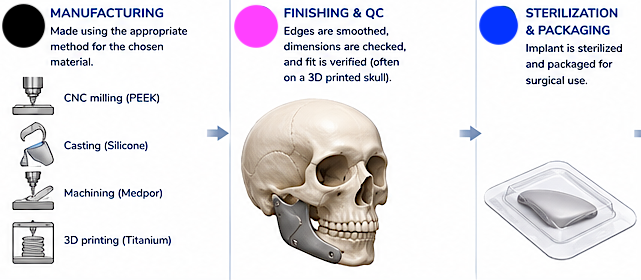
🎯 Typical accuracy (design → manufactured implant)
- Manufacturing accuracy:
Usually within ±0.1–0.5 mm depending on the material and method
- CNC-milled PEEK → extremely precise (often closer to ±0.1–0.2 mm)
- Silicone (cast from mold) → slightly more variability
- Medpor → moderate precision
- Digital design accuracy:
Essentially exact to the CT data resolution (often sub-millimeter)
👉 So in a lab sense, the implant you receive is almost identical to the digital design.
🧠 Where accuracy really matters: fit to the patient
This is where things get more nuanced.
Even if the implant perfectly matches the design, the real-world fit depends on several variables:
1. CT scan quality
- Slice thickness (e.g., 0.5–1 mm vs 2–3 mm) affects accuracy
- Motion artifacts can distort anatomy
- Poor scans = imperfect starting model
2. Software design assumptions
- Mirroring the opposite side assumes symmetry (which humans don’t perfectly have)
- Soft tissue is not part of the design—only bone is
- Surgeon-driven contour decisions introduce subjective elements
3. Surgical placement variables
- Soft tissue tension can slightly alter final position
- Intraoperative positioning (even by 1–2 mm) matters
- Fixation (screws vs pocket placement) affects stability
4. Biological interface
- Periosteum and soft tissue thickness can subtly change how the implant “sits”
- Swelling initially masks true contour
📊 Practical takeaway
- Implant vs design:
✅ Near-perfect match (sub-millimeter accuracy) - Implant vs patient anatomy (in surgery):
✅ Typically within ~1 mm fit, which is considered excellent in craniofacial surgery
⚠️ Where discrepancies show up
Even with perfect manufacturing, small differences can occur:
- Minor edge gaps (often intentional to avoid pressure)
- Slight contour differences due to soft tissue behavior
- Rare need for intraoperative adjustment (much less than with stock implants)
💡 Why this level of accuracy is clinically important
- Symmetry improvements are far more predictable
- Operative time is reduced (less carving/shaping)
- Outcomes are reproducible from the plan
Bottom line
Custom facial implants are extremely accurate to their design (sub-millimeter), and in real surgical use typically achieve ~1 mm or better anatomical fit, which is considered highly precise in facial surgery.
How Are The Measurements Determined For Custom Facial Implant Designs
Custom facial implants are designed to fit your exact anatomy, so their measurements aren’t arbitrary—they’re derived from detailed imaging and digital modeling. Here’s how that process typically works:
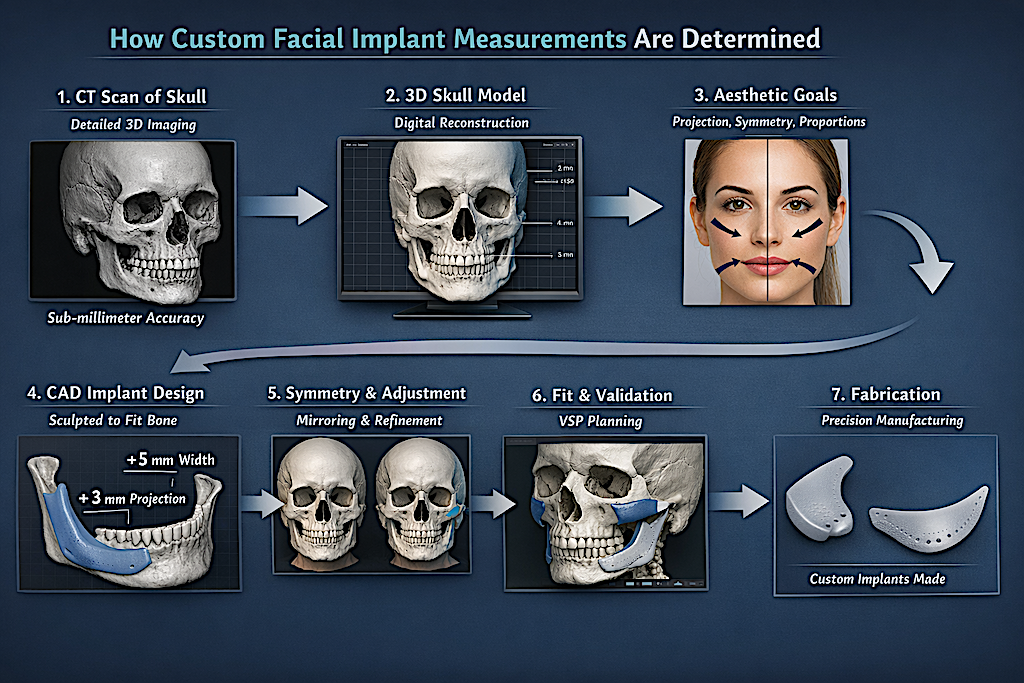
1. High-resolution imaging (foundation of everything)
- A CT scan (most common) or sometimes 3D CBCT is taken of your skull.
- This captures precise bone structure in 3D, down to sub-millimeter accuracy.
- Soft tissue may also be considered, but implants are primarily designed off bone anatomy.
2. 3D digital reconstruction
- The scan data is converted into a 3D computer model of your skull.
- Surgeons and engineers can rotate, zoom, and measure every contour.
- This allows exact baseline measurements: thickness, asymmetry, projection, angles.
3. Defining the aesthetic and structural goals
This is where measurements become customized:
- Desired augmentation amount (e.g., +3 mm cheek projection, +5 mm jaw width)
- Symmetry corrections (one side may differ from the other)
- Functional considerations (bite, muscle attachments, nerves)
These goals come from:
- Surgeon analysis
- Patient input (photos, morphing simulations, preferences)
- Sometimes comparison to ideal proportions or the patient’s own anatomy
4. Digital implant design (CAD modeling)
- The implant is sculpted digitally on top of your bone model.
- Measurements are determined in terms of:
- Projection (outward thickness) in millimeters
- Width/length coverage across the bone surface
- Edge tapering (to avoid visible transitions)
- Curvature matching to your anatomy
Think of it like adding a perfectly contoured layer that blends into your existing bone.
5. Symmetry and mirroring (if needed)
- For asymmetry, one side can be:
- Mirrored from the better side, or
- Independently designed with different measurements
- This is one of the biggest advantages over stock implants.
6. Validation and refinement
- The design is reviewed and adjusted:
- Ensuring proper fit against bone (no gaps or pressure points)
- Avoiding nerves, tooth roots, and muscle interference
- Some surgeons use virtual surgical planning (VSP) to simulate placement.
7. Manufacturing precision
- Final implants are fabricated (often from silicone or porous polyethylene) using the exact digital dimensions.
- Accuracy is typically within fractions of a millimeter.
Key idea
Custom implant measurements are not “standard sizes”—they’re:
Derived directly from your CT scan and tailored to specific millimeter-level changes in projection, width, and contour.
How Aesthetic Norms Influence Custom Facial Implant Designs
Modern facial implant design is shaped by evolving aesthetic norms involving proportion, contour, identity, ethnicity, gender expression, and perceptions of natural beauty. Today’s custom implants are designed to create structural harmony and individualized facial balance rather than simply enlarging facial features.
Facial Proportion Ideals
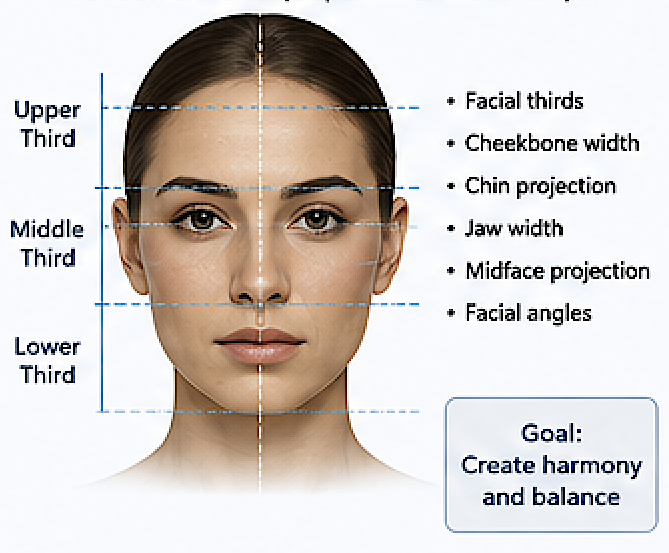
Custom implant planning evaluates facial thirds, jaw width, cheekbone projection, chin balance, and midface support to improve overall harmony and proportion.
Gender-Specific Aesthetic Standards
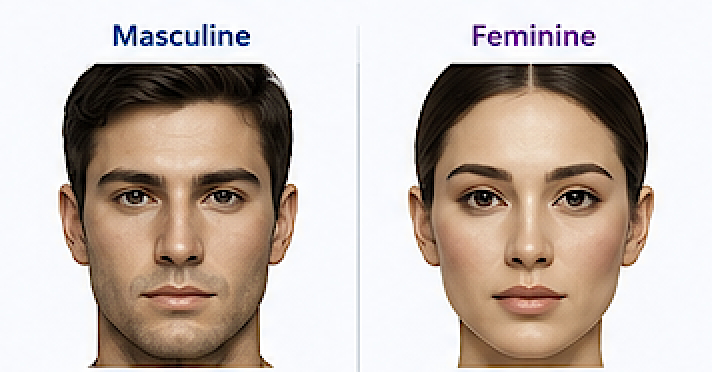
Masculine implant designs often emphasize stronger jawlines and skeletal definition, while feminine designs favor softer transitions and smoother contour lines.
Ethnic & Cultural Considerations
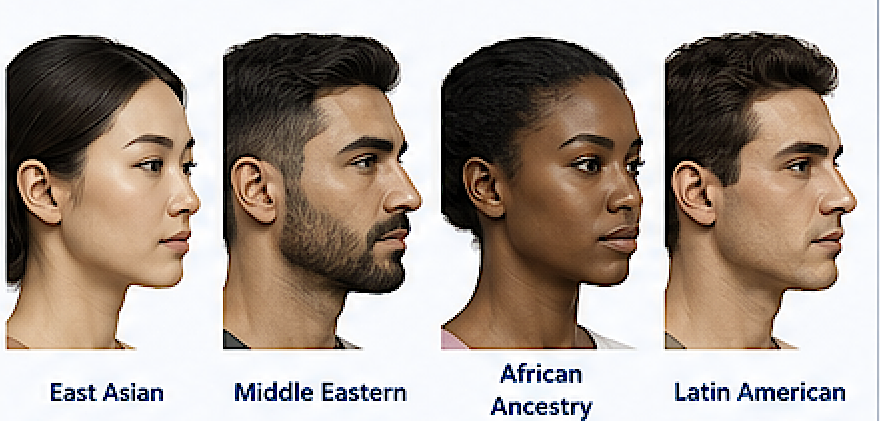
Modern implant planning prioritizes preservation of ethnic identity and patient-specific facial characteristics rather than imposing universal beauty ideals.
Naturalness Standard
Contemporary implants are designed with feathered edges, smooth transitions, and anatomically adaptive contours to create natural-looking results.
Digital Imaging & Social Media Influence
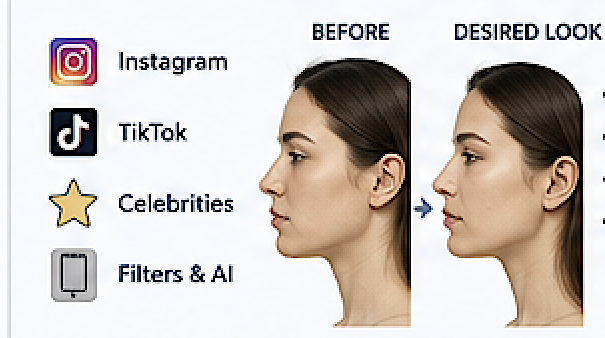
High-definition imaging, celebrity aesthetics, and social media trends increasingly influence requests for sharper jawlines, cheekbones, and profile definition.
Aging & Rejuvenation Goals
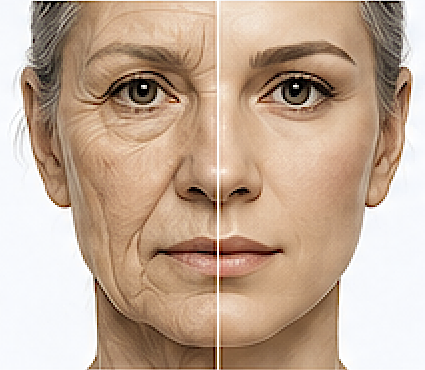
Custom implants can restore youthful skeletal support by improving infraorbital projection, jawline definition, and prejowl contour.
Symmetry Expectations
Implants may correct asymmetries and improve facial balance while maintaining natural variation.
Anatomical & Functional Limits
Successful implant design must respect nerve anatomy, soft tissue thickness, airway function, bite mechanics, and long-term skeletal stability.
Core Principle
The best custom facial implants do not create an obviously augmented face. They create structural harmony, proportionate enhancement, and identity-consistent refinement.
Is The Golden Ratio Useful In Custom Facial Implant Designs
Yes. The golden ratio can influence custom facial implant design, but it is used more as an aesthetic reference framework than as a strict mathematical rule.
In facial implant surgery, surgeons evaluate harmony, balance, symmetry, and proportion between facial regions. The golden ratio (approximately 1.618) is one of several proportional concepts that can guide these decisions.
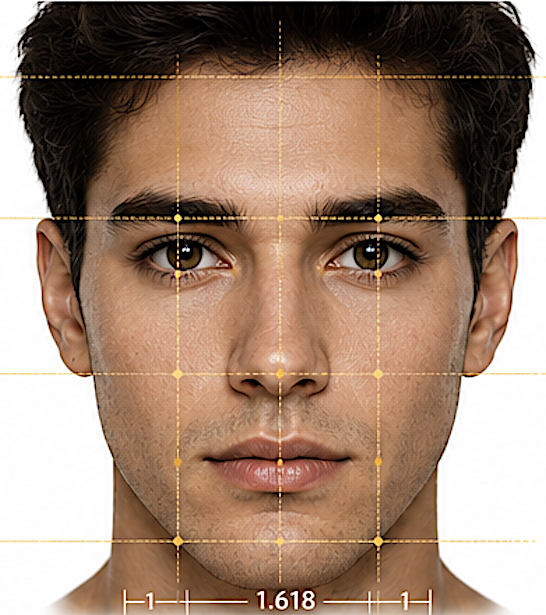
Common ways it may influence implant design include:
- Chin projection relative to nose and forehead
- Bigonial width (jaw angle width) relative to midface width
- Facial thirds:
- hairline → brow
- brow → base of nose
- nose base → chin
- Bizygomatic width relative to lower facial width
- Eye spacing and orbital balance
- Masculine versus feminine proportional goals
For example:
- A custom jaw implant may be designed to widen the lower face to create stronger proportional balance with the cheekbones.
- A chin implant may increase projection to improve the profile ratio between nose, lips, and chin.
- Midface implants may restore proportional facial convexity and support.
The concept is especially relevant in:
- Custom jawline implants
- Chin implants
- Cheek/malar implants
- Orbital and infraorbital implants
- Full facial skeletal augmentation
However, experienced facial implant surgeons do not design implants by simply applying a fixed golden ratio formula. Modern custom implant design relies more heavily on:
- Skeletal anatomy
- Soft tissue behavior
- Sex-specific facial characteristics
- Ethnic facial norms
- Patient goals
- Occlusion and airway considerations
- 3D CT analysis
- Dynamic facial balance
Two patients can both have attractive faces while deviating significantly from “ideal” golden ratio measurements.
In contemporary custom implant planning, the golden ratio is best viewed as:
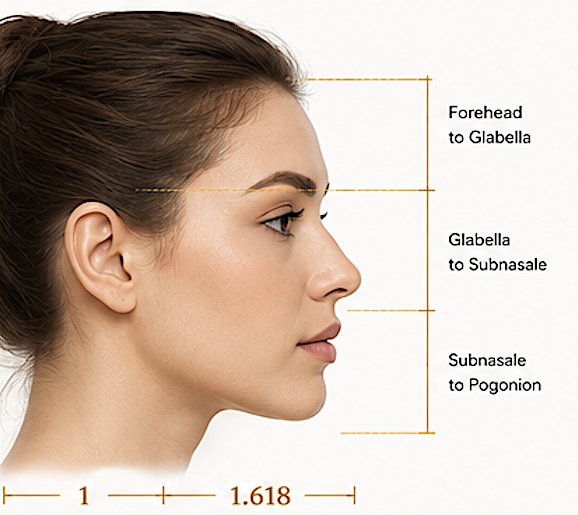
- an artistic guideline,
- a communication tool for facial aesthetics,
- and a starting point for proportion analysis,
rather than a precise engineering target.
Mathematically, the classic golden ratio relationship is:
ϕ= aa+b = ba ≈1.618
In custom implant surgery, surgeons translate these proportional ideas into 3D skeletal modifications rather than direct linear equations.
How Do The Classic Canons Apply To Custom Facial Implant Designs
If by the classic canons you mean the traditional artistic and anthropometric canons (Greek canon, Renaissance proportional ideals, neoclassical facial proportions, Ricketts/Gonzales-Ulloa facial analysis, etc.), they provide a useful framework for custom facial implant design, but only as a starting point rather than a treatment goal.
1. The Classical Canons Establish a Reference Architecture
Traditional canons describe relationships such as:
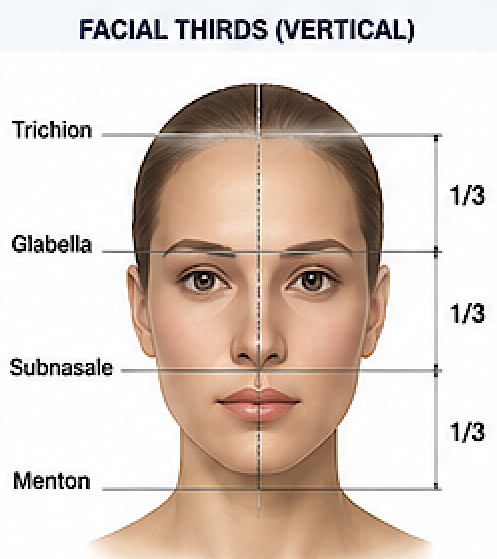
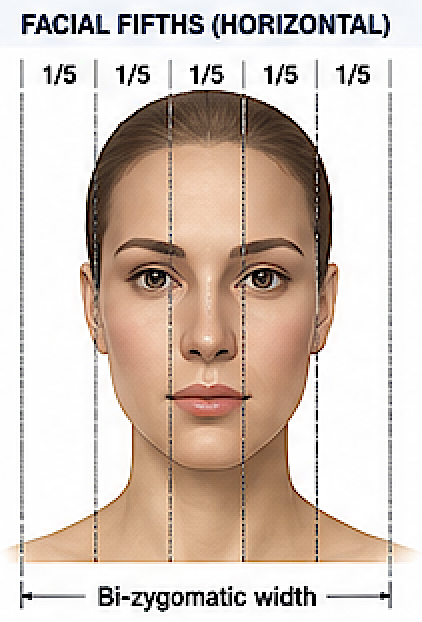
- Facial thirds (trichion–glabella, glabella–subnasale, subnasale–menton)
- Facial fifths
- Projection relationships between forehead, nose, lips, chin, and neck
- Symmetry around the midsagittal plane
- Ideal jaw width relative to bizygomatic width
- Nasofrontal, nasolabial, and cervicomental angles
When designing custom implants, these proportions help define:
- Where skeletal deficiency exists
- How much projection is needed
- Whether augmentation should be vertical, horizontal, or transverse
- Overall facial balance
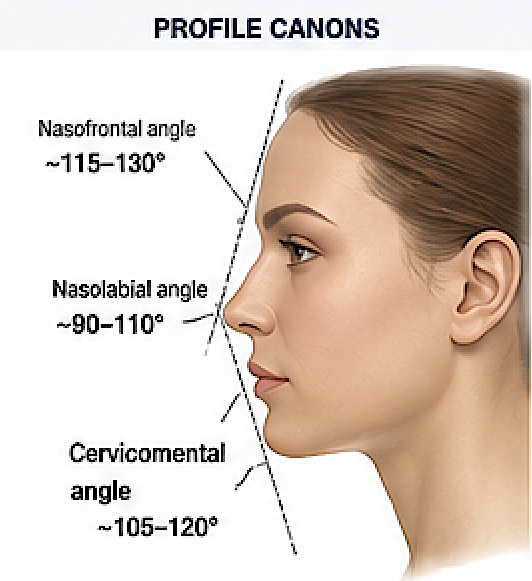
For example, a retrusive chin identified by classical profile analysis may suggest a custom chin implant or a chin-wing design.
2. Implants Modify the Skeletal Foundation
The canons were developed from external facial appearance, but implants act on the underlying skeleton.
Thus, the surgeon translates:
Soft tissue imbalance → skeletal correction
Examples:
|
Canonical observation |
Implant implication |
|
Narrow lower fifth |
Jaw angle widening |
|
Weak lower third |
Chin projection and/or vertical lengthening |
|
Flat midface |
Paranasal or infraorbital augmentation |
|
Deficient lateral facial frame |
Zygomatic augmentation |
The implant design is therefore guided by the proportions but implemented through skeletal modification.
3. Modern Custom Implant Design Often Goes Beyond Classical Canons
Classical ideals were based on relatively narrow concepts of attractiveness.
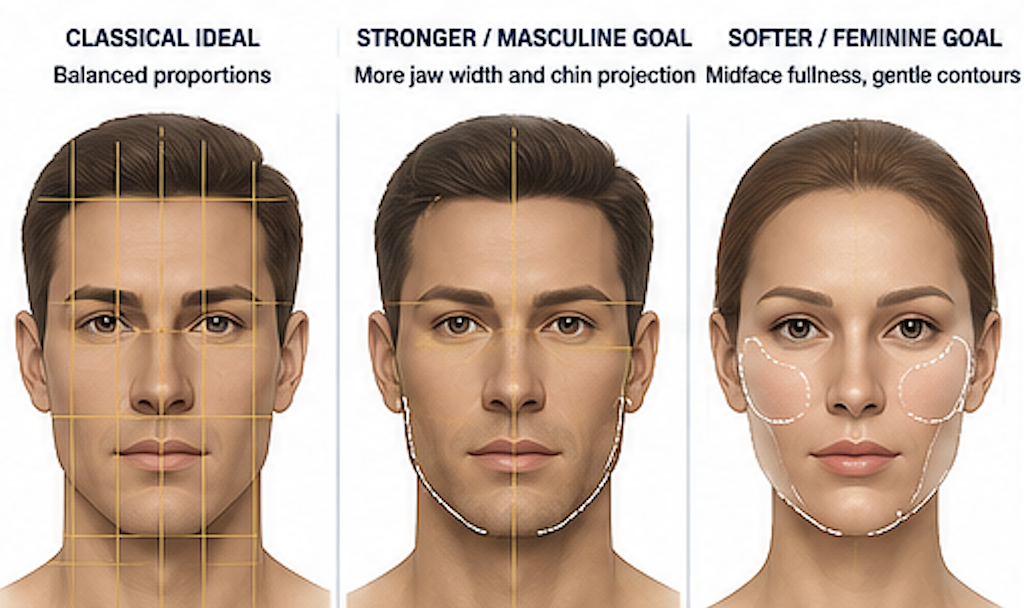
Today’s custom implant planning often considers:
- Sex-specific aesthetics
- Ethnic norms
- Individual patient goals
- Three-dimensional facial shape
- Age-related skeletal changes
For example:
- A male patient may desire a jaw width exceeding classical facial fifth proportions.
- A female patient may want midface augmentation while maintaining a softer mandibular contour.
- Some patients seek intentionally stronger-than-average facial structure.
In these situations the implant design may deliberately depart from classical canons.
4. The Most Useful Canon for Implant Design Is Facial Harmony
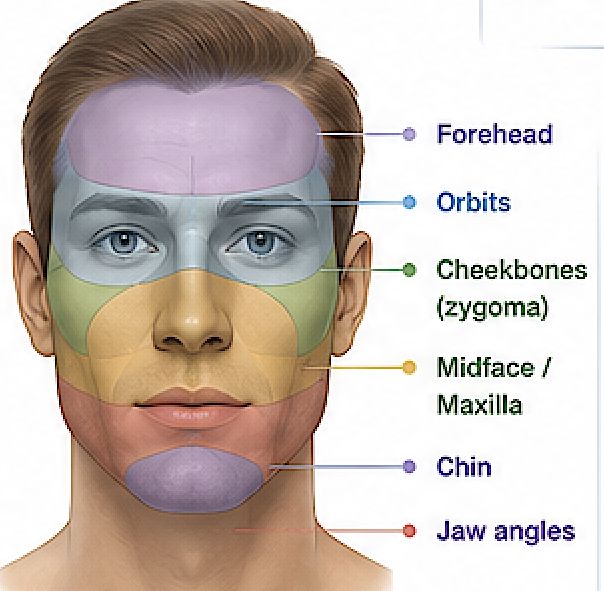
In practical implant surgery, the most important principle is not adherence to any single numerical canon but maintenance of harmonious relationships among:
- Forehead
- Orbit
- Cheekbone
- Paranasal area
- Maxilla
- Chin
- Jaw angles
A custom implant that perfectly follows a textbook proportion but disrupts overall facial flow often appears unnatural.
5. Three-Dimensional CT-Based Design Has Replaced Many Classical Measurements
With modern custom implants, surgeons can evaluate:
- Skeletal asymmetries
- Facial width-to-height ratios
- Projection vectors
- Surface curvature
- Soft-tissue response
This allows a transition from:
“Does the patient fit the canon?”
to
“What skeletal changes create the desired facial balance for this individual?”
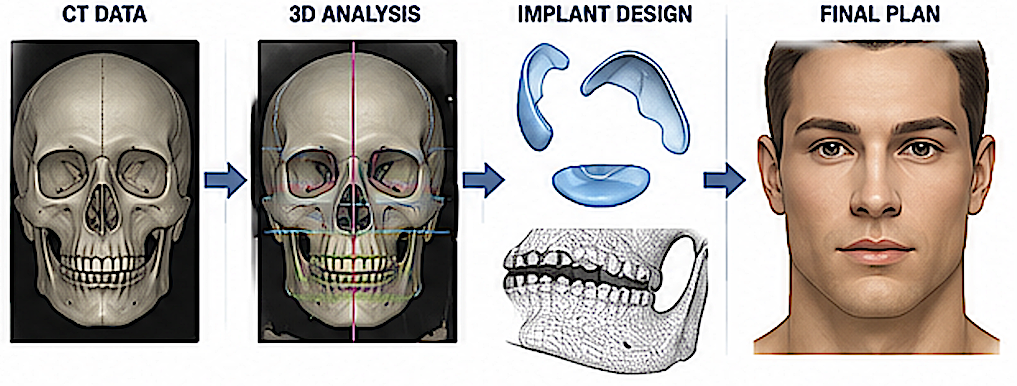
The classical canons remain valuable because they identify the direction of correction, but CT-based 3D design determines the actual implant geometry.
For custom facial implants, I would characterize the classical canons as a diagnostic framework, not a design template. They tell you what is disproportionate; the implant design determines how to correct it in three dimensions.
The Geometry of Custom Facial Implant Designs
The geometry of custom facial implant design is less about making an implant “bigger” and more about controlling shape, vector, footprint, edge transition, and soft-tissue translation.
A strong framework:
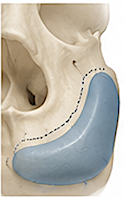
Footprint first, projection second
The implant must cover enough skeletal surface to blend into native bone. A small high-projection implant risks a visible shelf; a broader, tapered design creates a more natural transition.
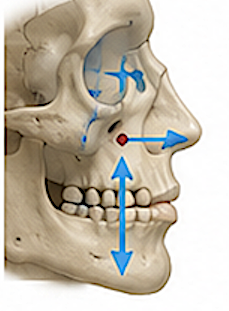
Vector-based design
Projection is not just outward. Chin, jawline, infraorbital, malar, and forehead implants each require different directional vectors: anterior, inferior, lateral, superoanterior, or wraparound. In negative orbital vector cases, for example, the goal is to rebuild the infraorbital–midface platform, not simply add volume under the eye.
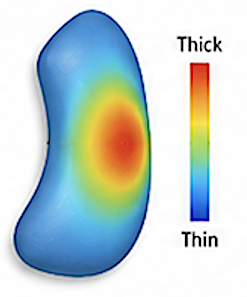
Thickness gradients
Maximum thickness should sit where the aesthetic deficiency is greatest, then gradually taper medially, laterally, superiorly, and inferiorly. Feathered edges are critical to avoid palpability, visibility, and unnatural step-offs.
Anatomic saddling and fit
Custom implants are CT-based and should lock onto stable bony landmarks. For jawline implants, this improves fit, symmetry, and contour control compared with stock implants.
Natural transition zones
The best designs avoid abrupt borders. They use broad surface blending, feathered margins, and gradual contour changes so the face looks structurally improved rather than implanted.
Asymmetry correction
Each side does not need to be identical in implant geometry. True customization often means designing different right and left thicknesses or shapes to create perceived symmetry.
Core principle: Custom facial implant geometry is the translation of an aesthetic goal into a safe, stable, anatomically blended 3D skeletal shape.
What Makes For A Good Custom Facial Implant Design
A good custom facial implant design usually gets five things right:
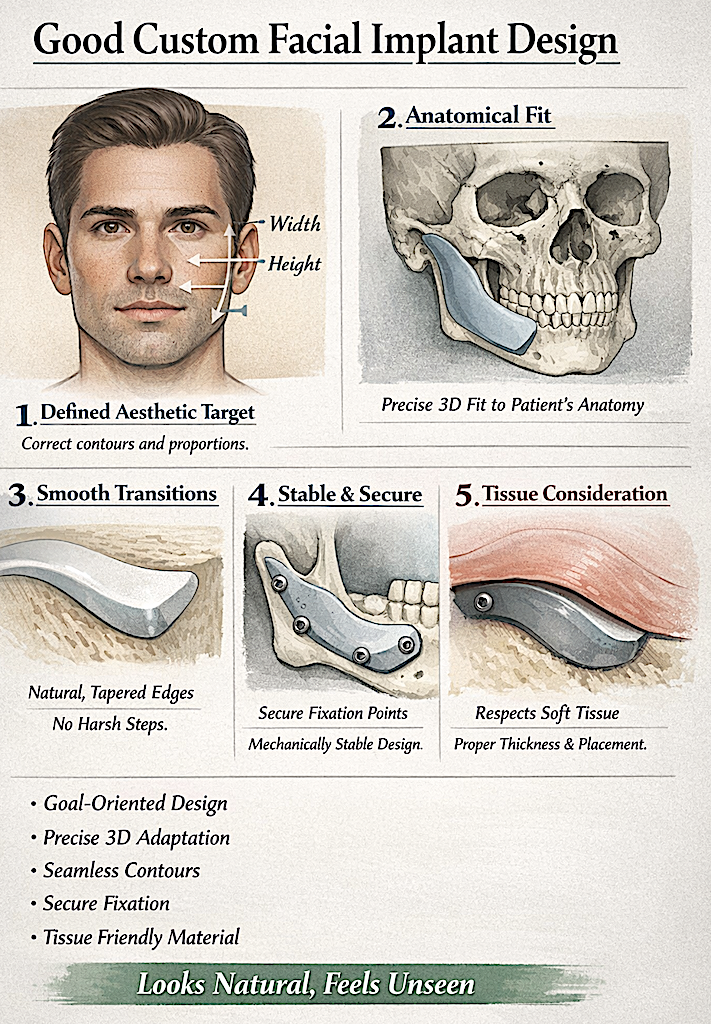
1. It starts with the right aesthetic goal
The best implant is not just “bigger.” It should create the intended shape change in the correct vectors: projection, width, vertical length, transition zones, and symmetry. In facial implant literature, unsatisfactory outcomes are often aesthetic rather than mechanical, which is why precise preoperative definition of the target contour matters so much.
2. It matches the patient’s anatomy in 3D
Patient-specific implants work well because they are designed from CT-based anatomy and can fit the underlying skeleton closely, reducing guesswork and intraoperative carving. Reviews of maxillofacial patient-specific implants consistently describe the value of CAD/CAM workflows for precise adaptation to complex facial contours and improved surgical planning.
3. It has smooth, natural contour transitions
A strong design avoids abrupt edges, step-offs, and “stuck-on” fullness. The implant should feather into native bone so the augmentation looks like skeletal anatomy, not a discrete mass. This is especially important in the chin, malar, and mandibular angle, where visible contour errors can happen even when the implant is technically well positioned.
4. It is mechanically and surgically stable
A good implant design considers fixation, thickness distribution, footprint, and load behavior. In jawline and maxillofacial PSI workflows, fixation planning and engineering review are treated as core parts of design, not afterthoughts. For mandibular applications in particular, biomechanics matter because the jaw experiences complex functional strain; designs that ignore this can concentrate stress or create instability.
5. It respects soft tissue and biology
Even a perfectly shaped implant can fail aesthetically if the overlying soft tissue cannot support it well. Good design accounts for tissue thickness, pocket behavior, palpability risk, edge visibility, and the material being used. Reviews of patient-specific facial implants emphasize that material choice, manufacturing workflow, and complication profile all influence long-term success.
In practical terms, a strong custom implant design should be:
- Goal-driven rather than anatomy-driven alone
- Symmetric when needed, asymmetric when appropriate
- Largest where the face needs change, thinnest where it should disappear
- Easy to seat reproducibly with clear orientation and fixation strategy
- Built for the soft tissue envelope, not just the bone
Common design mistakes are overfilling one subunit, making the implant too thick at the edge, creating a shape that looks good on bone views but not through the soft tissue, and neglecting how the implant will actually insert and fixate. Aesthetic dissatisfaction is a recognized reason for revision even when infection or migration do not occur.
My rule of thumb: the best custom facial implant is the one that is invisible as an implant. It should read as a more ideal skeleton, seat easily, fixate predictably, and produce a soft-tissue result that looks inevitable.
What is the Role of the 3D CT Scan in Custom Facial Implants
A 3D CT scan is the foundation of modern custom facial implant design. It provides the precise anatomical information needed to create implants that fit a patient’s unique facial skeleton rather than relying on standard, off-the-shelf sizes.
Here’s how it is used throughout the process:
1. Captures the patient’s facial anatomy
A high-resolution CT scan produces detailed, three-dimensional images of the facial bones, including:
- Cheekbones (zygomas)
- Chin and jaw (mandible)
- Orbital rims
- Nose
- Forehead and temples
Unlike photographs or surface scans, CT imaging shows the underlying bone, which is what facial implants attach to.
2. Creates a digital 3D model
The CT data (typically stored as DICOM files) is converted into a digital 3D model of the skull using specialized software.
This allows the surgeon and biomedical engineer to:
- Rotate the skull in any direction
- Measure asymmetries precisely
- Plan implant dimensions to fractions of a millimeter
3. Enables virtual surgical planning
Before surgery, the surgeon can virtually:
- Design the implant shape
- Simulate augmentation
- Evaluate facial proportions
- Ensure symmetry
- Avoid critical anatomical structures such as nerves and tooth roots
This planning helps predict the postoperative skeletal contour before an implant is ever manufactured.
4. Allows truly custom implant design
Instead of selecting a stock implant, engineers design an implant that conforms exactly to the patient’s bone.
The implant can be customized for:
- Thickness
- Projection
- Width
- Contour
- Edge transitions
- Screw fixation locations
The result is a “lock-and-key” fit against the bone.
5. Improves symmetry
For patients with facial asymmetry, the CT scan makes it possible to:
- Mirror the normal side onto the deficient side
- Quantify differences in volume and projection
- Design implants that restore balanced facial proportions
This is especially valuable after trauma, congenital conditions, or previous surgery.
6. Facilitates manufacturing
Once the design is finalized, the implant is manufactured using medical-grade materials such as:
- Solid silicone
- Porous polyethylene (Medpor)
- PEEK (polyether ether ketone)
- Titanium (for selected reconstructive applications)
Because the implant is based directly on the CT-derived model, it requires minimal intraoperative modification.
7. Helps during surgery
The preoperative CT model helps surgeons:
- Plan incisions
- Determine implant orientation
- Identify fixation points
- Minimize operating time
Some centers also use patient-specific cutting guides or surgical navigation derived from the CT data.
Why CT is preferred over surface scanning
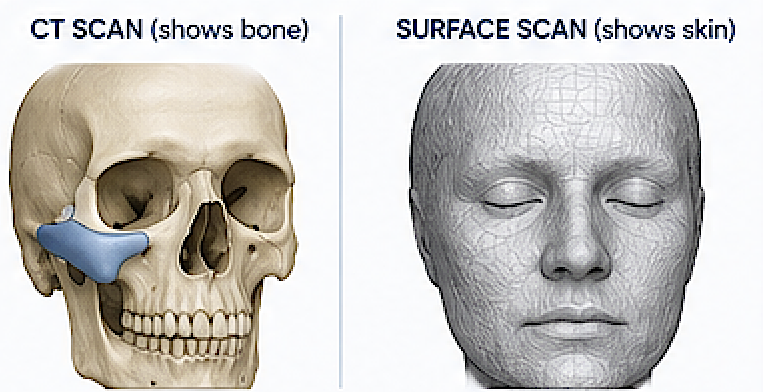
While 3D photographic or optical surface scans accurately capture the skin, they do not show the underlying bone. Since facial implants rest directly on the skeleton, CT provides the essential anatomical information needed for precise implant design. Surface scans may be combined with CT when soft-tissue simulation or aesthetic planning is important.
Typical CT requirements for custom facial implants
Most surgeons and implant manufacturers request:
- Thin-slice CT (approximately 0.5–1.0 mm slice thickness)
- No significant motion artifact
- Coverage of the entire facial skeleton relevant to the planned implants
- DICOM image files for digital planning
Benefits of CT-based custom implants
Compared with standard implants, CT-based custom implants can offer:
- More accurate fit to the patient’s anatomy
- Better facial symmetry
- More predictable aesthetic outcomes
- Less need for intraoperative carving or reshaping
- Improved implant stability and positioning
In summary, the 3D CT scan is the key enabling technology for custom facial implants. It transforms the patient’s facial skeleton into a precise digital model, allowing implants to be designed specifically for their anatomy, virtually tested before surgery, and manufactured with a highly accurate fit.
Can Custom Facial Implant Designs Be Done with MRIs
Yes, custom facial implant designs can be created from MRI data, but in most cases CT scans are preferred and provide better results for implant design.
Here’s why:
CT vs. MRI for Facial Implant Design
CT Scans
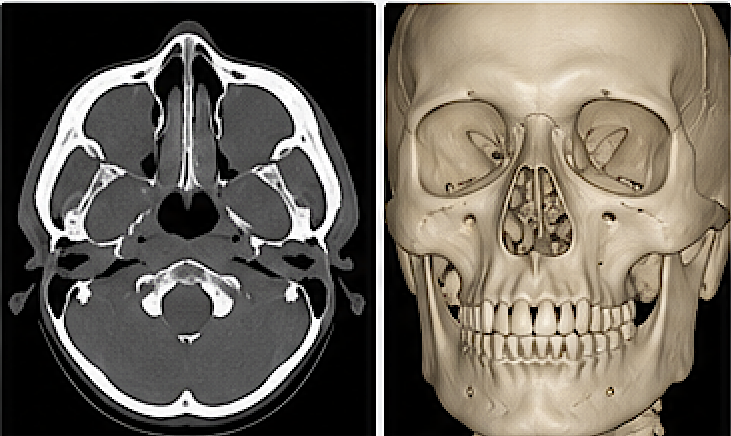
- Excellent visualization of bone anatomy.
- Provide precise 3D skeletal models.
- Standard imaging modality for custom chin, jaw angle, cheek, orbital, and midface implants.
- Allows accurate CAD/CAM implant design and manufacturing.
MRI Scans
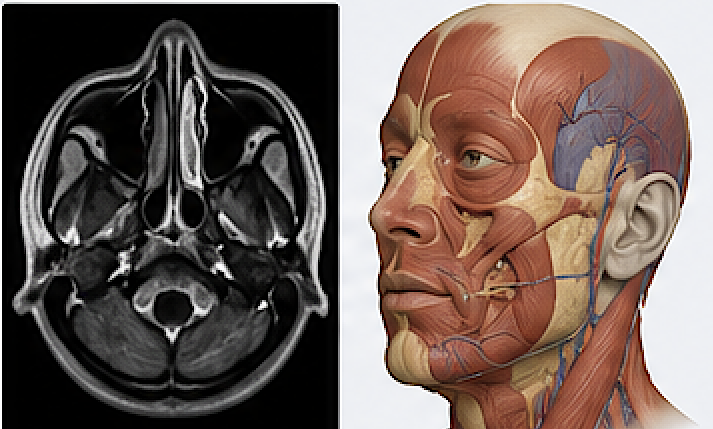
- Excellent visualization of soft tissues (muscles, fat, nerves, vessels).
- Bone surfaces are less clearly defined than on CT.
- Traditional MRI sequences are generally not ideal for generating precise bony models.
- Can sometimes be used when CT is unavailable or undesirable, particularly with modern high-resolution MRI protocols and specialized segmentation techniques.
When MRI-Based Design May Work Well
MRI can be useful when:
- The implant is primarily intended to affect soft-tissue contours.
- Radiation exposure is a significant concern.
- Specialized MRI sequences are available that adequately define the facial skeleton.
- The design incorporates both soft-tissue and skeletal analysis.
Practical Reality
For most custom facial implants:
- A maxillofacial CT scan with thin slices (0.5–1.0 mm) remains the gold standard.
- MRI may be used as a supplementary study to assess soft tissues, asymmetries, or prior surgical changes.
- Some design companies can merge CT and MRI datasets to optimize implant planning.
If a CT Cannot Be Obtained
In certain circumstances, a custom implant can be designed from:
- High-resolution MRI
- Cone-beam CT (CBCT)
- Existing CT scans obtained for other purposes
- Surface facial scans combined with MRI data
The feasibility depends on the implant location (chin, jaw angles, cheeks, orbital rims, etc.) and the quality of the MRI sequences.
Can I Design My Own Custom Facial Implants
Yes—you can design custom facial implants, but there are a few important realities to understand depending on what you mean by “design.”
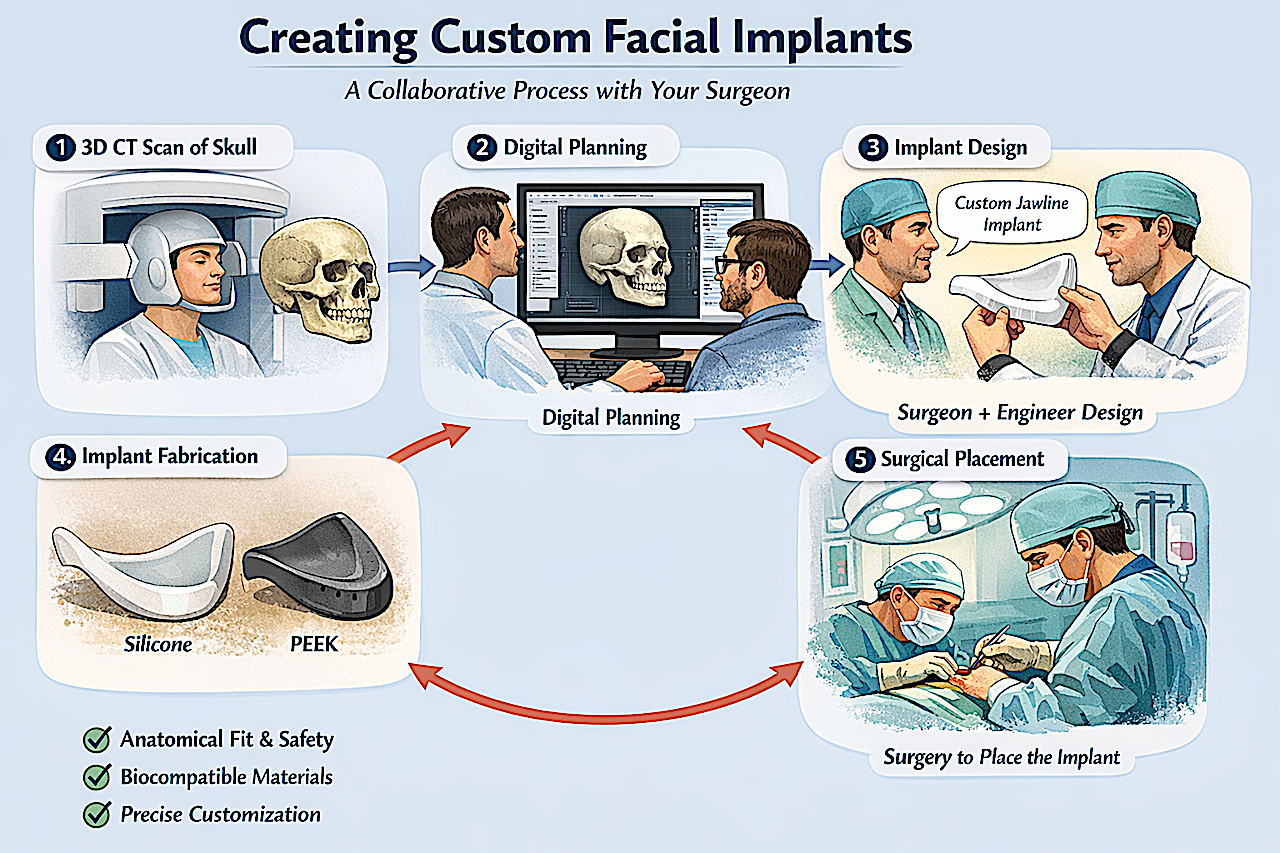
1. Conceptually designing (what most patients mean)
If you’re thinking:
- “I want a specific jawline, chin, cheek shape, etc.”
- “I want something unique to my face”
Then yes—this is very doable, but it’s always done in collaboration with a surgeon, not independently.
Typical process:
- 3D CT scan of your skull
- Digital planning (CAD software)
- Surgeon + medical engineer design the implant
- Implant is manufactured (often silicone or PEEK)
- Surgically placed
These are called custom (patient-specific) implants, and they’re commonly used for:
- Jawline augmentation
- Chin reshaping
- Cheek implants
- Orbital/craniofacial reconstruction
2. Personally designing it yourself (without medical oversight)
This is where things get tricky.
You can:
- Sketch ideas
- Use 3D modeling software (Blender, ZBrush, etc.)
- Even create conceptual designs
But you can’t safely or realistically produce/use them medically on your own, because:
- Implants must meet strict biocompatibility standards
- Design must account for:
- Nerves
- Blood supply
- Muscle movement
- Bone fixation
- Manufacturing requires medical-grade materials and sterilization
- Surgical placement is complex and high-risk
3. If you’re serious about doing this
The best route is:
- Find a surgeon experienced in custom facial implants (very important—not all do this)
- Bring references, goals, even sketches if you want
- Work through their 3D planning process
Some surgeons actually encourage patient input during design.
4. Reality check
Custom implants are:
- More expensive than standard implants
- More precise and natural-looking when done well
- Highly dependent on surgeon skill and planning
Bottom line
- ✅ You can absolutely be involved in designing your own facial implants
- ❌ You shouldn’t try to independently create or implant them yourself
- 🤝 The real process is collaborative design with a specialist using medical imaging and CAD
Can Custom Facial Implants Be Made in the US and Shipped Overseas for Surgery
Yes. Custom facial implants are commonly designed and manufactured in the United States and then shipped internationally for implantation surgery overseas. This is already done routinely in craniofacial, maxillofacial, and aesthetic surgery.
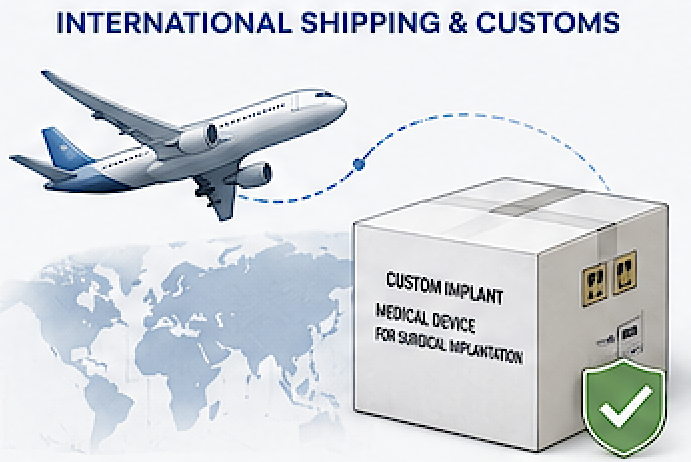
Typically the workflow looks like this:
- CT scan is obtained in the patient’s country
- The DICOM files are sent electronically to the implant designer/manufacturer in the US
- A custom implant is digitally designed (usually in PEEK, silicone, porous polyethylene, or titanium)
- The surgeon reviews and approves the design
- The implant is manufactured in the US
- It is sterilized and exported to the destination country for surgery
From a regulatory standpoint, custom facial implants are considered medical devices, and US export is allowed provided FDA export and manufacturing requirements are followed.
The major issues are usually not whether export is allowed, but rather:
- the import regulations of the destination country
- customs clearance
- whether the implant material is approved locally
- sterilization/documentation requirements
- timing/logistics
Many countries require documentation such as:
- certificate of manufacture
- sterilization certificate
- material biocompatibility documentation
- FDA registration/listing information
- Certificate to Foreign Government (CFG) in some cases
For custom facial implants specifically:
- Silicone and PEEK implants are commonly shipped internationally
- Titanium patient-specific implants are very common for reconstructive craniofacial surgery worldwide
- Customs is usually easier when the implant is clearly labeled as “patient-specific medical device for surgical implantation”
Some important nuances:
For a custom facial implant to be manufactured in the US and shipped to another country the request for that implant must be initiated by a surgeon in the country where the patient resides
The custom facial implant cannot be designed by a US surgeon and then shipped to another country to be implanted by a different surgeon
Practically speaking, if you are asking from the standpoint of an actual surgical workflow:
- Yes, US-based companies can legally manufacture and export patient-specific facial implants
- International surgeons routinely use them
- The biggest determinant is the receiving country’s medical device import rules and customs process rather than US export prohibition
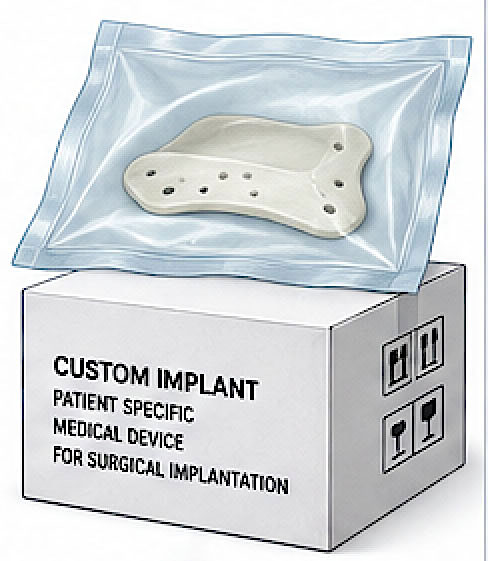
Countries where this is commonly done include:
- UAE
- Saudi Arabia
- UK
- EU countries
- Australia
- Canada
- South Korea
- Latin American countries
The more difficult destinations are usually countries with:
- restrictive medical device registration systems
- unpredictable customs clearance
- bans on non-registered implant manufacturers
Can A Custom Facial Implant Design Made For One Patient Be Used In Another Patient
Yes, sometimes—but usually not ideally, and often not without modification.
For custom facial implants (PEEK, porous polyethylene, titanium, silicone, etc.), whether an implant designed for one patient can be used in another depends on several factors:
If the implant has already been manufactured
A patient-specific implant is designed from that individual’s CT scan and anatomy. Another patient would need to have:
- Very similar skeletal dimensions
- Similar asymmetries
- Similar aesthetic goals
- Matching implant footprint and fixation locations
In reality, exact matches are uncommon. Even small differences in facial skeleton shape can lead to:
- Poor fit
- Edge visibility or palpability
- Malposition
- Difficulty with fixation
- Suboptimal aesthetic outcome
Situations where reuse may be possible
An existing design can sometimes serve as a starting template for another patient if:
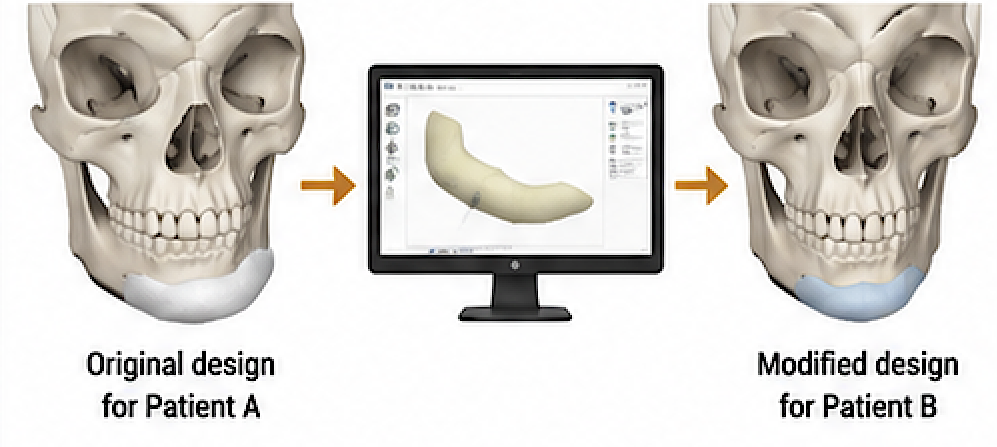
- The second patient has a similar anatomy.
- The implant is digitally modified before manufacturing.
- The implant was originally designed as a more “generic” augmentation shape rather than a highly patient-specific reconstruction.
This is commonly done by implant designers who maintain libraries of prior designs and adapt them to new patients.
Reconstruction vs. Cosmetic Augmentation
Reconstructive implants
- Cranial defects
- Orbital reconstruction
- Mandibular defects
These are highly patient-specific and generally not transferable.
Cosmetic implants
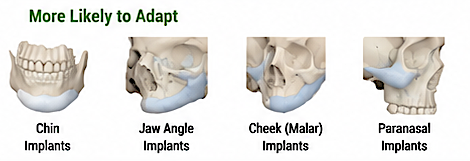
- Chin
- Jaw angle
- Cheek/malar
- Paranasal
These have a higher likelihood of being adapted from a previous design because the goal is augmentation rather than defect replacement.
Regulatory considerations
For FDA-regulated patient-specific implants, the implant is typically manufactured and labeled for a particular patient. Even if anatomically compatible, using the exact manufactured implant in another patient may create regulatory, documentation, and liability issues.
Practical approach
In facial implant design practices, a prior patient’s custom implant is often used as a digital template, then adjusted to the new patient’s CT anatomy before manufacturing a new implant. This is much more common than taking the exact finished implant and placing it in another person.
For cosmetic facial implants, I’d estimate that many custom jaw, chin, and cheek implant designs can be adapted to another patient with modifications, but very few finished patient-specific implants are truly interchangeable without redesign.
Role Of Ai In Custom Facial Implant Designing
AI is starting to play a meaningful—though still evolving—role in custom facial implant design, especially in aesthetic facial surgery. Its benefits can be seen inj modeling, predictive aesthetic outcomes and implant designs.
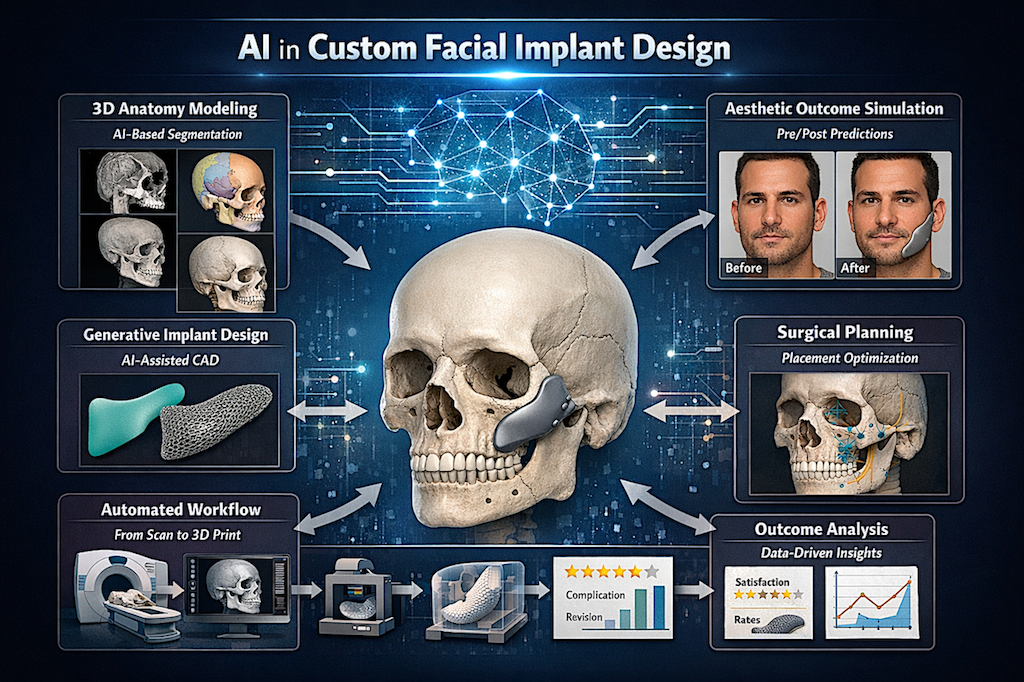
1. Patient-Specific Anatomy Modeling
AI enhances how we interpret imaging (CT/CBCT):
- Automated segmentation of bone, soft tissue, and nerves
- Faster conversion of DICOM → 3D models
- Reduced manual labor compared to traditional thresholding
👉 Result: highly accurate patient-specific 3D skull models in minutes instead of hours.
2. Predictive Aesthetic Simulation
AI can estimate how changes to skeletal structure affect soft tissue:
- Predicts post-op facial contours
- Simulates outcomes of:
- Chin implants
- Jawline augmentation
- Orbital/cheek implants
- Uses trained datasets of pre/post outcomes
👉 This is especially valuable for consultation and expectation management, though still imperfect in fine detail.
3. Generative Design of Implants
This is where AI is becoming transformative:
- AI-assisted CAD can:
- Suggest implant shapes based on anatomy + goals
- Mirror contralateral normal anatomy (for asymmetry cases)
- Optimize:
- Thickness distribution
- Edge blending
- Fit to bone surface
- Generative algorithms can create:
- Porous structures for tissue integration
- Stress-distribution optimized designs
👉 Reduces design time and improves anatomical conformity.
4. Surgical Planning Optimization
AI tools can assist with:
- Determining ideal implant position and size
- Planning screw placement or fixation points
- Identifying risk zones (nerves, tooth roots, sinuses)
👉 Helps standardize planning, especially in complex recon cases.
5. Outcome Analysis & Continuous Learning
AI can learn from past cases:
- Compare planned vs actual outcomes
- Identify patterns in:
- Patient satisfaction
- Complication rates
- Revision needs
👉 Over time, this builds evidence-based design refinement.
6. Workflow Automation
AI is streamlining the full pipeline:
- Scan → segmentation
- 3D reconstruction
- Implant design suggestions
- Simulation
- Export to 3D printing
👉 What used to take days can be reduced to hours.
Current Limitations (Important Clinically)
AI is helpful—but not replacing surgeon judgment:
- Soft tissue prediction still lacks precision (especially in thicker tissues)
- Aesthetic “beauty” decisions remain subjective
- Regulatory and liability concerns
- Requires high-quality imaging and datasets
- Many tools are still semi-automated, not fully autonomous
Where This Is Heading
In the near future, expect:
- Real-time design during consultation
- Fully automated custom implant generation from a single scan
- Integration with AR/VR for intraoperative guidance
- AI-trained aesthetic “standards” tailored to demographics
Bottom Line
AI is not designing implants independently—but it’s becoming a powerful co-pilot that:
- Speeds up workflows
- Improves anatomical precision
- Enhances predictability
The surgeon still drives the aesthetic vision and final decisions.
Can I Just Let Ai Make My Custom Facial Implant Design(s)
Yes—but only to a point. For custom facial implants, today’s AI can be a very useful design assistant, but it cannot reliably replace the expertise of an experienced implant designer and surgeon.
Here’s how AI performs at different stages:
|
Task |
AI Capability |
Reliability |
|
Segment CT scan into a 3D skull |
Excellent |
★★★★★ |
|
Identify facial asymmetries |
Very good |
★★★★☆ |
|
Generate an initial implant shape |
Good |
★★★☆☆ |
|
Mirror the opposite side |
Excellent |
★★★★★ |
|
Create smooth transitions |
Excellent |
★★★★★ |
|
Predict soft tissue changes |
Fair |
★★☆☆☆ |
|
Determine ideal aesthetics |
Limited |
★★☆☆☆ |
|
Design for surgical insertion |
Poor |
★☆☆☆☆ |
|
Avoid nerves, muscle, and soft tissue problems |
Limited |
★★☆☆☆ |
|
Final implant optimization |
Requires surgeon |
Essential |
Where AI Works Well
AI excels at processing data. Given a high-quality CT scan, it can:
- Create an accurate 3D skull model.
- Measure deficiencies in millimeters.
- Compare the face to normative proportions.
- Mirror normal anatomy for asymmetric cases.
- Produce a smooth preliminary implant that fits the bone.
For straightforward augmentations—such as a simple chin, forehead, or occipital implant—AI can often generate a reasonable first draft.
Where AI Falls Short
The most important decisions in custom facial implant design are aesthetic and surgical rather than geometric. AI does not inherently understand questions such as:
- How much jaw angle widening is enough without appearing unnatural?
- Should the implant increase width, projection, or both?
- How thick can a forehead implant be before creating an unnatural contour?
- Will the implant distort the lower lip or smile?
- Will the implant be insertable through the planned incision?
- Where should edges be feathered to avoid visibility or palpability?
These are decisions based on surgical experience and an understanding of facial aesthetics that AI has not yet mastered.
The Best Current Workflow
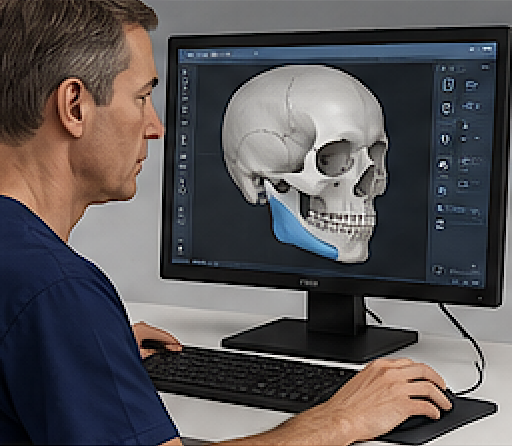
The most effective approach today is a collaboration between AI and an experienced surgeon:
- Obtain a high-resolution CT scan.
- Use AI to create an initial implant design.
- Have the surgeon refine the implant based on the patient’s goals and anatomy.
- Review the design interactively with the patient.
- Manufacture the finalized implant.
This combines AI’s speed and precision with the surgeon’s aesthetic judgment and surgical planning.
Looking Ahead
Within the next 5–10 years, AI will likely become capable of generating highly sophisticated implant designs from CT scans and patient photographs. Even then, surgeon oversight will remain important because aesthetic goals are subjective and surgery must account for anatomical constraints, implant placement, and long-term outcomes.

The bottom line: AI can already produce an excellent starting design, but it should not be trusted to produce the final implant design without review by an experienced custom facial implant surgeon. The best results currently come from AI-assisted, surgeon-directed design rather than AI alone.
Can Ai Face Images Be Replicated by Custom Facial Implant Designs
Yes—up to a point.
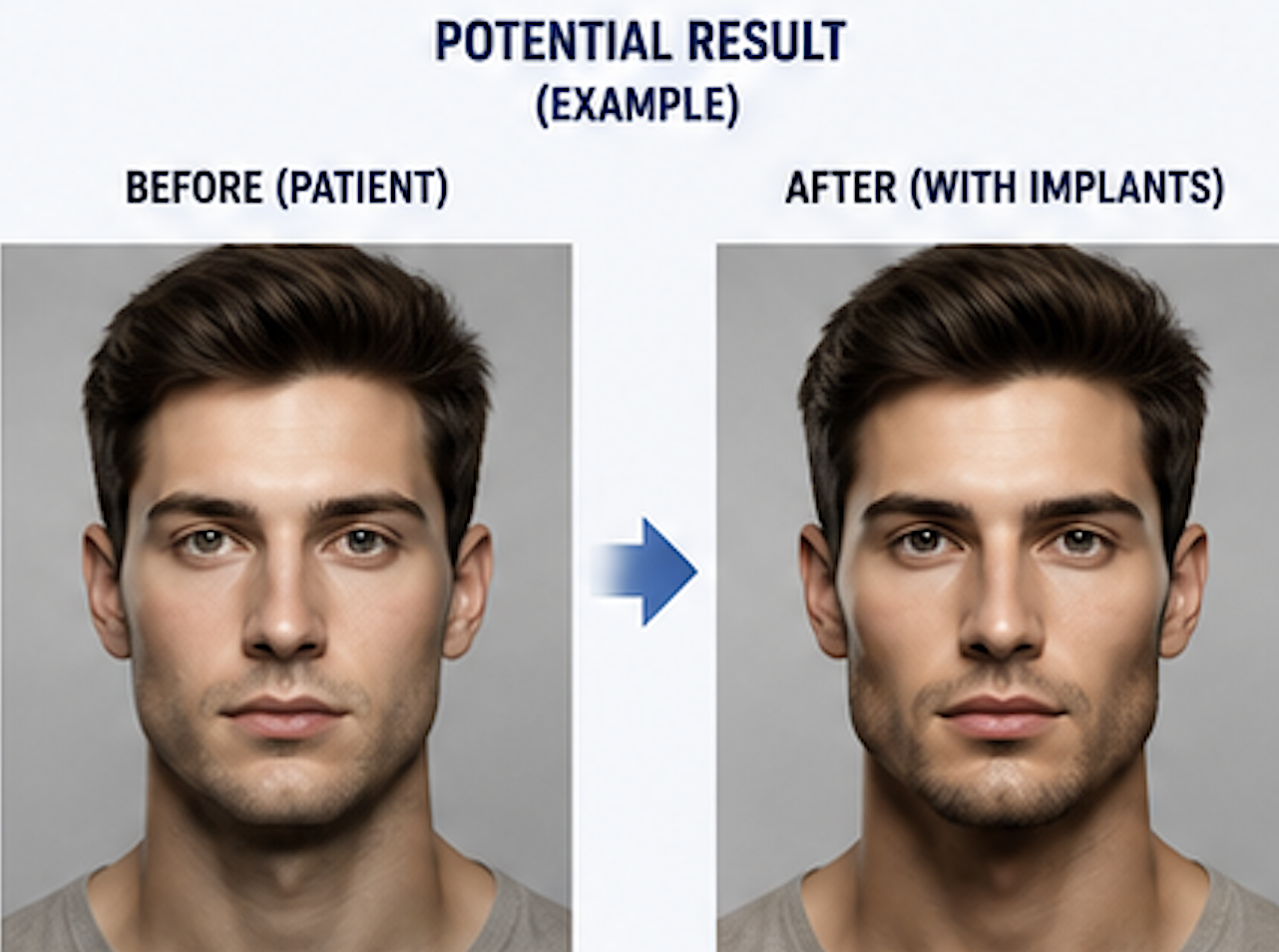
If by “AI face images” you mean AI-generated facial renderings (for example, a desired jawline, cheekbone shape, chin projection, or midface contour), custom facial implants can sometimes be designed to reproduce many of those skeletal contour changes. In fact, AI-generated images can serve as a visual design target during implant planning.
However, there are important limitations:
What implants can realistically replicate
Custom implants are best at changing features determined by the underlying facial skeleton:
- Chin projection, width, and shape
- Jawline definition and mandibular angles
- Cheekbone prominence and contour
- Paranasal (around the nose) augmentation
- Orbital rim augmentation
- Midface projection
For these areas, a custom implant designer can use CT-based 3D modeling and attempt to create the bony framework that approximates the AI image.
What implants cannot fully replicate
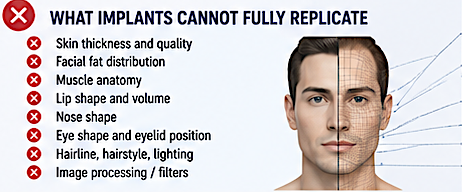
Many AI-generated faces achieve their appearance through factors beyond bone structure:
- Skin thickness and quality
- Facial fat distribution
- Muscle anatomy
- Lip shape and volume
- Nose shape
- Eye shape and eyelid position
- Hairline and hairstyle
- Lighting and image processing
An AI face may appear achievable, but much of its attractiveness may come from soft-tissue characteristics rather than skeletal architecture.
How this is commonly approached
A practical workflow would be:
- Generate or select the AI face.
- Obtain a CT scan of the patient’s facial skeleton.
- Perform 3D morphing to compare the patient’s anatomy with the AI target.
- Design custom implants to move the skeletal contours toward the target.
- Use soft-tissue prediction software to estimate the resulting appearance.
Accuracy of replication
For a face where the desired changes are primarily jaw/chin/cheek related, achieving perhaps 70–90% of the skeletal contour differences may be possible. Achieving an exact match to the AI image is generally not possible because soft-tissue response is not perfectly predictable and AI images often depict anatomically idealized features.
As a facial implant surgeon, you may find AI renderings particularly useful as a communication tool: they can define aesthetic goals that can then be translated into specific implant dimensions and contours, rather than being viewed as a literal surgical outcome.
How Long Does It Take To Get A Custom Face Implant Ready For Surgery
For a custom facial implant (chin, jaw angle, cheek, orbital, forehead etc.), the timeline is usually:
- Design phase: 1-3 weeks
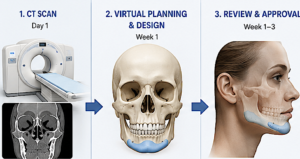
- This includes getting a high-resolution CT scan, virtual surgical planning, and reviewing the implant design with the surgeon and manufacturer.
- Manufacturing phase: 2–6 weeks
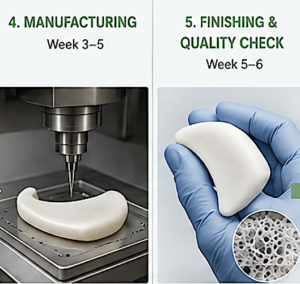
Depends on the company, material (solid silicone, porous polyethylene/PEEK, titanium), complexity, and whether revisions are needed.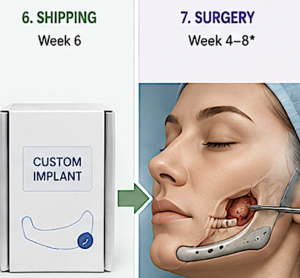
- Total typical timeline: about 6–8 weeks from receiving the CT scan to surgery.
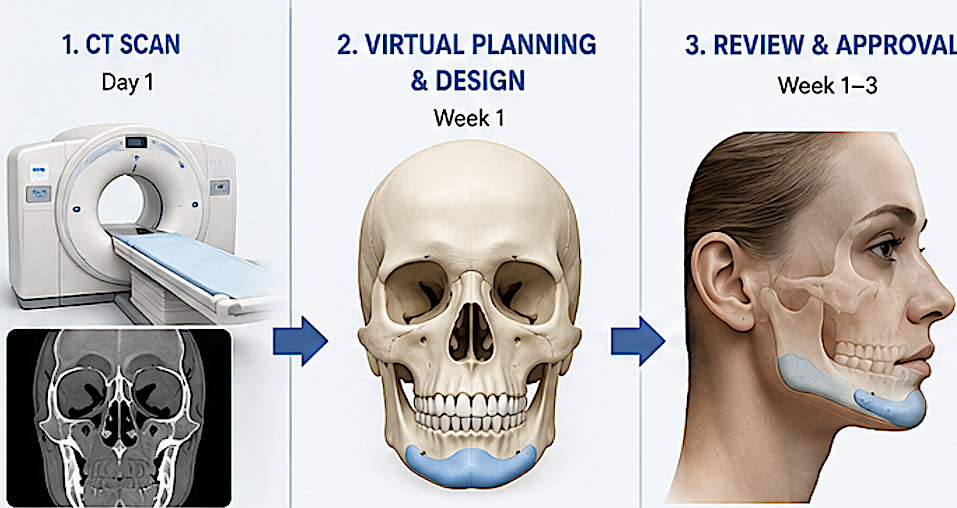
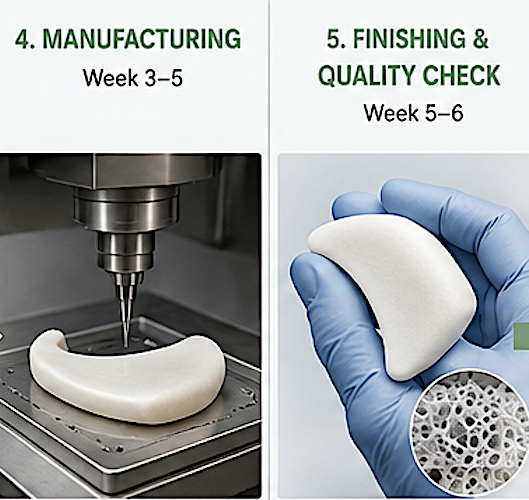
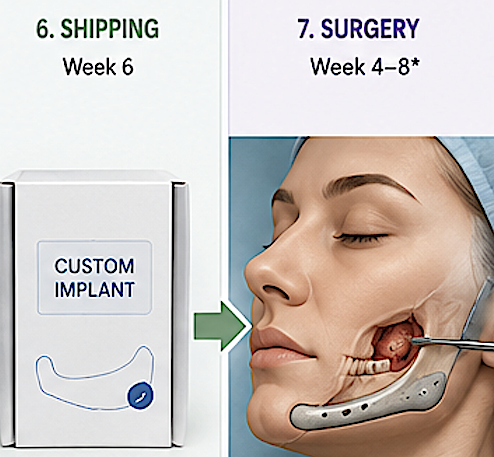
In some cases:
- Complex multi-piece implants may take 8–12 weeks.
- International shipping or FDA/custom regulatory steps can add time.
For most U.S. facial implant companies used in aesthetic surgery, once the design is approved, production itself is often 3 to 4 weeks; the biggest variable is the time it takes to get through the design process. Some patients takes much longer than others.
Should I Dissolve My Injectable Fillers Before Getting Custom Facial Implants
In some but not all cases, yes—dissolving hyaluronic acid fillers before planning custom facial implants may be advisable, but it depends on the type, amount, and location of the filler.
Some reasons to consider dissolving fillers before implant design:
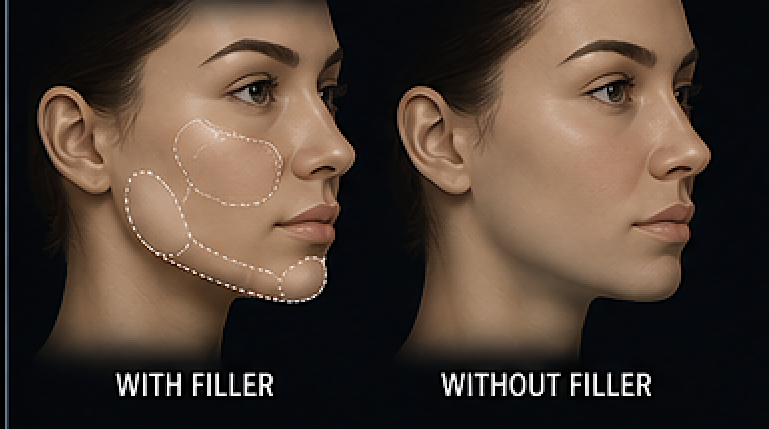
- Accurate facial analysis
- Custom implants are designed to correct your underlying skeletal structure.
- Fillers can artificially increase projection in areas like the chin, jawline, cheeks, or under-eyes, making it difficult to determine your true anatomy.
- If implants are designed while filler is present, the implant may end up under- or over-correcting once the filler eventually disappears.
- CT scan accuracy
-
- Custom implants are usually designed from a CT scan.
- While fillers don’t alter the bone itself, they can affect the soft-tissue appearance used in aesthetic planning and surgical simulation.
- Better prediction of implant outcome
-
- Seeing what your face looks like without temporary augmentation before making a permanent skeletal change can be helpful.
That said, there are exceptions:
- If the filler is in an area unrelated to the implant (for example, cheek filler when planning jaw implants), dissolving is not necessary.
- If the filler is very old and largely metabolized, it may have minimal impact.
- Some non-hyaluronic fillers (Radiesse, Sculptra, Bellafil, silicone) cannot simply be dissolved.
But if dissolving hyaluronic (HA) fillers is to be done the approach is:
- Dissolve HA filler.
- Wait several weeks (often 2–6 weeks, sometimes longer depending on the area and amount).
- Reassess facial structure.
- Obtain CT imaging and proceed with implant design.
If you’re specifically considering custom jawline, chin, cheek, infraorbital, paranasal, or midface implants, knowing:
- what filler you have,
- where it is located,
- how much was injected, and
- what implants you’re considering,
would allow a more accurate recommendation.
How Is Custom Facial Implant Surgery Performed
Custom facial implant surgery is a highly planned, precision-driven procedure that combines digital design with traditional surgical techniques. Here’s exactly how it’s performed, step by step:
Surgery Day
Anesthesia
- Performed under general anesthesia
Surgical Placement
Incisions
Depends on implant location:
- Inside the mouth (intraoral) → most common
- No visible scars
- Under the chin → for some chin/jaw implants
- Lower eyelid (transconjunctival) → for infraorbital/midface
- Hairline or scalp → for forehead/temple
Pocket creation
- The surgeon carefully creates a precise pocket on the bone
- This is done in the subperiosteal plane (directly on bone surface)
👉 This is crucial because:
- It stabilizes the implant
- Prevents movement
- Ensures accurate positioning
Implant insertion
- The custom implant is:
- Inserted into the pocket
- Positioned to match the preoperative plan exactly
Because it’s custom:
- While it is commonly perceived that the implant“locks” into place with minimal adjustment that is simply not true. It is one smooth surface (implant) against another smooth surface (bone).
Fixation always used))
- Small titanium screws are used to secure the implant. They are usually self-tapping although thicker implants may need drilled screws.
Closure
- Incisions are closed with resorbable sutures:
- Dissolvable (inside mouth)
- Fine external sutures (if external incision used)
Immediate Postoperative Phase
- Swelling begins right after surgery
- Compression or dressings may be applied
- Most patients go home the same day or after short observation
Key Technical Advantages During Surgery
Custom implants make the operation more precise:
- Pre-shaped fit → less intraoperative guesswork
- Better symmetry → based on digital planning
- Reduced need for trimming or modification
- More predictable outcomes
Screw Fixation In Custom Facial Implants
Screw fixation in custom facial implants is a core part of achieving stability, precise positioning, and long-term integration—especially with patient-specific implants (PSIs) made from materials like silicone orPEEK. Here’s a structured breakdown from a surgical and design perspective:
Purpose of Screw Fixation
- Primary stability: Prevents micromotion during healing
- Accurate positioning: Ensures the implant sits exactly as planned (critical for symmetry)
- Load sharing: Especially relevant in mandibular or zygomatic augmentation
- Prevention of migration: Particularly important in smooth alloplastic implants
Implant Design Considerations
1. Preplanned Screw Holes
- Integrated into CAD design of the implant
- Positioned in thick cortical bone regions (e.g., zygomatic body, mandibular border)
- Avoidance of:
- Tooth roots
- Inferior alveolar nerve
- Infraorbital nerve
2. Number of Screws
- Typically 2–4 screws per implant segment
- Larger implants (jawline, wraparound mandibular) may require more
- Redundancy helps prevent rotation
3. Hole Geometry
- Countersunk holes → allow screw heads to sit flush
- Angulated holes → can direct screws into optimal bone stock
- Some designs include locking screw interfaces (less common in facial implants vs plates)
Screw Selection
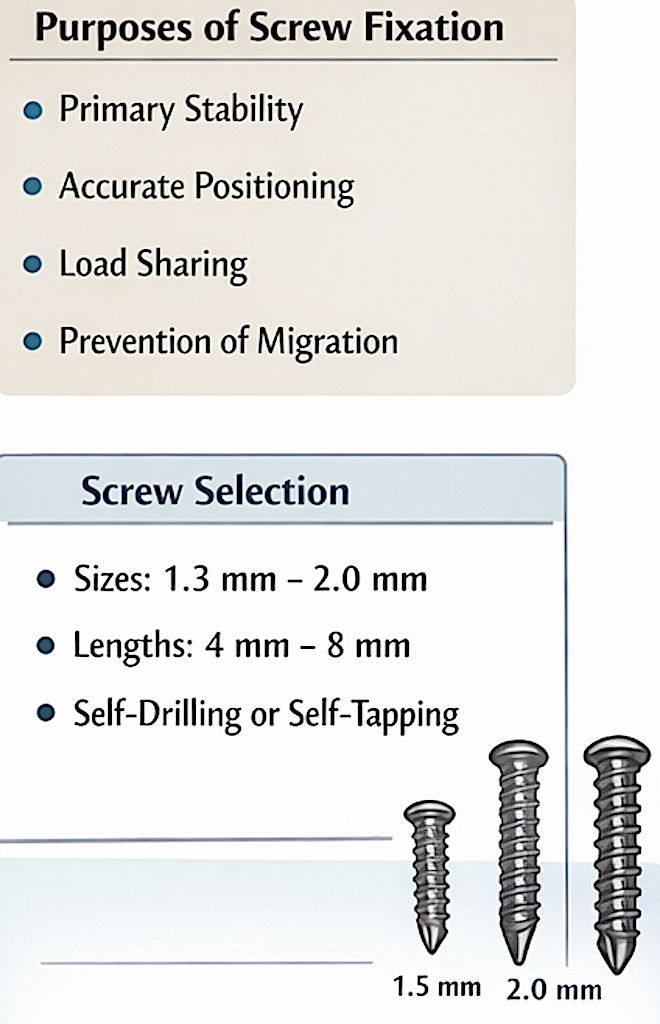
Common Specs:
- Diameter: 1.3 mm, 1.5 mm, 2.0 mm (most common range)
- Length: 4–8 mm typically (depends on bone thickness)
- Type:
- Self-drilling vs self-tapping
- Titanium is standard
Region-Specific Preferences:
- Midface (zygoma, infraorbital rim): 1.3–1.5 mm screws
- Mandible: 1.5–2.0 mm screws for stronger fixation
Biomechanical Considerations
- Shear vs pull-out forces:
- Facial implants experience mostly shear forces, so multiple screws spaced apart improve resistance
- Bone quality matters:
- Dense cortical bone → better fixation
- Thin maxillary bone → may require more screws or strategic placement
- Avoid over-tightening:
- Can strip bone or deform PEEK implants
Surgical Technique
- Precise pocket dissection
- Subperiosteal plane is standard
- Passive fit of implant
- Custom implants should “snap” into place with minimal adjustment
- Sequential fixation
- First screw stabilizes → remaining screws secure
- Drill guides (optional)
- Some systems use guides for exact screw trajectory
⚠️ Complications Related to Fixation
- Screw loosening (rare with proper technique)
- Palpability or visibility (especially in thin soft tissue areas)
- Nerve injury if poorly planned
- Infection → may require screw removal
- Malposition if first screw placed inaccurately
Special Considerations for Custom Implants
- PSIs reduce intraoperative guesswork → fixation points are pre-optimized
- Can incorporate:
- Extended flanges for better screw purchase
- Buttress engagement (zygomaticomaxillary, mandibular angle)
- Often fewer screws needed compared to stock implants due to precision fit
Practical Pearls (from real-world use)
- First screw placement determines everything—treat it like a hinge point
- Always verify full seating before fixation (no soft tissue interposition)
- In mandibular angle/jawline implants, posterior screw placement is key for rotational control
- For PEEK implants, avoid excessive torque—material is strong but not ductile like titanium
Do Custom Facial Implants Snap Into Place
No, custom facial implants don’t literally “snap” into place—but well-designed ones can fit very precisely.
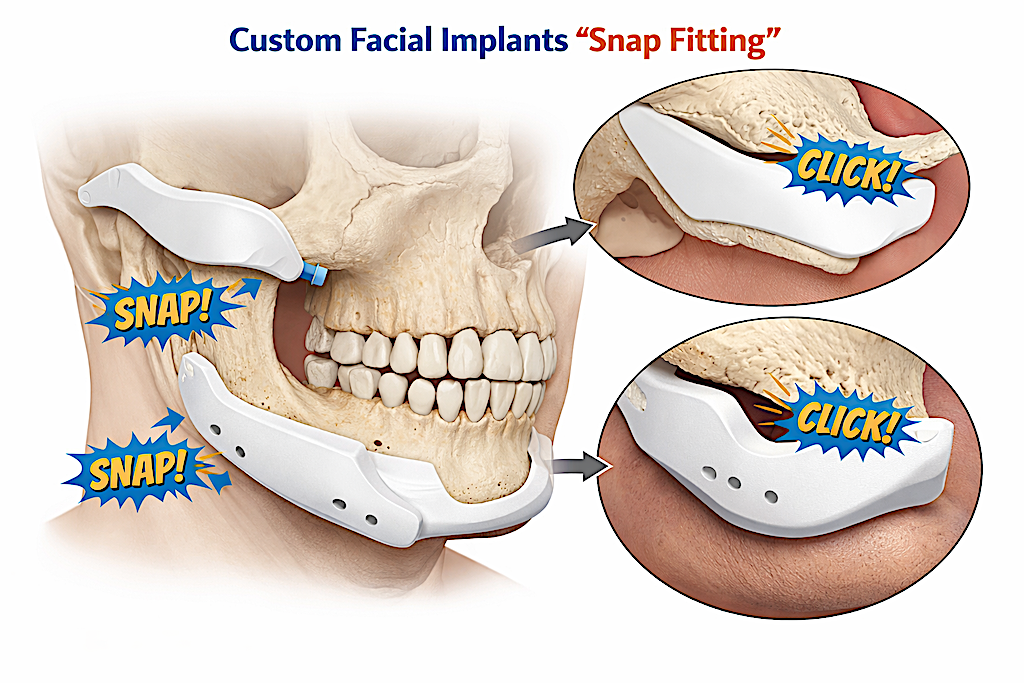
Here’s how it actually works:
- Custom implants are designed from your CT scan, so they match your bone anatomy closely (almost like a puzzle piece).
- During surgery, the surgeon places the implant onto the bone surface and manually positions it into the intended location.
- Because of the precise fit, there can be a subtle “self-seating” feel—it may settle into the correct position naturally—but it’s not a snap-lock mechanism.
- The implant is then secured with small screws (usually titanium) to keep it stable long-term.
Why they don’t “snap”:
- Your anatomy has soft tissue, slight variations, and surgical access limitations.
- A true snap-fit would risk improper seating or pressure on surrounding structures.
- Controlled placement + fixation is safer and more predictable.
In practice, a good custom implant:
- Fits very snugly
- Requires minimal adjustment
- Ends up highly stable once fixated
What Makes Custom Facial Implant Placement More Difficult Than Standard Implants
Custom facial implant placement is more difficult than using stock implants because every stage becomes patient-specific rather than standardized. The challenges are both technical and biologic.
The main factors are:
1. Precise Fit to Irregular Bone Anatomy
A custom implant is designed to match the patient’s exact skeletal contours from CT imaging.
That sounds easier in theory, but in surgery:
- soft tissue swelling changes visibility
- exposure may be limited
- tiny positioning errors become obvious
- the implant may only fit correctly in one exact orientation
Even 1–2 mm of rotational error can create:
- asymmetry
- edge visibility
- contour irregularities
- bite/jaw imbalance (mandible implants)
Unlike stock implants, custom implants often have no “forgiving” positioning range.
2. Larger Implant Size
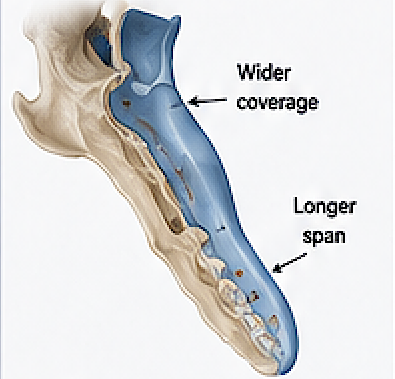
Custom implants are frequently:
- wider
- longer
- more anatomically wrapping
Examples:
- jawline implants extending from chin to mandibular angle
- infraorbital-malar implants
- temporal implants
- forehead implants
Large implants require:
- wider dissection
- larger insertion paths
- more soft tissue release
This increases:
- swelling
- nerve risk
- operative time
- infection risk
3. Limited Surgical Access
Facial surgery uses small incisions whenever possible.
For example:
- intraoral incisions
- lower eyelid incisions
- scalp incisions
Trying to place a large rigid custom implant through a limited opening is mechanically difficult.
Challenges include:
- maneuvering around nerves
- avoiding implant contamination
- avoiding soft tissue tearing
- seating the implant fully against bone
Sometimes the implant must be inserted at a very precise angle to “lock” into place.
4. Soft Tissue Resistance
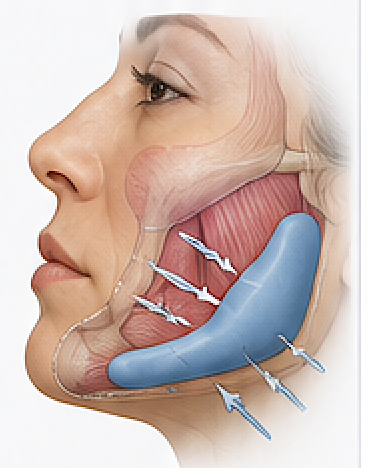
The overlying facial soft tissues may resist expansion.
This is especially true in:
- jaw angle augmentation
- cheek augmentation
- forehead widening
- orbital rim augmentation
The soft tissue envelope can:
- push implants out of position
- create asymmetry
- place tension on closure
Large custom implants may require extensive tissue release to avoid displacement.
5. Need for Exact Symmetry
The human face is extremely sensitive to asymmetry.
A small discrepancy in:
- cheek projection
- jaw angle width
- chin midline
- orbital contour
can be visible immediately.
Custom implants are usually designed specifically to correct asymmetry, which paradoxically makes placement harder because:
- the implant is not symmetrical itself
- left/right orientation matters precisely
- tiny positioning shifts alter the intended correction
6. Fixation Complexity
Most custom implants require screw fixation.
This means:
- identifying safe screw zones
- avoiding tooth roots
- avoiding nerves
- obtaining stable bone purchase
In areas like:
- infraorbital rim
- mandibular angle
- temple
- orbital walls
fixation can be technically demanding.
7. Revision Surgery and Scar Tissue
If the patient previously had:
- implants
- orthognathic surgery
- trauma
- fillers
- infection
placement becomes much harder because scar tissue:
- distorts anatomy
- limits dissection planes
- reduces tissue elasticity
- obscures nerves
Revision custom implant surgery is substantially more difficult than primary placement.
8. Implant Material Behavior
Different materials behave differently intraoperatively.
Solid Silicone
- flexible
- easier to insert
- easier to revise
- can shift if not fixed well
Porous Polyethylene (Medpor)
- rigid
- difficult insertion
- tissue ingrowth
- harder revision/removal
PEEK
- very rigid
- highly precise fit
- difficult to insert through small incisions
- requires excellent design accuracy
Titanium custom implants are even less forgiving because they cannot flex.
9. Intraoperative Design Reality
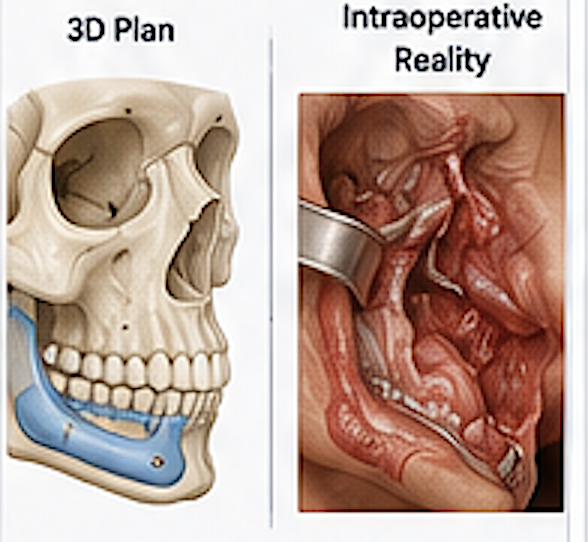
A custom implant that looks perfect on a computer model may encounter real-world issues:
- soft tissue thickness differences
- imperfect CT positioning
- asymmetrical muscle pull
- intraoperative swelling
- manufacturing tolerances
Sometimes minor modifications are needed during surgery despite “custom” design.
10. Aesthetic Judgment
The hardest part is often not technical placement — it is predicting how skeletal augmentation will translate externally through soft tissue.
For example:
- 5 mm skeletal augmentation may look dramatic in a thin face
- barely visible in a thick soft tissue face
This requires experience in:
- facial proportions
- soft tissue behavior
- aesthetic balance
- gender-specific contours
That is why excellent implant surgeons often spend more time planning than operating.
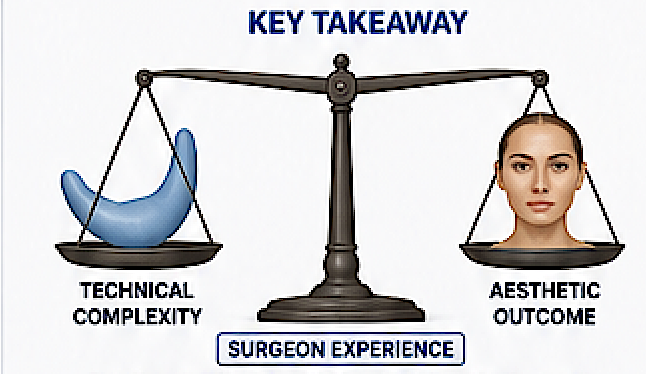
In many cases, the success of custom facial implants depends less on manufacturing precision and more on:
- surgical exposure
- accurate seating
- fixation
- soft tissue management
- aesthetic judgment of the surgeon.
Is Implant Design or Surgeon Experience with Placement More Important in Custom Facial Implants
For custom facial implants, implant design is usually the limiting factor in the final aesthetic result — but surgeon experience becomes more important when things get complex.
The reality is that the two are deeply intertwined. The best outcomes happen when the surgeon is effectively also directing the design process.
A rough way to think about it:
- Design determines ~70–80% of the aesthetic outcome
- Surgical execution determines ~20–30%
- But if the surgery is done poorly, it can ruin a perfect design.
Here’s why design is so dominant in custom implants specifically:
1. The implant is the result
Unlike rhinoplasty or soft tissue surgery, facial implants are structural.
The:
- width
- projection
- flare
- transition zones
- symmetry
- edge blending
- angularity
- vector of augmentation
…are all literally built into the implant.
A surgeon cannot “freestyle” a custom jaw implant into looking better once it’s inserted. If the CAD design is wrong:
- the gonial angle may sit too low,
- the chin may project incorrectly,
- the wraparound may over-widen the posterior jaw,
- or the infraorbital transition may look uncanny.
Once manufactured, the implant largely dictates the outcome.
That’s why elite custom implant surgeons obsess over:
- CT analysis,
- skeletal proportions,
- soft tissue response,
- and iterative CAD modifications.
2. Average designers create average outcomes
A lot of surgeons outsource design heavily to engineers.
That’s a problem because engineers understand:
- fit,
- anatomy,
- manufacturing,
…but often not facial aesthetics.
The best surgeons personally direct:
- the vectors,
- contours,
- degree of augmentation,
- and aesthetic philosophy.
This is why two surgeons using the same implant company can get dramatically different results.
3. Placement experience still matters enormously
Where surgical experience becomes critical:
Avoiding malposition
Even a perfect implant can fail if:
- it rotates,
- sits asymmetrically,
- rides too high/low,
- or doesn’t fully seat on bone.
Managing soft tissue
Experienced surgeons understand:
- how thick tissue affects visibility,
- where edges may show,
- how the masseter changes jaw implant appearance,
- swelling patterns,
- and long-term tissue adaptation.
Fixation strategy
Large custom implants often require:
- multi-point screw fixation,
- precise pocket dissection,
- and tension control.
Poor fixation can ruin symmetry.
Revisions
Revision custom implant surgery is where surgeon skill becomes absolutely dominant:
- scar tissue,
- stretched soft tissue,
- bone erosion,
- nerve issues,
- infection risk,
- previous implant distortion.
This is a completely different level technically.
The key insight
The very best custom facial implant surgeons are not just “good operators.”
They are:
- aesthetic diagnosticians,
- skeletal designers,
- and surgical technicians simultaneously.
That combination is rare.
A mediocre surgeon with a brilliant design team usually produces inconsistent results.
A brilliant surgeon with mediocre design philosophy also produces mediocre results.
The highest-level outcomes almost always come from surgeons who:
- Personally control the design process,
- Have enormous pattern recognition from prior cases,
- And perform high volumes of the surgeries themselves.
That accumulated aesthetic judgment is probably the single hardest thing to replicate.
Can Custom Facial Implants Be Modified In Surgery If Needed (Customizing The Custom Implant)
Short answer: yes—but only to a limited extent, and it depends on the material and the situation.
Custom facial implants are designed preoperatively (usually from a CT scan) to match your anatomy very precisely, so ideally no intraoperative modification is needed. But surgeons still build in some flexibility:
What can be adjusted during surgery
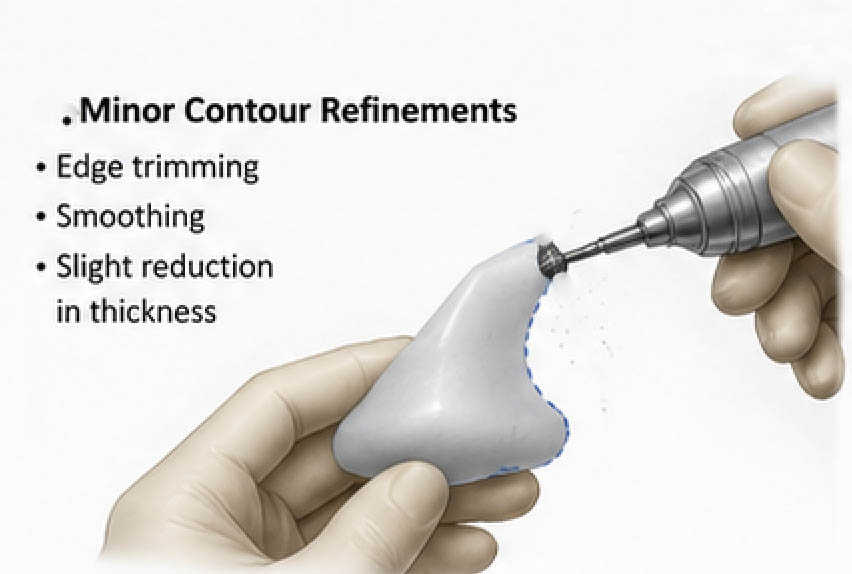
- Minor contour refinements
- Small edge trimming or smoothing
- Slight reduction in thickness in select areas
- Positioning adjustments
- Implants can be shifted slightly for optimal symmetry and fit
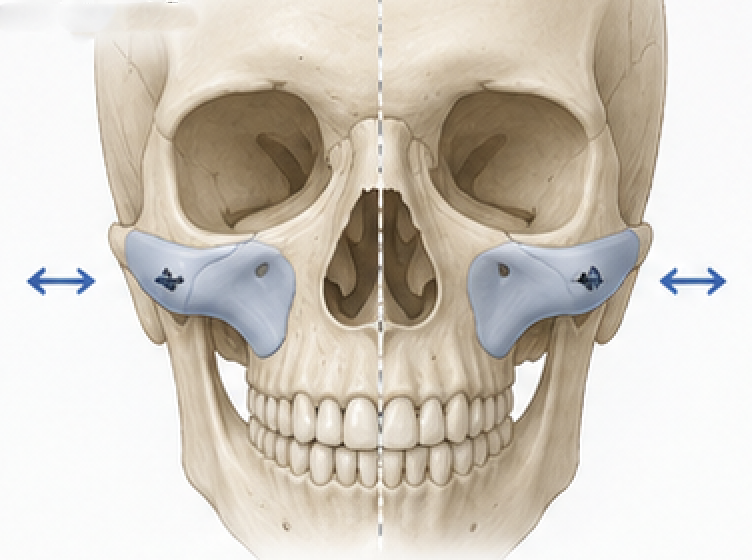
- Fixation changes
- Screw placement or minor stabilization tweaks
What usually cannot be changed easily
- Major shape or volume changes
- You can’t significantly enlarge or reshape a custom implant on the spot
- Core structural design
- The overall 3D geometry is fixed once manufactured
Material matters
- Silicone (most common for facial implants)
- Easier to trim or shave significantly during surgery
- PEEK (polyetheretherketone)
- Very rigid; allows only minimal modification
- Porous polyethylene (Medpor)
- Can be modified a bit, but more limited and requires care
Practical reality
In some cases I may:
- Slightly overbuild certain areas in the design phase (if needed) knowing they can be reduced intraoperatively
- Use surgical judgment to fine-tune positioning rather than reshape the implant
Can One Custom Facial Implant Be Stacked On Top Of Another Custom Facial Implant
Yes. In selected cases, one custom facial implant can be designed and placed on top of another implant (“stacked” or layered implants), but it is not common and requires careful planning.
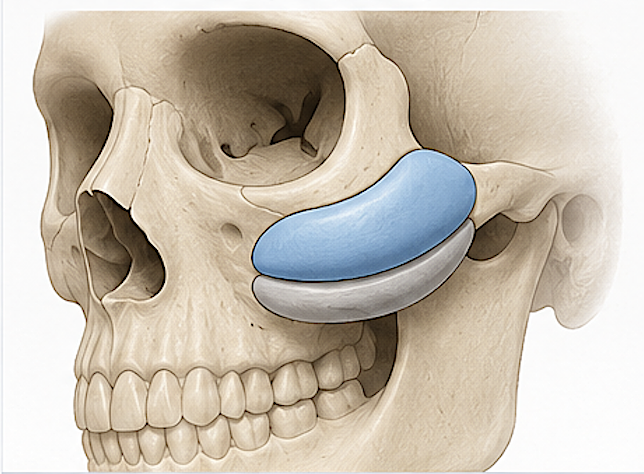
This is usually done in one of three ways:
- A secondary custom implant placed over a prior implant (overlay)
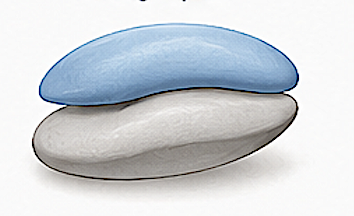
- Most commonly done when a patient already has an implant in place and wants additional projection, contour change, or asymmetry correction.
- The new implant is designed from a CT scan that includes the existing implant position.
- A modular implant system
- Two interlocking custom components are intentionally designed together.
- Used when a single-piece implant would be too large to insert or when different tissue planes are advantageous.
- A small adjunct implant over a larger base implant (extension)
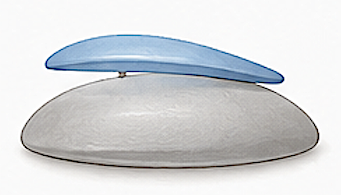
- Example: a paranasal implant added over a cheek implant, or a chin extension added over an existing chin implant.
Key technical considerations:
- Stability
The upper implant must be fixated securely so the two implants do not shift independently. - Tissue thickness and blood supply
Excessive stacking can create soft tissue tension, palpability, or visibility. - Infection risk
Two implant interfaces slightly increase complexity. Any movement between layers can predispose to chronic inflammation. - Material compatibility
Usually both implants are made from the same material (commonly silicone or porous polyethylene). Mixing materials is possible but less ideal. - Bone contact
Ideally at least one implant has broad contact with bone for stable fixation. - Design accuracy
The secondary implant must be designed from a high-quality CT scan with the original implant in place. Otherwise the fit can be inaccurate.
In facial implant revision surgery, stacked custom implants are often preferable to removing a well-positioned existing implant if:
- the current implant is stable,
- the patient wants incremental augmentation,
- and removal would create scar tissue or contour problems
However, if the original implant is malpositioned or oversized, replacing it with a newly designed single custom implant is usually the better approach rather than stacking another one on top.
Can Two Different Custom Facial Implant Materials Be Placed In The Same Patient
Yes. It is entirely possible to place two different facial implant materials in the same patient, and it is done in selected aesthetic cases.…although rarely in the same surgery. The key issue is not whether the materials are different, but whether the combination is biologically compatible, mechanically stable, and surgically appropriate for the specific anatomy and goals.
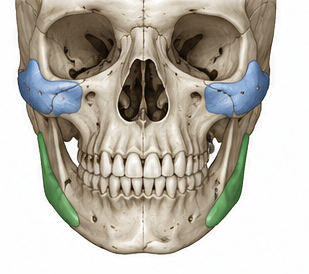
Possible examples:
- Silicone chin implant combined with PEEK jaw angle implants
- PEEK jawline implant combined with silicone infraorbital-malar implants
- Titanium fixation hardware used alongside virtually any implant material
- Custom porous polyethylene implants combined with hydroxyapatite or bone grafting
The body does not “reject” implants simply because they are made of different materials. What matters more is:
- Tissue response to each material
- Risk of infection
- Stability and fixation
- Blood supply to surrounding tissues
- Whether the materials are in direct contact
- Surgical planes and soft tissue coverage
That said, there are some practical considerations.
Potential Advantages of Mixing Materials
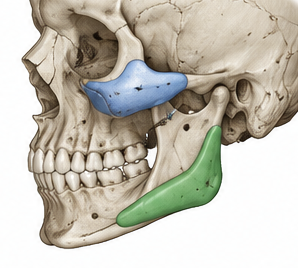
- Different materials excel in different locations
- One material may provide rigidity while another provides better contour refinement or implant edging
- Custom implants may solve one area while stock implants solve another
- Revision surgery may require adding a new material without removing a previous implant
- Different surgeons may have different material preferences resulting in a mixed material facial augmentation
For example:
- A patient may already have a silicone chin implant and later receive custom PEEK jaw angle implants.
- A cranial reconstruction may use PEEK while facial contouring uses silicone elastomer implants.
Potential Concerns
Infection Risk
If one implant becomes infected, nearby implants of any material can become secondarily involved.
Differential Tissue Integration
- Silicone forms a capsule and remains removable.
- Porous polyethylene allows tissue ingrowth.
- PEEK behaves differently from both.
This can make future revisions more complex.
Mechanical Interface
If two rigid implants directly abut one another, their edges and fixation must be carefully planned to avoid palpability, instability, or stress concentration.
Imaging and Planning
Different materials behave differently on CT imaging and during virtual surgical planning.
Materials Commonly Combined Safely
|
Material Combination |
Typical Use |
|
Silicone + Titanium |
Facial implants with fixation |
|
Silicone + Medpor |
Different facial regions |
|
PEEK + Titanium |
Craniofacial reconstruction |
|
Medpor + Bone graft |
Orbital/facial reconstruction |
|
PEEK + Silicone |
Custom skeletal + contour augmentation |
Situations Where Caution Is Greater
- Previously infected implant pockets
- Thin soft tissue coverage
- Irradiated tissue
- Multiple prior surgeries/scarring
- Autoimmune/inflammatory disorders
- Direct implant-on-implant contact in mobile areas
In aesthetic facial surgery, the most common mixed-material scenario today is probably a patient with older silicone implants later receiving newer custom PEEK or Medpor implants elsewhere in the face.
So the short answer is: yes, two different custom facial implant materials can absolutely coexist safely in the same patient when properly planned and surgically executed.
How Long Does Custom Facial Implant Surgery Take
Custom facial implant surgery isn’t one fixed length—it depends on what’s being done and how many areas are involved. But here’s a realistic breakdown:
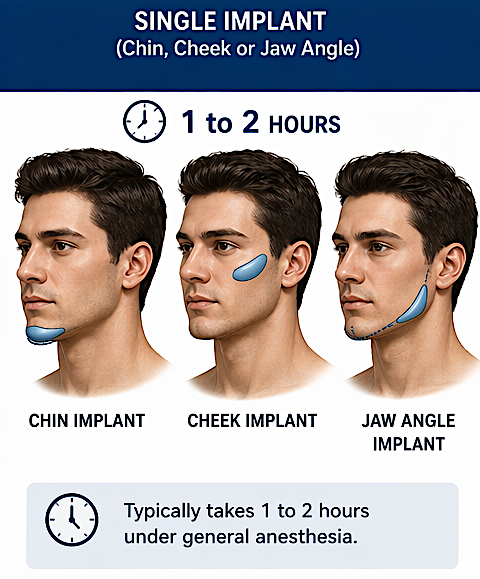
- Single implant (chin, cheek, jaw angle):
Usually 1 to 2 hours
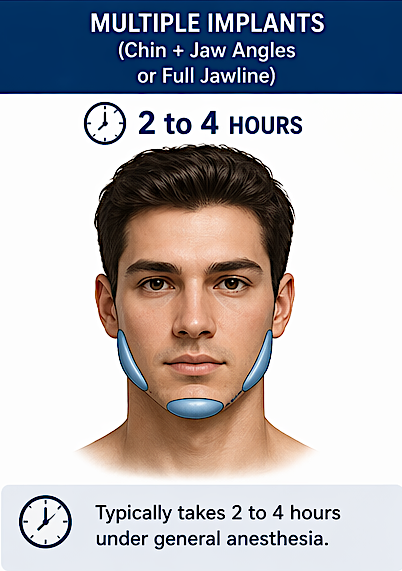
- Multiple implants (e.g., chin + jaw angles, or full jawline):
Typically 2 to 4 hours
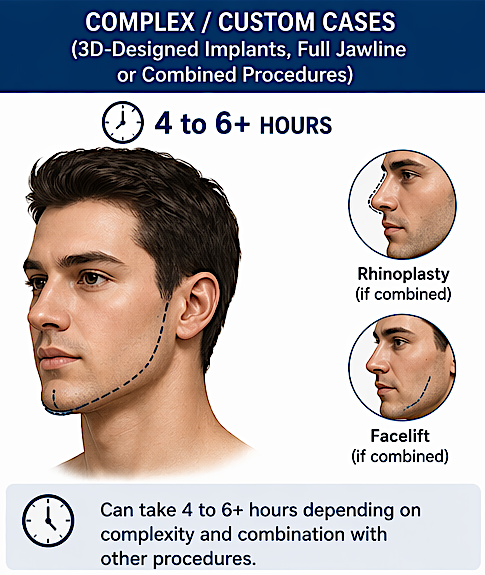
- Complex/custom cases (3D-designed implants, combined with other procedures like rhinoplasty or facelift):
Can take 4 to 6+ hours
A few other factors that affect time:
- Whether the implant is prefabricated vs. fully custom (3D-designed)
- Surgical approach (inside the mouth vs. external incisions)
- If it’s a revision surgery (these take longer)
- Surgeon experience and planning
Even if the surgery itself is a few hours, expect:
- Several hours total at the surgical center
- Usually same-day discharge (outpatient), unless combined with bigger procedures
Custom Facial Implant Recovery
Recovery from custom facial implants is usually straightforward, but may be more involved than standard off-the-shelf implants because the implants are bigger (cover more surface area) and more than one implant may be done at the same time.
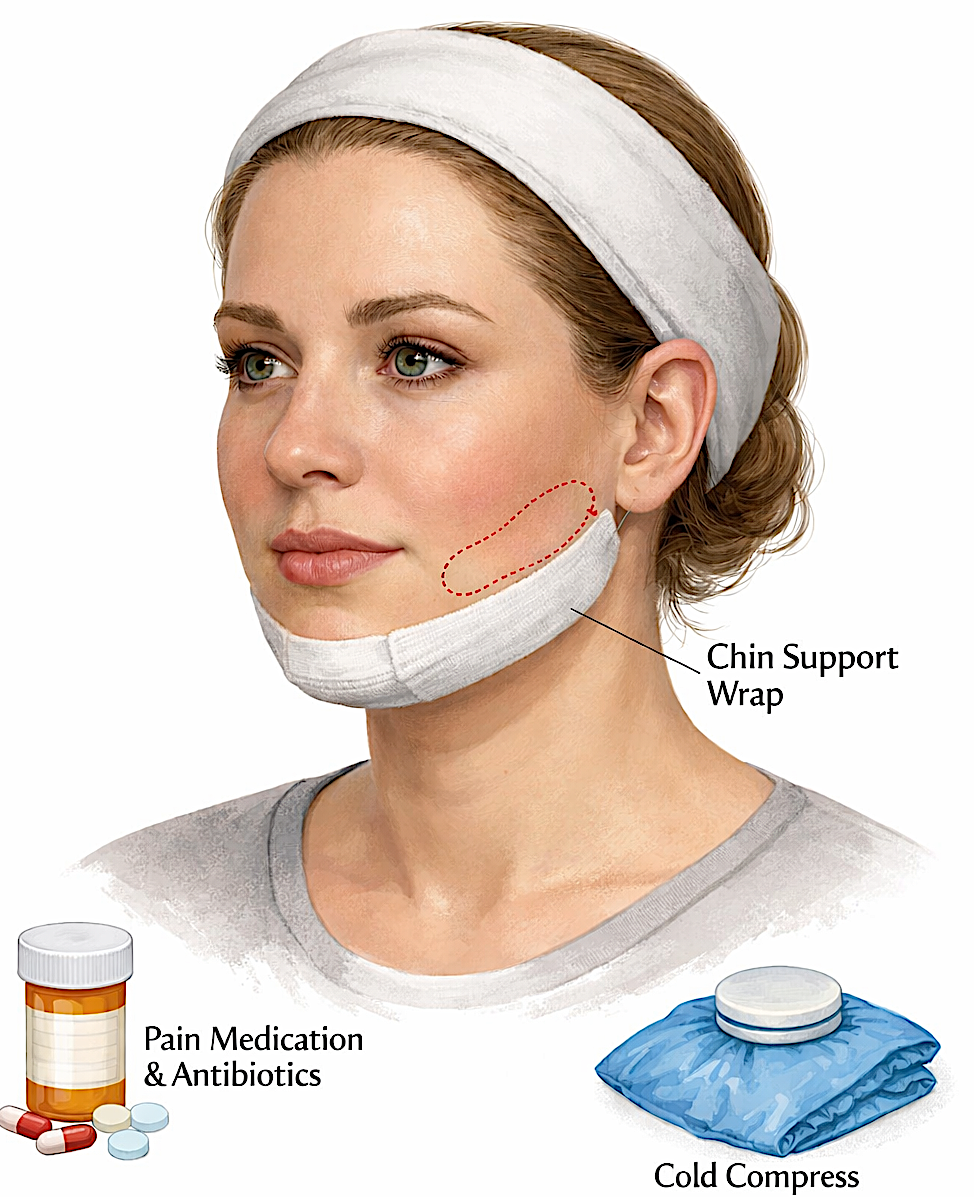
Here’s a clear breakdown of what to expect:
Immediate Recovery (Days 1–5)
- Swelling: Significant, peaks around day 2–3
- Bruising: Common, especially around eyes (for cheek/orbital implants)
- Discomfort: Moderate; usually well-controlled with medication
- Diet: Often soft foods if implants are near the jaw/chin
- Activity: Rest, head elevation, limited movement
If implants were placed intraorally (through the mouth):
- Expect more swelling
- Strict oral hygiene (antibacterial rinses)
- Slightly higher infection risk early on
Early Recovery (Week 1–2)
- Swelling starts to go down but still noticeable
- Sutures (if external) may be removed around 5–7 days
- Most people can return to non-physical work in 7–10 days
- Tightness or stiffness in the face is common
Intermediate Phase (Weeks 3–6)
- Majority of swelling resolves (about 70–80%)
- Facial definition begins to show
- Numbness or altered sensation may still be present
- Light exercise can resume (depending on surgeon guidance)
Final Healing (2-3+ Months)
- Residual swelling continues to fade
- Implants “settle” into final position
- Nerve sensation gradually returns (can take months)
- Final aesthetic result becomes clear
Common Temporary Side Effects
- Swelling (can last several weeks)
- Numbness (especially chin/jawline)
- Tight or “stiff” feeling
- Asymmetry early on (usually swelling-related)
What Makes Custom Implant Recovery Unique
- Often more precise fit → better long-term comfort
- May involve larger dissection → more initial swelling
- Usually fixed with screws → more stability, less shifting
- Designed from CT scans → results are more predictable
Recovery Tips
- Sleep with head elevated for at least 1–2 weeks
- Avoid pressure on the face (no side sleeping early on)
- Stick to soft foods if jaw/chin involved
- Follow oral hygiene instructions carefully if intraoral
- Be patient—swelling can mask results for week
How Accurate Are Custom Facial Implants In Achieving My Desired Result
Short answer: custom facial implants are among the most precise tools we have in facial surgery—but they are not perfectly predictive. Think of them as highly accurate in shape and placement, but moderately variable in how closely they match your exact aesthetic vision.
Here’s a more grounded breakdown.
🔬 1. How accurate are they technically?
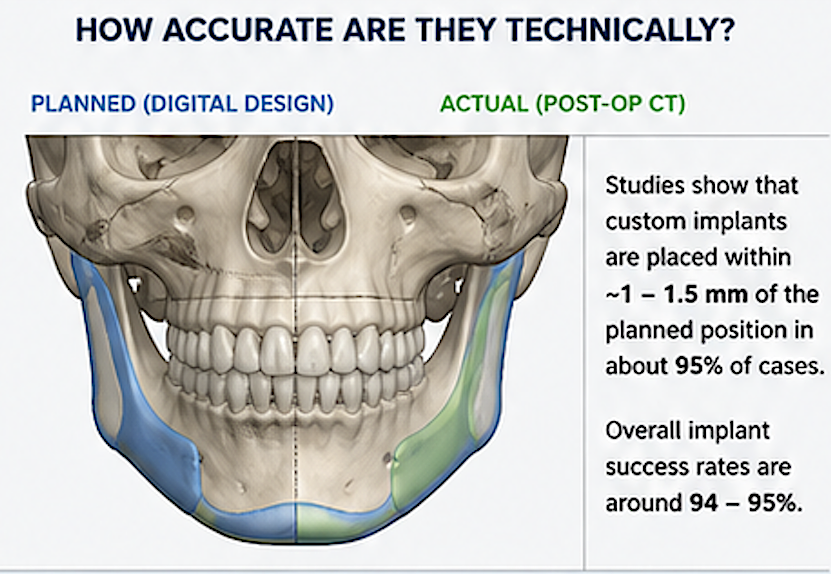
Modern custom implants are built from CT scans + CAD/CAM design, so their fit to your anatomy is extremely precise:
- ~95% of implants fall within ~1–1.5 mm of the planned position
- Overall implant success rates are around 94–95% in clinical studies
👉 Translation:
From a pure engineering standpoint, they’re very accurate. What you design is usually what gets implanted.
🎯 2. Do they achieve your “look goals”?
This is where things get less exact.
Even with perfect implant positioning, outcomes depend on:
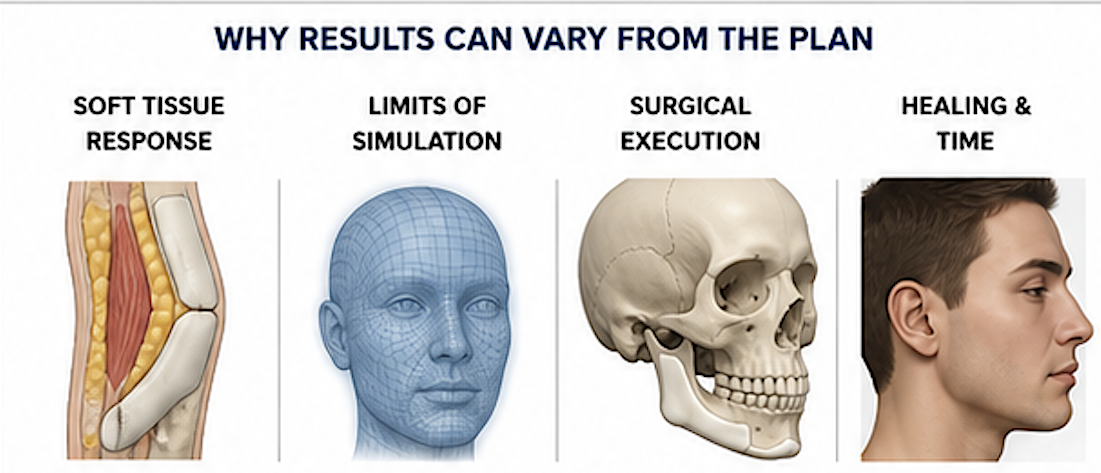
A. Soft tissue response (big wildcard)
- Skin thickness, fat, muscle, and swelling all affect the final look
- The implant is bone-based, but your visible result is soft tissue over it
👉 This is the #1 reason results don’t match simulations perfectly.
B. Limits of simulation / design
- Digital previews are approximations, not guarantees
- There’s no universal standard for facial measurement or aesthetic prediction
👉 So even a “perfect” design may not translate 1:1 visually.
C. Surgical execution
- Placement, fixation, and symmetry still rely on surgeon skill
- Even small shifts can affect aesthetics
📊 3. Real-world satisfaction & revisions
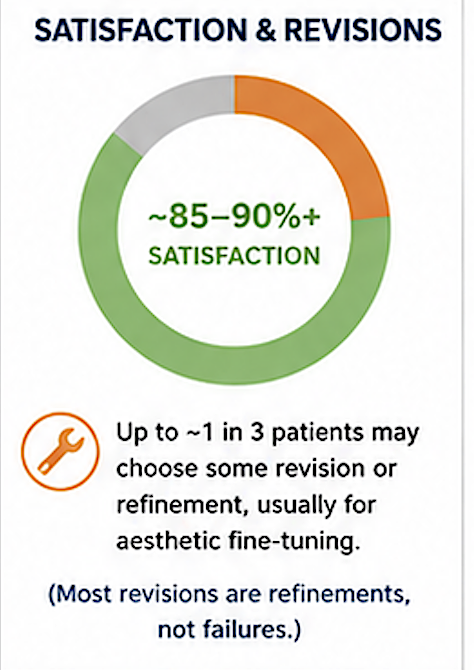
- Cosmetic facial procedures overall have ~85–90%+ satisfaction rates
- But with custom facial implants specifically, revision rates can be significant:
- Up to ~1 in 3 patients may want some revision, usually for aesthetic fine-tuning
👉 Important nuance:
Most revisions are not failures—they’re refinements once you see the real result.
⚖️ 4. So how “accurate” are they really?
A useful way to think about it:
| Aspect | Accuracy |
| Fit to your bone | ⭐⭐⭐⭐⭐ (very high) |
| Reproducing planned design | ⭐⭐⭐⭐☆ |
| Matching your exact vision | ⭐⭐⭐☆☆ |
| Long-term satisfaction | ⭐⭐⭐⭐☆ |
🧠 The key insight most people miss
Custom implants are not like ordering a custom object—they’re closer to sculpting through biology.
You’re combining:
- engineering (very precise)
- biology (less predictable)
- perception (highly subjective)
What determines if you get a great result
This matters more than the implant itself:
- Clarity of your aesthetic goal
- Surgeon’s experience with custom design (not just implants in general)
- How realistic the plan is for your anatomy
- Willingness to accept possible staged refinement
👍 Bottom line
- Custom implants are the most accurate method available for structural facial changes
- They dramatically increase the odds of hitting your goal vs standard implants
- But they are not perfectly predictive, and refinement is fairly common
Can I Play Sports After Getting Custom Facial Implants
Short answer: yes—but not right away, and it depends on the sport and healing stage.
Custom facial implants (jaw, cheek, chin, orbital, etc.) need time to stabilize and integrate before they can safely handle impact or strain.
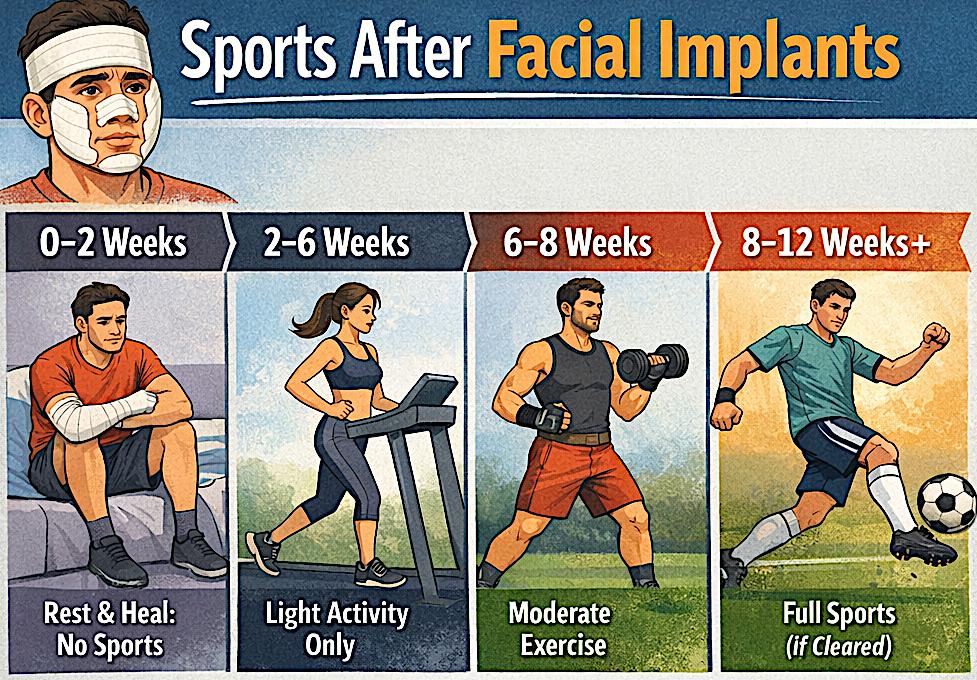
General timeline (typical, varies by surgeon & case)
0–2 weeks
- No sports
- Focus on healing, swelling control
- Risk: bleeding, implant shifting
2–6 weeks
- Light activity only (walking, light cardio)
- No contact, no heavy lifting, no risk of falls or blows
6–8 weeks
- Gradual return to moderate exercise
- Still avoid anything where your face could get hit
8–12+ weeks
- Many patients can return to full activity, including sports
- Contact sports (basketball, soccer, martial arts, football) may require closer to 10–12 weeks or longer
Key factors that matter
- Implant location
- Cheek/orbital → more vulnerable to impact
- Chin/jaw → affected by clenching, collisions
- Fixation method (screwed vs. pocketed)
- Bone healing vs. soft tissue only
- Swelling and numbness
- Your specific sport’s risk level
High-risk sports (need extra caution)
- Boxing, MMA, football, hockey → direct facial trauma risk
- Basketball, soccer → accidental elbows/headers
- Cycling, skiing → fall risk
You may need:
- Longer restriction period
- Protective gear (custom face mask in some cases)
What can go wrong if you return too early
- Implant shifting or displacement
- Increased swelling or fluid collection
- Prolonged pain or asymmetry
- Rarely, infection or need for revision
Bottom line
You’ll likely be able to return to sports, but:
- Non-contact: ~6–8 weeks
- Contact/high-risk: ~10–12+ weeks (sometimes longer)
What Is The Impact Resistance of Custom Facial Implants
Custom facial implants are designed to withstand normal daily forces and even moderate facial trauma quite well. Their actual “impact resistance” depends on three main factors:
- The implant material
- Its thickness/design
- How it is fixed to bone
The most common materials are silicone, porous polyethylene (Medpor), PEEK, and titanium. Each behaves differently under impact.
Silicone Implants
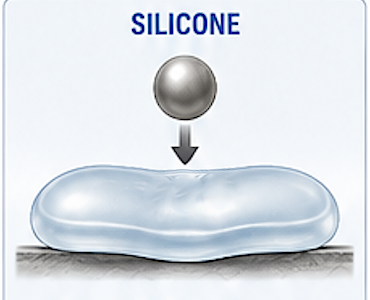
- Very flexible and highly resistant to cracking.
- They absorb force well because they deform elastically rather than fracture.
- Rarely “break” from trauma.
- More likely to shift position with a severe blow if not well encapsulated or screw-fixed.
Think of silicone more like a shock absorber.
Porous Polyethylene (Medpor)
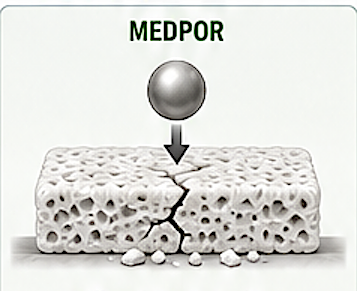
- Much stiffer than silicone.
- Tissue grows into it over time, which greatly stabilizes it.
- Resistant to displacement after healing.
- Can fracture under sufficiently high force because it is more rigid.
PEEK (Polyetheretherketone)
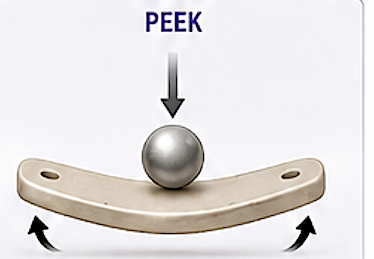
PEEK has become one of the most popular materials for custom jawline, cheek, orbital, and craniofacial implants because its mechanical properties are close to cortical bone.
Its strength characteristics are one reason it is favored for large custom implants:
- Lightweight
- Fatigue resistant
- Strong under compressive loading
- More rigid than silicone
- Less brittle than many acrylic materials
Commercial craniofacial PEEK systems report yield strengths around 115 MPa.
However:
- PEEK can fracture under major trauma.
- Unlike silicone, it has less elastic deformation capacity.
- In real-world facial trauma, the surrounding facial skeleton usually fractures before a properly designed PEEK implant fails.
Titanium
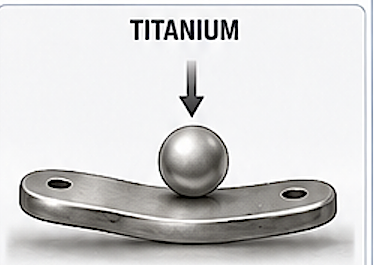
- Highest structural strength of the common implant materials.
- Extremely resistant to fracture.
- Used more for reconstructive than cosmetic augmentation cases.
- Transfers impact forces directly because it is very rigid.
What Happens During Facial Trauma?
In practical terms:
Mild to Moderate Trauma
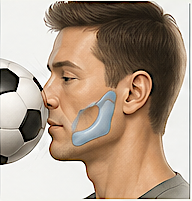
Examples:
- Sports contact
- Minor falls
- Accidental blows
Most custom implants:
- Stay intact
- Stay fixed
- Cause no long-term issues
After healing, scar capsule formation and/or tissue ingrowth stabilize the implant substantially.
Severe Trauma
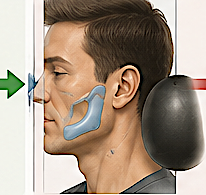
Examples:
- Car accidents
- Assaults
- High-speed sports injuries
Possible outcomes:
- Native facial bone fractures
- Implant fracture (more possible with rigid materials)
- Screw loosening
- Implant displacement
Interestingly, large custom jawline or cranial implants can actually provide some protective “shielding” effect to the underlying bone because they spread impact forces over a broader area.
Custom Facial Implant Potential Risks and Complications
Custom facial implants (can produce dramatic aesthetic results—but they also carry a distinct set of risks. Here’s a clear, medically grounded breakdown:
General Surgical Risks (apply to all implants)
These are not unique to custom implants but still important:
- Infection (1–5% typical range)
- Bleeding / hematoma
- Seroma (fluid collection)
- Incisional dehiscence/opening
- Scarring (external approaches)
Custom Implant–Specific Risks
1. Malposition
- Custom implants are designed to fit precisely, so they usually reduce this risk
- However, issues can occur if:
- Surgical placement is slightly off
- Soft tissue tension shifts the implant
- May require revision surgery
2. Infection
- Higher risk with intraoral implant placements
- Custom implants are often larger → harder to treat infections
- Infection may require implant removal, not just antibiotics
3. Nerve Injury
Depends on implant location:
- Chin/jaw implants → mental nerve (lower lip numbness)
- Cheek/orbital implants → infraorbital nerve (upper lip/cheek numbness)
- Forehead/brow bone implants → supraorbital nerve (forehead/scalp numbness)
Effects:
- Temporary numbness is common
- Permanent sensory change is rare but possible
4. Asymmetry
- Even with precise design:
- Human faces are naturally asymmetric
- Soft tissue swelling/healing can create imbalance
- Sometimes requires minor revision
5. Edge Visibility / Palpability
- More likely if:
- Skin is thin
- Implant edges are prominent
- Custom implants usually minimize this—but not completely
6. Bone Resorption (pressure atrophy)
- Long-term pressure from implant can cause:
- Implant imprinting on the bone
- No functional significance
- More relevant in:
- Chin implants
- Large jaw implants
7. Implant Exposure
- Implant becomes visible through skin or inside mouth
- Higher risk if:
- Infection occurs
- Soft tissue coverage is thin
- Usually requires removal
8. Design / Planning Errors (unique to custom implants)
This is the biggest custom-specific risk:
- Implant is based on CT scan + digital planning
- Problems can occur if:
- Patient goals weren’t clearly defined
- Surgeon planning was off
- Soft tissue response was misestimated
Implant designing is still a best guess estimate, not an exact science
9. Overcorrection or Under-correction
- Custom implants are precise—but that precision can lock in:
- Too much projection
- Not enough change
- Revision requires a new implant
10. Cost and Revision Complexity
- Custom implants are:
- Expensive
- Time-consuming to redesign (weeks)
- Revisions are more complex than standard implants
Advantages (Why people still choose custom)
Important context:
- Better fit to anatomy
- More control over shape and projection
- Ability to correct complex asymmetries
- Often fewer positioning issues vs stock implants
Who Is Higher Risk?
- Thin soft tissue patients
- Smokers
- Prior facial surgery or scarring
- Pre-existing implants
- Unrealistic expectations (planning mismatch risk)
Bottom Line
Custom facial implants are powerful but unforgiving:
- They reduce some risks (fit, symmetry potential)
- But introduce others (planning rigidity, harder revisions)
Why Do Custom Facial Implants Have a High Revision Rate?
🎯 It Is Usually About Precision—Not Problems
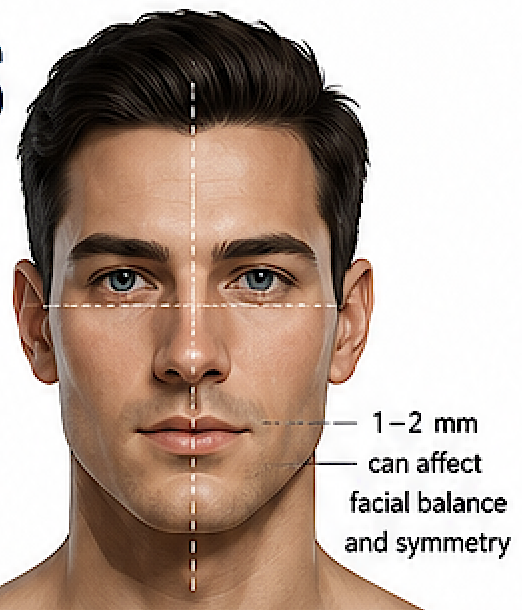
Custom facial implant patients seek subtle, highly refined changes where 1–2 mm can make a noticeable aesthetic difference. Most revisions are performed to optimize an already good result rather than to correct a complication.
🖥️ Computer Accuracy vs. Soft Tissue Reality
- CAD/CAM design: Extremely precise
- Bone fit: Highly accurate
- Soft tissue response: Variable and unpredictable
The implant can fit perfectly while the overlying skin and soft tissues heal differently than expected.
⚖️ Perfect Symmetry Doesn’t Exist
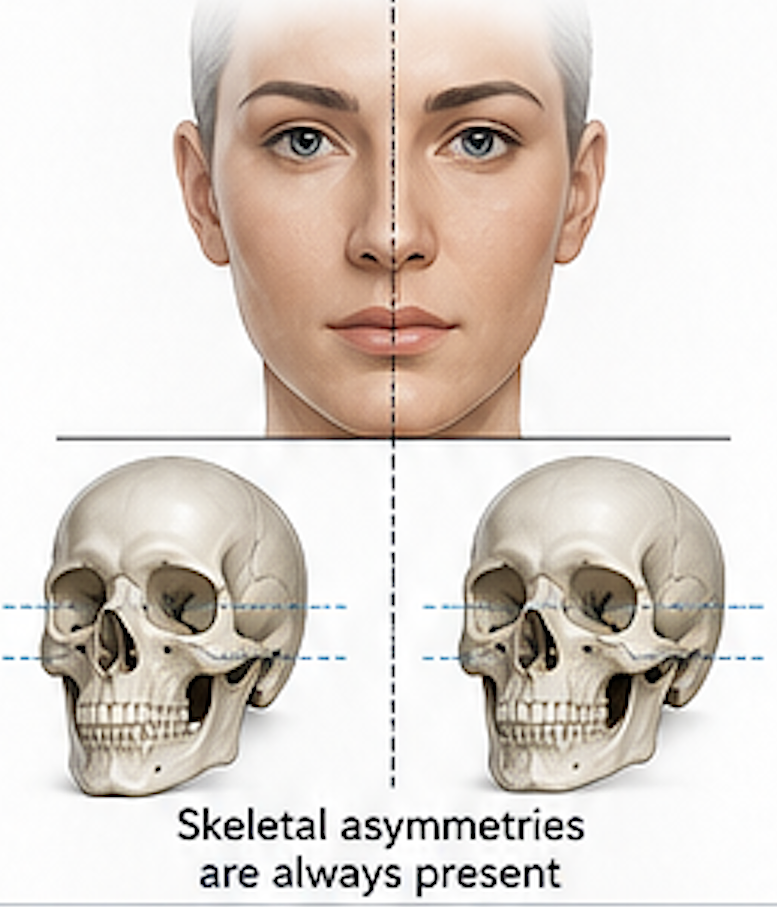
Every face has natural skeletal and soft tissue asymmetries. Even a perfectly designed implant cannot completely eliminate these differences, and small refinements may improve the final balance.
🔄 Most Revisions Are Refinements
Typical revisions involve:
- Minor projection adjustments
- Edge smoothing
- Improved contour blending
- Enhanced symmetry
These are usually elective aesthetic refinements, not corrections of implant failure.
Bottom Line

Higher Revision Rate ≠ Higher Complication Rate
✔ Low rates of infection, displacement, and implant failure
✔ Higher rates of elective aesthetic fine-tuning
✔ Reflects the pursuit of optimal facial harmony rather than surgical shortcomings
The goal is not simply improvement—it is aesthetic precision.
Can Custom Facial Implants Shift or Change Positon After Surgery
Yes—custom facial implants can shift after surgery, but it’s relatively uncommon when they’re properly designed and secured. Rigid implant fixation with screws is the key prevention.
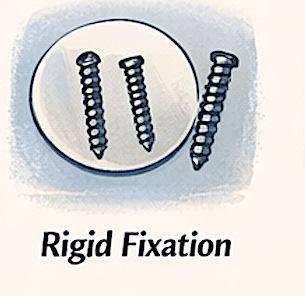
🔹 Why implants might shift
- Early healing phase (first few weeks):
- Swelling, movement, or not following post-op restrictions can allow slight movement.
- Lack of fixation:
- Implants that aren’t secured with screws are more prone to shifting.
- Pocket size issues:
- If the surgical pocket is too large, the implant has room to move.
- Trauma or pressure:
- Sleeping on the face, impact, or tight garments can displace it.
- Anatomy & location:
- Areas like the chin or jaw angle (with muscle movement) have slightly higher risk.
🔹 Why custom implants are more stable
- Designed to precisely fit your bone anatomy
- Always fixated with screws, which dramatically reduces mobility
- Better surface contact → less “dead space” for movement
🔹 Signs of possible shifting
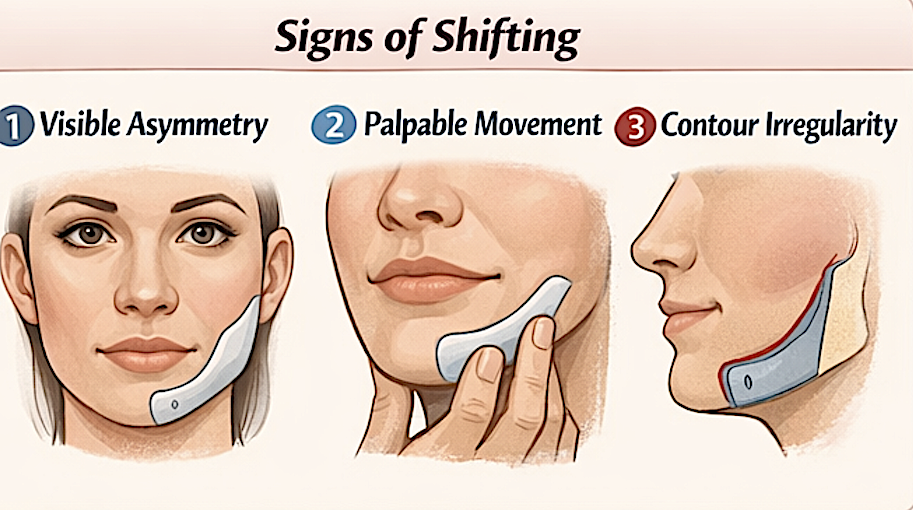
- Asymmetry that develops after initial healing
- A feeling of movement or instability
- Visible edge or contour irregularity
🔹 How surgeons prevent it
- Rigid fixation (small titanium screws)
- Tight, well-defined pocket dissection
- Post-op instructions (diet, activity limits, sleeping position)
🔹 Bottom line
- Yes, shifting is possible—but with modern custom implants and proper fixation, it’s rare.
- The highest risk window is the first 2–6 weeks after surgery.
- Most instances of suspected implant shifting is initial malpositioning which is not seen until weeks to months later when all swelling has resolved and the true implant position is revealed.
Do Custom Facial Implants Cause Bone Remodeling
Yes. Custom facial implants can cause bone remodeling and localized bone resorption, just as stock implants can. The fact that an implant is custom-designed does not eliminate the biological response of bone to chronic pressure.
However, custom implants may have some advantages:
Why bone remodeling occurs
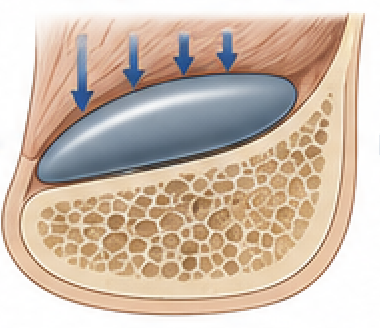
Bone adapts to mechanical forces (Wolff’s law). When an implant rests against bone for years:
- Areas under continuous pressure may undergo sosme limited implant settling onto the bone (bone imprinting)
- Bone imprinting is most visible in areas where the tissuers are tight due to strong muscular cover (chin and jaw angles)
- Areas subjected to altered loading may remodel
- The degree depends on implant stability, thickness, design, fixation, and location
Potential advantages of custom implants
Compared with off-the-shelf implants, custom implants:
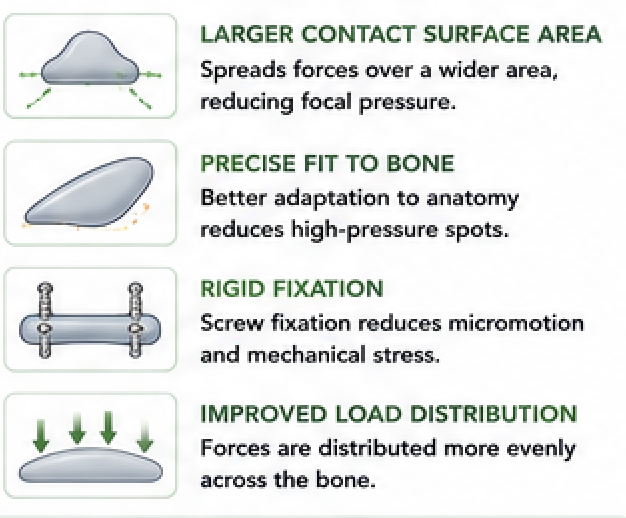
- Typically have a larger contact surface area
- Fit the underlying bone more precisely
- Can distribute forces more evenly
- Are often rigidly fixed with screws, reducing micromotion
These factors may reduce focal pressure concentrations that contribute to significant saucerization.
Location matters
Custom chin implants
- Most likely location for clinically significant remodeling
- Bone resorption has been documented even with screw fixation
Custom jaw implants
- Mild remodeling along the mandibular border or angle can occur
- Significant bone loss is uncommon
Custom cheek (malar) implants
- Usually produce minimal remodeling
- Changes are often detectable only on CT scans
Implant material

The material is less important than the biomechanics, but:
- PEEK implants are rigid and commonly screw-fixed
- Titanium implants can also be associated with underlying remodeling
- Porous polyethylene (Medpor) and silicone can show remodeling as well
No facial implant material is completely immune from long-term bone adaptation.
What is typically seen on CT?
For most custom facial implants followed over many years:
- Mild cortical thinning
- Shallow contour changes
- Stable bone remodeling
These findings are often incidental and do not affect aesthetics or implant stability.
In my experience in thousands of custom facial implants
The largest custom jawline implants (mandibular angle/body/chin designs) generally show far less clinically concerning bone resorption than traditional unfixed silicone chin implants. The broader footprint and rigid fixation appear to spread forces more favorably. Nevertheless, if a patient has a CT scan 5–15 years later, some degree of bone remodeling beneath portions of the implant should not be surprising and is generally considered a normal adaptive response rather than a complication.
Can Custom Facial Implants Withstand Trauma
Short answer: they’re fairly durable, but not indestructible—and they don’t “protect” you from trauma.
Here’s how it breaks down:
Most are made from materials like:
- Solid silicone
- Porous polyethylene (Medpor)
- PEEK (rigid polymer)
- Titanium
All of these are biocompatible and structurally stable, designed to last decades.
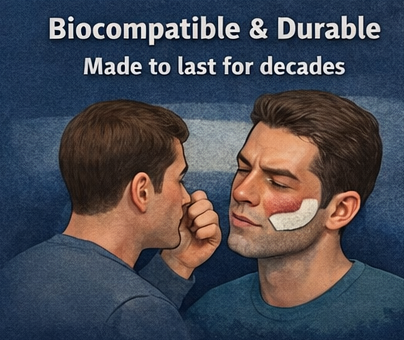
How they handle trauma
- Low to moderate impacts (bumps, minor accidents):
→ Usually no problem. Implants generally stay intact and in position. - Higher-force trauma (sports injury, car accident, assault):
→ Several things can happen:- The bone underneath can fracture (more common than implant failure)
- The implant can shift or displace
- Rarely, the implant can crack or deform (more likely with very rigid materials like PEEK under extreme force)
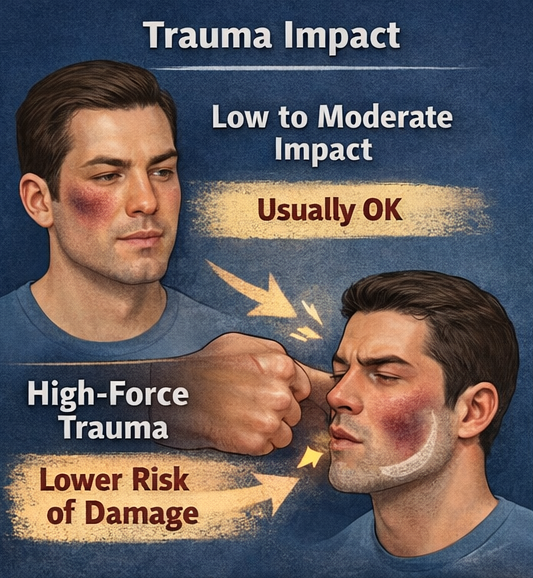
⚠️ Important reality check
- Implants are somewhat like shock absorbers
- They don’t necessarily make the bone stronger but they add a layer of protection
- They change how force is distributed, shielding the underlying bone
Material differences in trauma
- Silicone → flexible, best shock absorber, can not fracture but can shift
- Medpor → integrates with tissue, harder to move, but may fracture
- PEEK → very strong but more brittle under extreme force than silicone
- Titanium → can not fracture but may bend
🏥 If trauma occurs
After a significant facial injury, doctors will check for:
- Implant position
- Bone fractures
- Infection risk if exposed
Sometimes the implant is left alone; sometimes it needs revision or removal.
Bottom line
Custom facial implants are durable enough for everyday life, but in real trauma situations:
- Your bone is still the weak point
- The implant may shift or occasionally fail
- They should be considered cosmetic/structural enhancements—with some protective benefits
Will Custom Facial Implants Look Natural?
Short answer: they can look very natural—when designed and done well. But it depends heavily on a few key factors.
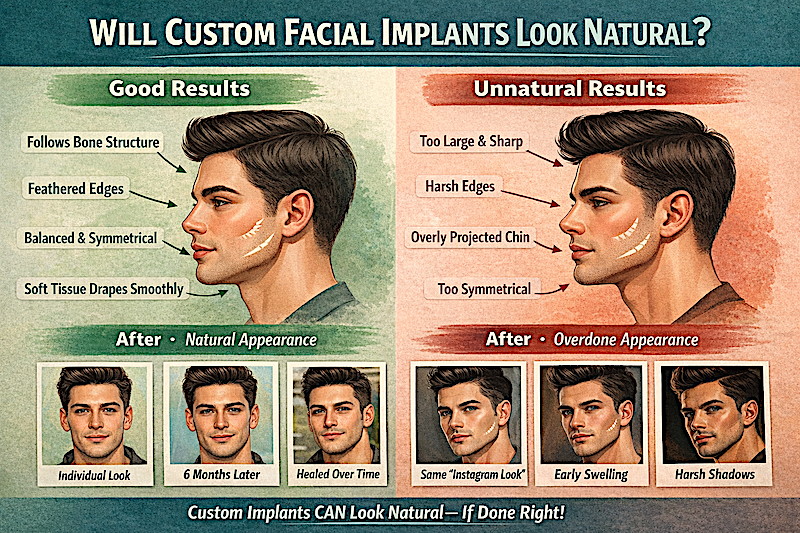
What makes custom implants look natural
Custom facial implants are designed from your CT scan, so they match your anatomy precisely. When done right:
- They follow your existing bone structure, not just “add volume”
- Edges are feathered so there are no visible transitions
- Symmetry is improved, not exaggerated
- Soft tissue drapes naturally over them
That’s why custom implants generally look more natural than off-the-shelf ones.
What can make them look unnatural
Even custom implants can look “off” if:
- The design is too aggressive or overbuilt
- The surgeon doesn’t account for soft tissue thickness
- Placement is slightly off
- The goal is more “dramatic change” vs subtle enhancement
Natural results come from restraint and good planning—not just the implant itself.
Areas that tend to look very natural
- Jawline (angle or width enhancement)
- Chin (projection or shape refinement)
- Cheekbones (especially when subtle)
These areas respond well because they’re structural and bone-based.
Areas that require more finesse
- Under-eye / infraorbital region
- Paranasal (around the nose)
These can look amazing—but are less forgiving if overdone.
Biggest factor: surgeon + design philosophy
The surgeon’s aesthetic judgment matters as much as the implant:
- Do they aim for natural harmony or bold transformation?
- Do they show long-term healed results (not just swelling phase)?
- Do they design implants themselves or outsource blindly?
Will People Be Able To Tell I Have Custom Facial Implants
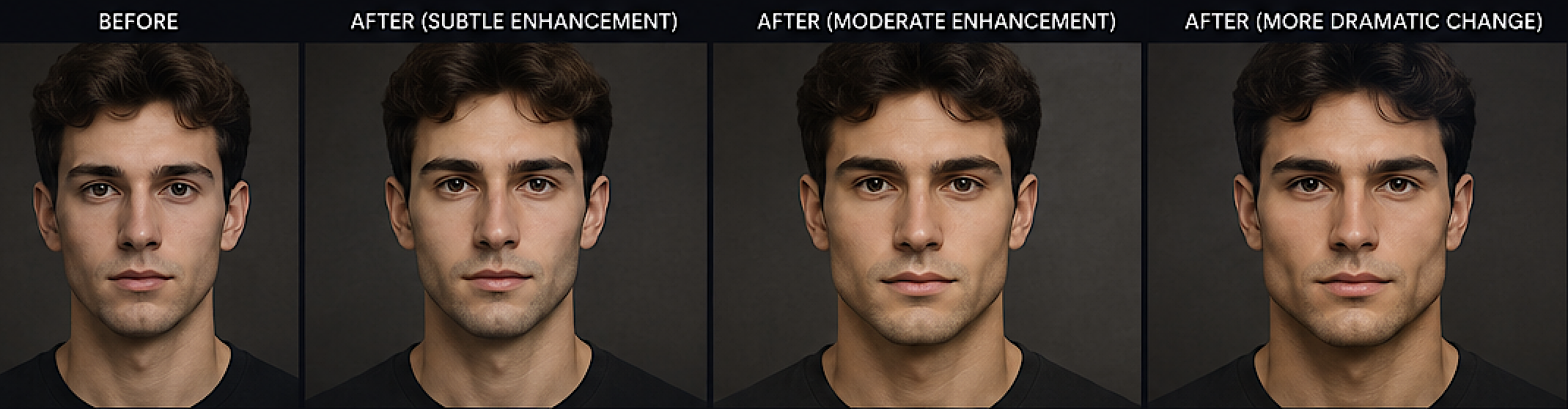
In most cases, well-designed custom facial implants are not obvious to other people. Whether someone can tell depends on several factors:
- Which area was augmented (chin, jaw angle, cheekbones, orbital rims, etc.).
- How large the change is. Subtle structural enhancement usually looks natural; very large changes can attract attention.
- Your starting anatomy. If implants bring features into better balance, people often perceive you as looking “better” or “stronger” rather than “operated on.”
- The quality of planning and execution. Custom implants generally allow a more natural fit and contour than stock implants because they’re designed around your specific bone structure.
- Soft tissue thickness. Thicker soft tissue tends to camouflage skeletal changes more than very thin soft tissue.
What often happens is that people notice something has changed but can’t identify what. Comments tend to be:
- “You look healthier.”
- “Did you lose weight?”
- “You look more confident.”
- “Something looks different.”
They usually do not jump to “custom facial implants” unless the result is unusually dramatic or they already know you’ve had surgery.
The situations where implants are more likely to be detectable are:
- Overly large jaw or cheek augmentation.
- Implant designs that create unnatural transitions or excessive projection.
- Very thin individuals where skeletal contours are highly visible.
- Cases where the implants alter facial proportions beyond the normal range.
Why Are Custom Facial Implants So Aesthetically Powerful
Custom facial implants are considered “powerful” because they’re designed specifically for one person’s anatomy, rather than being a generic, one-size-fits-all solution. That customization changes everything—from aesthetics to structural impact.
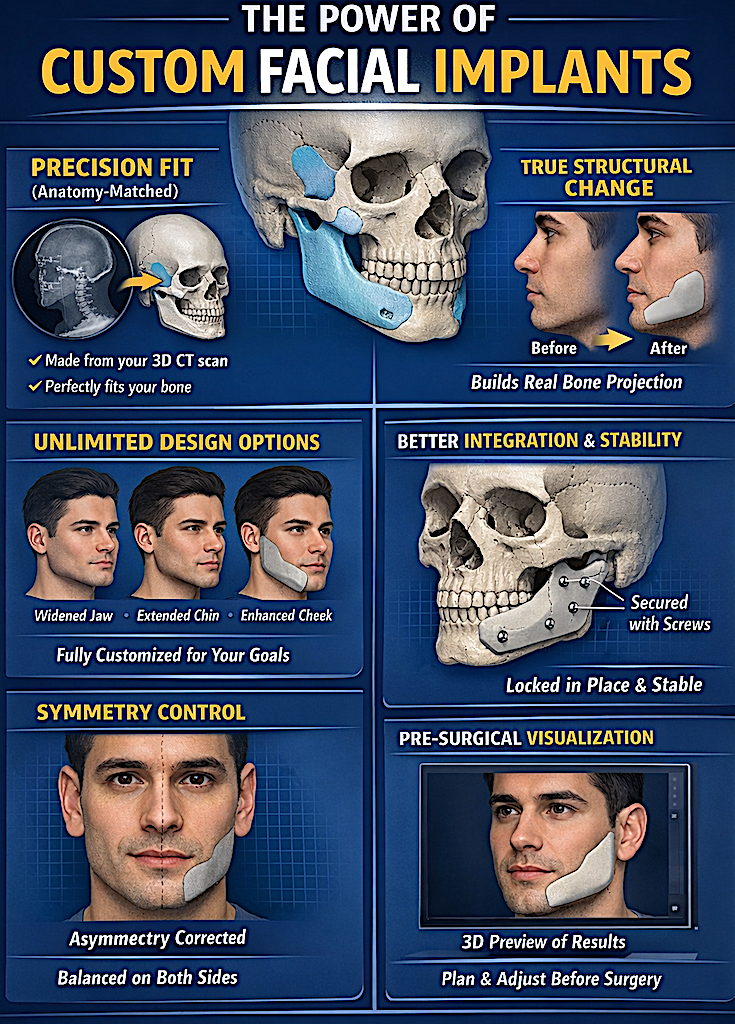
Here’s what really gives them that edge:
1. Precision Fit (Anatomy-Matched)
Custom implants are built from a 3D CT scan of your skull, so they:
- Fit perfectly against your bone
- Don’t rely on the surgeon to “shape” them during surgery
- Create very predictable, repeatable outcomes
Stock implants, by contrast, are approximations.
2. True Structural Change (Not Just Filling Space)
Custom implants can:
- Add projection exactly where needed (jawline, chin, cheekbones, orbital rims)
- Correct asymmetry with millimeter-level accuracy
- Build skeletal support, not just soft tissue volume
This is why they can dramatically change facial balance—not just enhance it.
3. Unlimited Design Possibilities
Because they’re digitally designed, you’re not limited to preset shapes:
- Jawline can be widened, lengthened, squared, or made more angular
- Chin can be vertically lengthened or advanced in complex ways
- Midface can be built forward for stronger profile harmony
It’s essentially facial architecture, not just augmentation.
4. Better Integration & Stability
Custom implants:
- Sit flush against bone → less movement risk
- Often have fixation points (screws) planned in advance
- Can be made from materials (like solid silicone or porous polyethylene) that integrate well
5. Symmetry Control
One of the biggest advantages:
- Each side can be designed differently if your face is asymmetric
- Surgeons can correct imbalances that stock implants simply can’t address
6. Pre-Surgical Visualization
You (and the surgeon) can:
- See a 3D simulation of the result before surgery
- Adjust the design until it matches your goals
That level of planning is a big reason outcomes can be so impactful.
Bottom line
Custom facial implants are “powerful” because they turn surgery into a planned engineering process instead of an artistic approximation. You’re not adapting your face to an implant—the implant is built for your face.
Can Custom Facial Implants Fix Facial Asymmetries
Yes—custom facial implants can correct certain types of facial asymmetry, but whether they’re the right solution depends heavily on the cause and severity of the asymmetry.
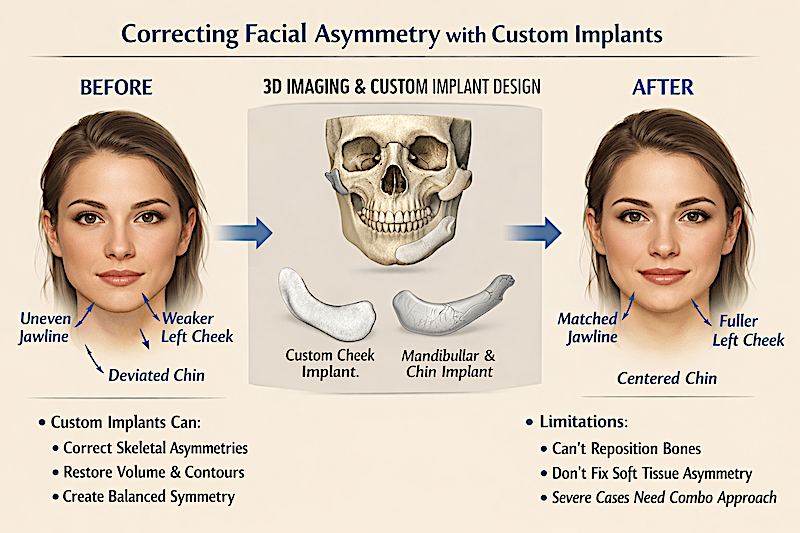
What custom implants can do well
Custom implants (usually designed from a 3D CT scan) are especially effective for:
- Skeletal asymmetry (uneven cheekbones, jawline, chin)
- Volume deficiencies on one side of the face
- Contour irregularities from trauma, congenital differences, or prior surgery
Because they’re custom-designed, they can:
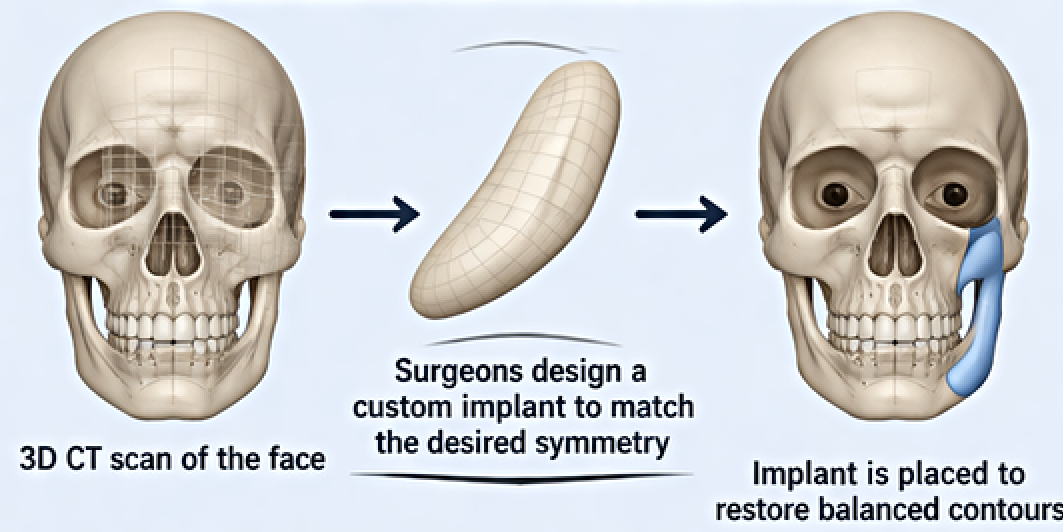
- Precisely match the “normal” side
- Restore symmetry in 3D (projection, width, and shape)
- Create more natural, balanced contours than standard implants
Where they’re most commonly used
- Jawline / mandibular angle asymmetry
- Chin deviation or deficiency
- Cheek (malar) asymmetry
- Orbital rim or midface contour issues
Limitations to understand
Custom implants are not a universal fix:
- They don’t reposition bones — if your asymmetry is due to jaw misalignment (bite issues), orthognathic (jaw) surgery may be needed instead or first
- They don’t correct soft tissue asymmetry completely (fat, muscle, skin differences)
- Severe asymmetries often require a combination approach (bone surgery + implants + fat grafting)
When they work best
- Mild to moderate asymmetry
- Good baseline alignment of the jaws/teeth
- When the issue is primarily volume or contour deficiency, not structural misalignment
Key advantage over fillers
While fillers can help temporarily, custom implants:
- Are permanent
- Provide structural support
- Offer greater precision and symmetry
Bottom line
Custom facial implants can be a very powerful tool for improving facial symmetry, but they’re best suited for contour and volume asymmetries, not major skeletal misalignment.
What Facial Soft Tissue Reductions Work Well With Custom Facial Implants
Combining custom facial implants with soft tissue reduction can produce a much sharper, more defined result—but only if the reductions are chosen carefully. The key principle is this: implants build structure, while soft tissue reduction removes volume that would otherwise blur that structure.
Here are the soft tissue procedures that tend to work best alongside custom implants:
1. Buccal Fat Reduction
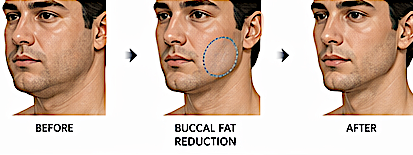
Best paired with: cheek (malar/submalar), jawline, or chin implants
- Removes deep fat in the lower cheek
- Enhances cheekbone projection from implants
- Prevents a “puffy” look that can hide implant definition
Works well when:
- You have thicker lower cheeks
- You’re adding cheek or jaw implants and want sharper contour
Caution: Over-reduction can make the face look hollow over time
2. Submental Liposuction (Under Chin)
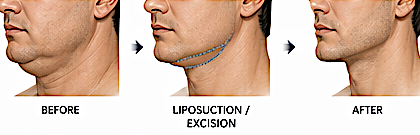
Best paired with: chin and jawline implants
- Removes fat under the chin and along upper neck
- Improves cervicomental angle (neck–chin definition)
- Helps jaw implants look cleaner and more angular
Works well when:
- Even mild fullness exists under the chin
- You want a crisp jawline result from implants
3. Perioral/Lateral Facial Liposuction
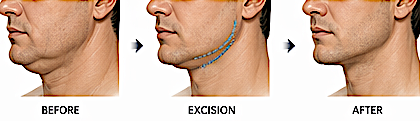
Best paired with: cheekl, chin or lower face implants
- Reduces heaviness around the mouth
- Helps avoid a “bottom-heavy” look after chin/jaw augmentation
- Enhance cheek implants particularly for the high cheekbone look
More selective use:
- Not as commonly done as buccal fat removal
- Works best in thicker, fuller lower faces
- Synergestic with buccal lipectomies
4. Masseter Reduction (Botox or surgical)
Best paired with: jaw angle implants
- Reduces width from enlarged chewing muscles
- Allows jaw implants to define shape rather than bulk
Important nuance:
- If you want a wider, stronger jaw, you may avoid reducing the masseter
- If you want a more sculpted/angular look, reduction helps
5. Skin Tightening (not removal, but critical)
Best paired with: all implants
- RF, laser, or surgical tightening may be needed
- Especially important if volume is removed (to prevent sagging)
Strategic Combinations
Some commonly effective pairings:
- Cheek implants + buccal fat removal → high cheekbone definition
- Jaw/chin implants + submental lipo → sharp jawline and neck angle
- Jaw implants + masseter Botox → angular but not bulky lower face
- Full custom wraparound implant + selective fat reduction → balanced sculpting
What doesn’t usually work well
- Aggressive fat removal everywhere → leads to a skeletal or aged look
- Removing volume in areas where implants already create projection → can look unnatural
- Ignoring skin quality → loose skin undermines implant definition
The Big Picture
The most successful outcomes come from balance:
- Implants define the framework
- Soft tissue reduction reveals that framework
- Skin quality maintains the final contour
Are Custom Facial Implants Permanent
Yes—custom facial implants are generally permanent, but with a few important nuances.
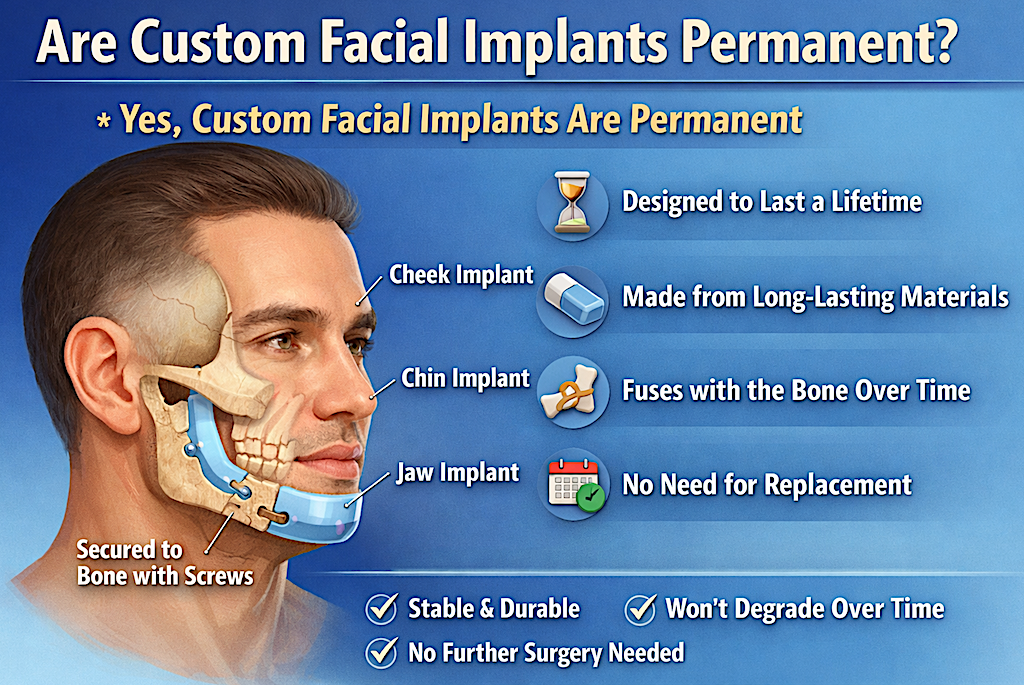
What “permanent” means
- Custom implants are designed to stay in place for life
- They don’t dissolve or wear out like fillers
- The body typically forms a stable interface around them, especially with porous materials
But they are not “irreversible”
- Implants can be removed or replaced if needed
- Reasons someone might change/remove them:
- Aesthetic dissatisfaction
- Infection or complications (rare)
- Shifting or asymmetry
- Desire for revision as face ages
Longevity in real life
- Many patients keep them for decades without issues
- They don’t require routine replacement like some other implants (e.g., breast implants sometimes do)
One key distinction
- Custom implants (designed from your CT scan) tend to:
- Fit better
- Be more stable
- Have lower revision rates than standard “off-the-shelf” implants
If you’re considering them, the real question isn’t just “are they permanent,” but how adjustable or revisable the plan is. A well-designed custom implant should look natural long-term and still give you options if your goals change.
Can Custom Facial Implants Be Detected At The Airport
Yes—custom facial implants can sometimes be detected at airport security, but it depends on the type of implant and the screening method.
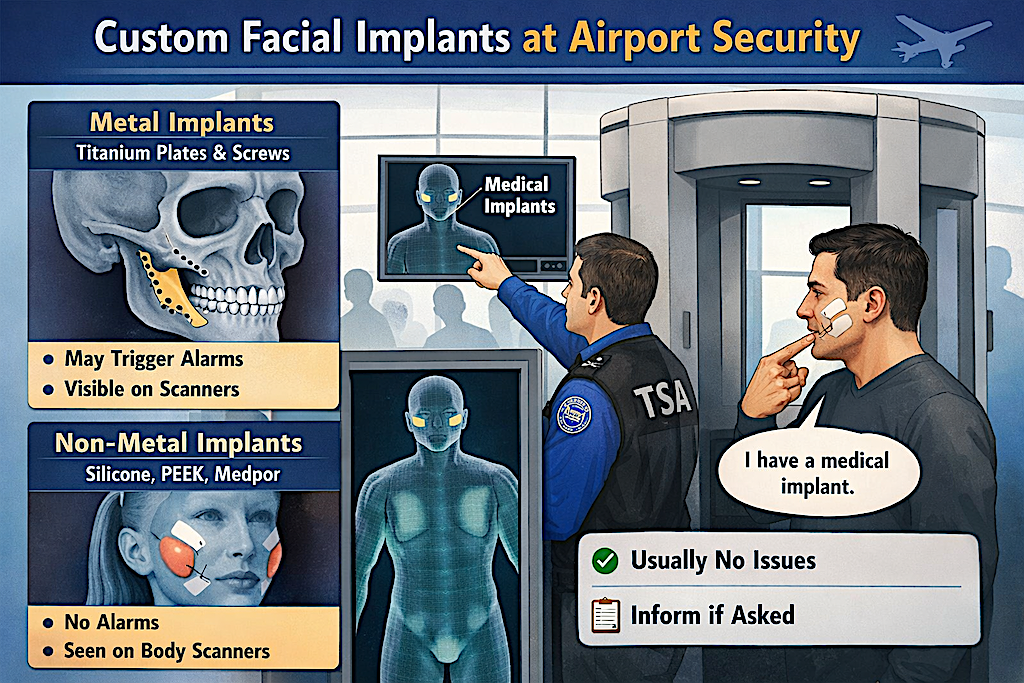
Here’s how it typically breaks down:
1. Metal implants (titanium, screws, plates)
- These can trigger metal detectors, especially if there’s a decent amount of hardware.
- However, small facial implants (like chin, jaw angle, or orbital implants) usually don’t set off alarms because the metal volume is low.
- On advanced scanners, they may show up as an internal object but are recognized as medical implants.
2. Non-metal implants (silicone, PEEK, Medpor, etc.)
- These do not trigger metal detectors.
- They can appear on full-body scanners (millimeter-wave scanners), but they’re typically seen as non-threatening anatomical variations.
- TSA agents are trained not to flag these as suspicious.
3. CT-style or advanced scanners
- At some airports (especially internationally), scanners can visualize internal structures more clearly.
- Even then, custom facial implants look like expected medical devices, not contraband.
4. Practical reality
- Most people with facial implants pass through security without any issue or secondary screening.
- It’s far less likely to cause problems than, say, a joint replacement or large orthopedic hardware.
Should you disclose it?
- You don’t need to proactively tell TSA.
- If you’re ever questioned (rare), simply stating you have a medical facial implant is sufficient—no documentation is usually required.
Can I Get Botox and Filllers If I Have Custom Facial Implants
Yes. In most cases, Botox and dermal fillers can be safely performed in patients who have custom facial implants, but there are some important considerations.
Botox
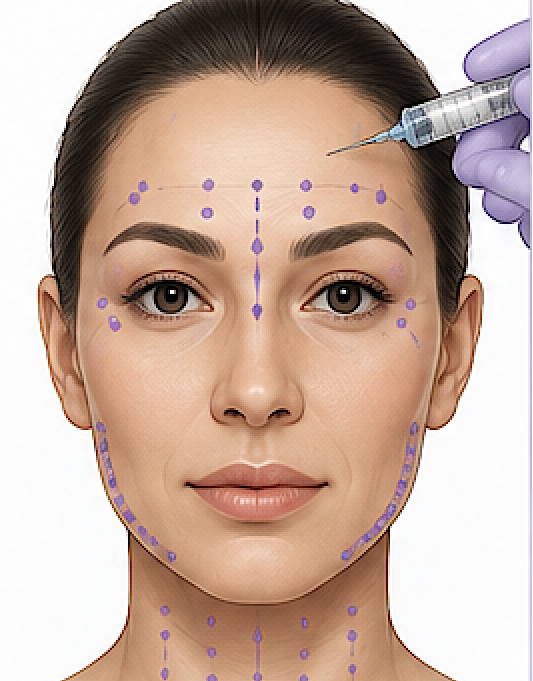
Botox injections are generally not affected by facial implants because Botox is injected into muscles, not onto the bone or implant itself. Common treatment areas such as:
- Forehead
- Frown lines (glabella)
- Crow’s feet
- Masseter muscles (jaw slimming/clenching)
- Neck bands
can usually be treated normally even when custom implants are present.
Injectable Fillers
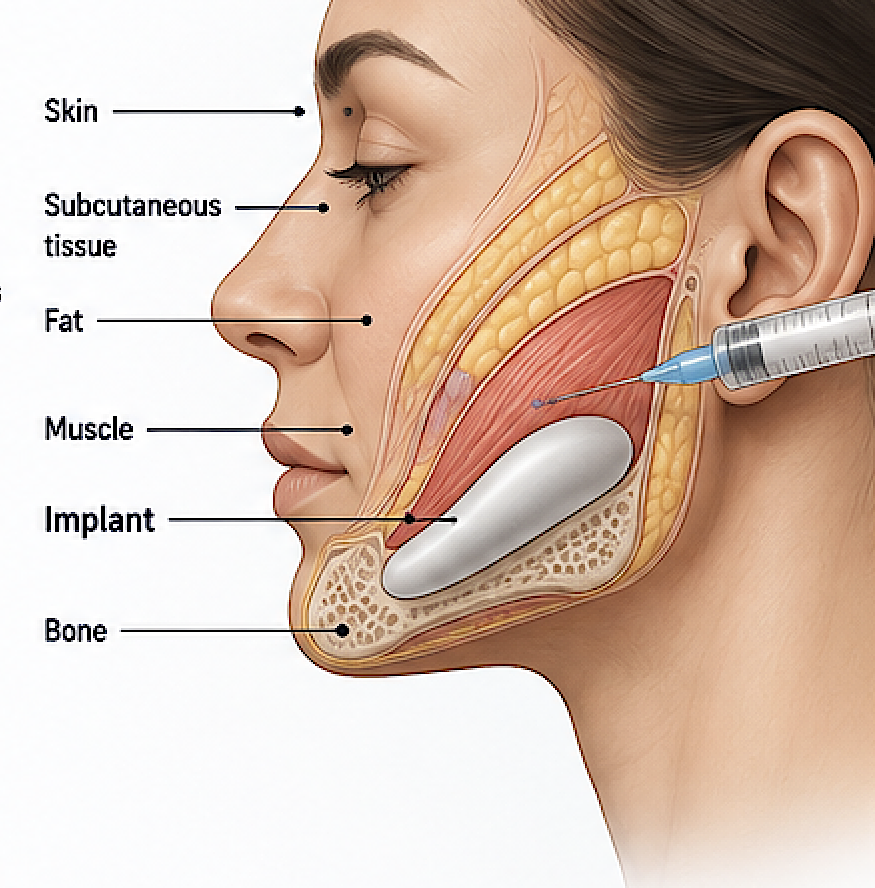
Fillers require more planning because they are placed in the soft tissues that lie over the implant.
Key considerations:
- Knowledge of implant location and design: The injector should know exactly where the implant sits and how far it extends.
- Avoiding the implant pocket: If fillers are injected deeply near the implant edges, there is a small risk of entering or disturbing the implant pocket.
- Changes in anatomy: Custom implants often alter the normal contours and tissue thickness, which can affect filler placement and the amount needed.
- Ultrasound guidance: For complex facial implant patients, some injectors use ultrasound to visualize anatomy and improve safety.
Areas Commonly Treated Successfully
Patients with custom implants frequently still receive fillers in:
- Lips
- Nasolabial folds
- Marionette lines
- Tear troughs (depending on anatomy)
- Cheeks (if the implant does not already provide sufficient projection)
When Extra Caution Is Needed
Additional planning is warranted if:
- The implants were placed recently (typically within the last few months).
- There has been previous infection or implant-related complications.
- The fillers would be injected directly over large custom cheek, infraorbital, jawline, or chin implants.
- The injector is unfamiliar with your implant design.
Best Practice
If you have custom facial implants, the safest approach is to:
- Tell your injector exactly what implants you have and when they were placed.
- Provide operative reports or implant design information if available.
- Use an injector experienced with patients who have facial implants.
Do Custom Facial Implants Slow Down Aging
Custom facial implants do not directly slow the biological aging process, but they can make the face appear younger for a longer period of time by improving skeletal support.
Aging of the face occurs at several levels:
- Bone resorption – the facial skeleton gradually loses volume and projection.
- Fat atrophy and redistribution – facial fat compartments shrink or descend.
- Soft tissue laxity – ligaments loosen and skin sags.
- Skin aging – collagen loss, wrinkles, and sun damage.
Custom implants primarily address the first factor. By increasing projection of the cheeks, jawline, chin, piriform area, or orbital rims, they can restore or augment the underlying framework that naturally diminishes with age.
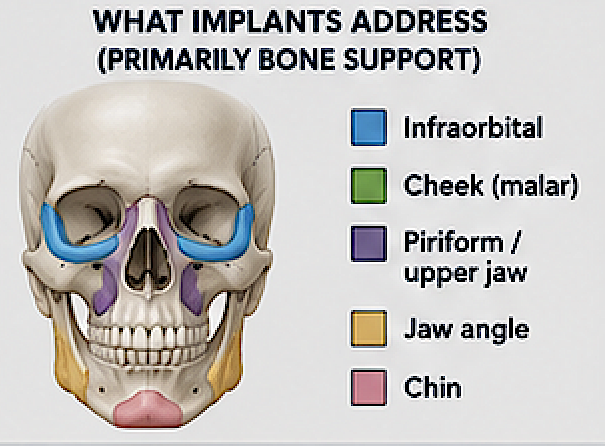
Potential “anti-aging” effects
- Better cheek support may reduce the appearance of midface flattening.
- Jawline implants can maintain a stronger mandibular contour despite soft tissue descent.
- Piriform implants can support the base of the nose and upper lip area, helping with deepening nasolabial folds.
- Infraorbital implants can improve age-related hollowing beneath the eyes.
What implants cannot do
- Prevent continued bone loss elsewhere.
- Stop skin laxity.
- Prevent wrinkles or sun damage.
- Prevent fat loss in the face.
An interesting concept: structural aging resistance
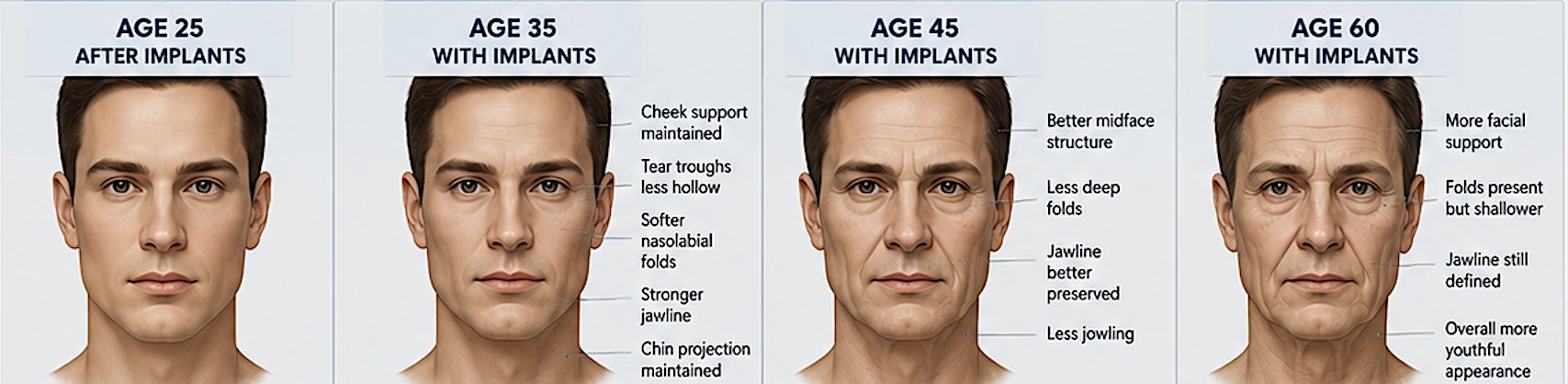
Some surgeons believe that patients with stronger facial skeletal projection (whether naturally occurring or created with implants) often age more favorably because the soft tissues have a more robust framework over which to drape. In that sense, implants may provide a degree of long-term structural support, making future aging changes less apparent than they otherwise would be.
However, a patient with implants will still age. They may simply age from a more favorable starting point and retain better facial proportions over time.
For example, a 35-year-old who receives custom cheek and jaw implants may still look older at 60, but often looks younger than they would have if the underlying skeletal deficiencies and age-related volume loss had never been addressed.
So the most accurate answer is:
Custom facial implants do not slow aging biologically, but they can compensate for skeletal aging and provide permanent structural support that may make age-related facial changes less noticeable over decades.
Are Custom Facial Implants Reversible
Yes—custom facial implants can be removed or revised, but “reversible” doesn’t always mean returning perfectly to your original state. Here’s how it works in practice:
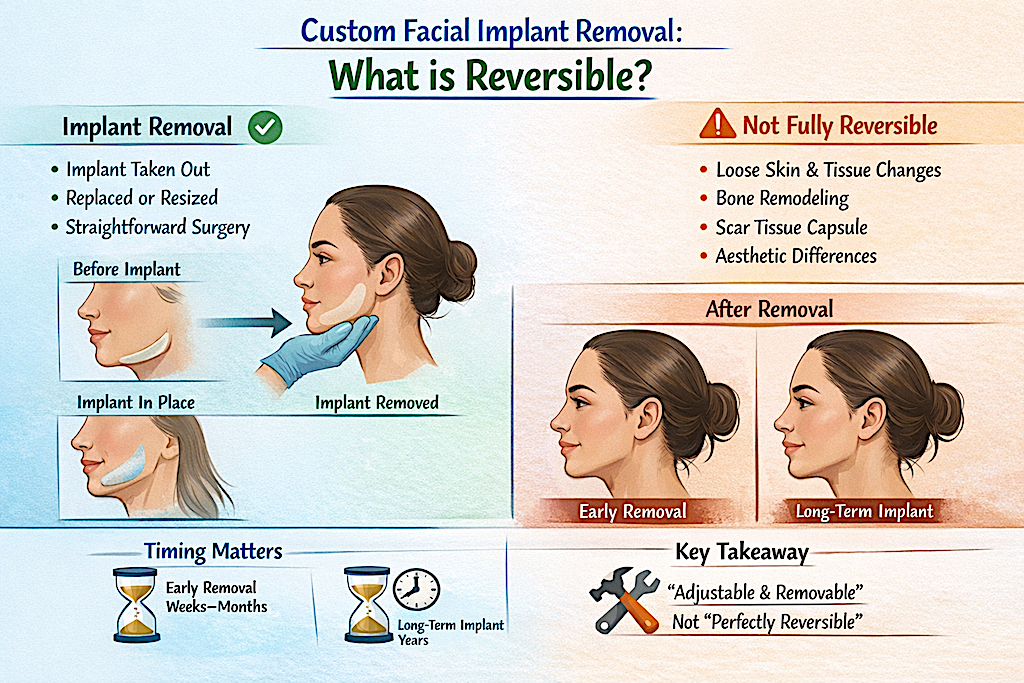
✅ What is reversible
- The implant itself can be taken out (chin, jawline, cheek implants, etc.)
- Removal is usually straightforward for an experienced surgeon
- It can also be replaced or resized if the issue is shape, symmetry, or projection
⚠️ What may not fully reverse
- Soft tissue changes: Skin and underlying tissue may have stretched or adapted to the implant
- Bone remodeling: Long-term implants can cause mild pressure changes to bone
- Scar tissue (capsule): Your body forms a layer around implants, which may remain or need adjustment
- Aesthetic differences: After removal, the face may look slightly different than before (sometimes a bit looser or less defined)
🕒 Timing matters
- Early removal (weeks–months): closer to original appearance
- Long-term implants (years): more adaptation → less “perfect reversal”
Common reasons for removal/revision
- Dissatisfaction with size/shape
- Asymmetry
- Infection or complications (rare)
- Desire for a more natural look
Key takeaway
Think of it as “adjustable and removable” rather than perfectly reversible. Most patients can return to a natural look, but not always identical to baseline without additional procedures.
Can Custom Facial Implants Be Done With Other Aesthetic Facial Procedures
Yes—custom facial implants are very commonly combined with other aesthetic facial procedures, and in many cases that’s actually the best approach for balanced, natural-looking results.
Why combine procedures?
Custom implants (chin, jawline, cheek, orbital, etc.) change the underlying skeletal framework. But facial aesthetics also depend on:
- Soft tissue (skin, fat, muscle)
- Aging changes (sagging, volume loss)
- Skin quality
So combining procedures helps ensure everything matches the new structure.
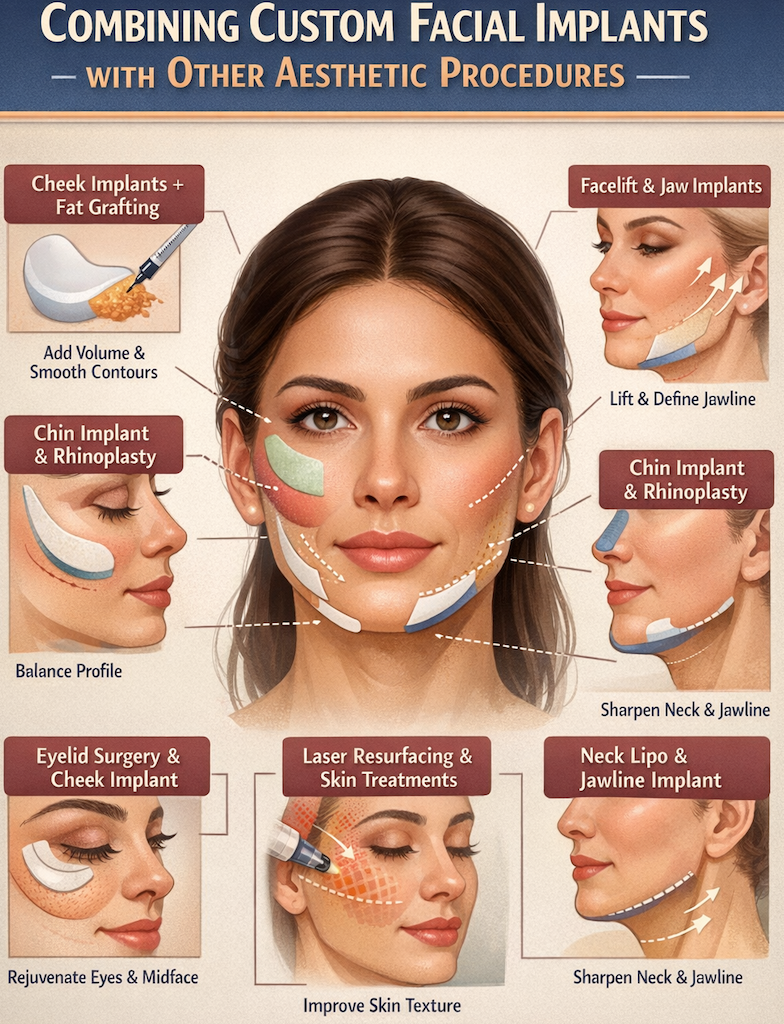
Common combinations
1. Implants + Fat Grafting
- Adds soft tissue volume over the implant
- Smooths transitions and avoids a “too sharp” or artificial look
- Very common with cheek and jaw implants
2. Implants + Facelift
- Implants enhance structure (e.g., jawline definition)
- Facelift tightens loose skin and repositions tissue
- Especially useful in patients with aging-related sagging
3. Implants + Rhinoplasty
- Often done together for facial balance
- Example: chin implant + nose reshaping
- Helps harmonize profile proportions
4. Implants + Neck Liposuction or Neck Lift
- Jawline implants define the border
- Neck procedures remove fullness or tighten skin
- Together, they create a sharper cervicomental angle
5. Implants + Eyelid Surgery (Blepharoplasty)
- Common with cheek or orbital implants
- Addresses both skeletal support and eyelid aging
6. Implants + Skin Procedures
- Laser resurfacing, peels, or microneedling
- Improve skin quality to match structural changes
Benefits of doing them together
- Single anesthesia event
- One recovery period
- Better overall aesthetic harmony
- Often more cost-efficient than staging procedures
Important considerations
- Surgical planning becomes more complex → requires experience
- Swelling can be greater initially
- Not every combination is appropriate for every patient
- Staging may still be recommended in certain case
Can Custom Facial Implants Be Done At The Same Time As A Facelift
Custom facial implants can be done at the same time as a facelift, and in the right patient it’s actually a very effective combination. But it’s not automatically appropriate in every case.
Here’s how it generally breaks down:
Why combine them
A facelift mainly repositions and tightens soft tissues (skin, SMAS layer). It does not add volume or change underlying bone structure. Custom implants, on the other hand, enhance skeletal definition (chin, jawline, cheekbones).
So combining them can:
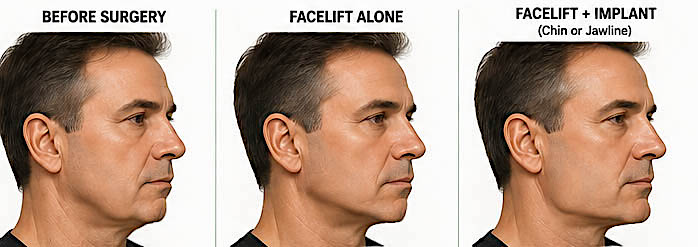
- Improve jawline sharpness beyond what a facelift alone can do
- Add chin projection or width for better facial balance
- Restore structural support that aging has reduced
- Create a more complete, longer-lasting rejuvenation
Common combinations
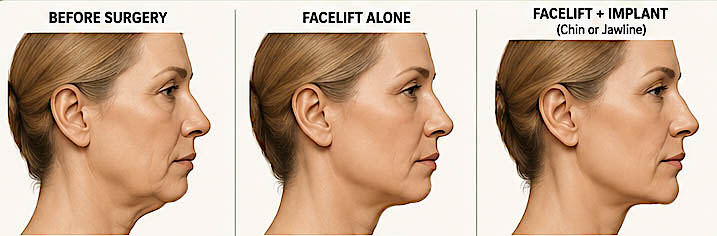
- Facelift + custom jawline implant
- Facelift + chin implant (standard or custom)
- Facelift + cheek implants (less common but still done)
Advantages of doing both together
- One surgery, one anesthesia, one recovery period
- The facelift tissues can be redraped over the new structure, often giving a more defined result
- Potentially better harmony vs. staging procedures separately
Things to be cautious about
This is where surgical judgment matters:
- Incision overlap:
Facelift incisions are around the ears; implants (especially jawline/chin) are often placed through intraoral or submental approaches. The plan has to avoid compromising blood supply. - Swelling and healing complexity:
Combining procedures increases swelling and requires careful management. - Infection risk:
Implants introduce a foreign material, so sterility and technique are critical—especially if intraoral access is used. - Overcorrection risk:
If the implant is too aggressive, the facelift can make it look even more pronounced.
When it makes the most sense
- Weak or recessed chin/jawline that a facelift alone won’t fix
- Desire for a more sculpted, angular lower face
- Patients seeking structural enhancement, not just “tightening”
When it might not be ideal
- Minimal skeletal deficiency (implant may be unnecessary)
- Higher-risk patients where shorter surgery is preferred
- Situations where staging gives better control of the final result
How Long After Double Jaw Surgery Can I Get Custom Facial Implants
There isn’t a one-size-fits-all timeline, but in most cases custom facial implants are considered only after full skeletal healing from double jaw (orthognathic) surgery—not during the early recovery phase.
Here’s the realistic breakdown:
Typical timeline
- 0–6 weeks: Initial bone healing, swelling is still significant
- 3 months: Early stability, but bones are still remodeling
- 6 months: Substantial healing; swelling mostly resolved
- 9–12 months: Preferred window for secondary procedures like custom implants
Why you usually wait ~9–12 month
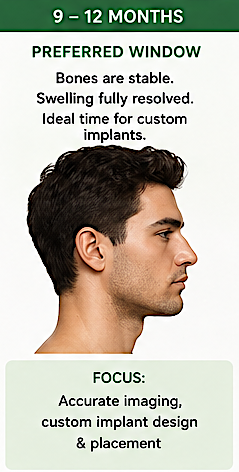
- Your bone positions need to fully stabilize after the jaw surgery
- Residual swelling must resolve so implant design is accurate
- Custom implants rely on precise 3D imaging, which is unreliable too early
- Operating too soon increases risk of malposition, asymmetry, or revision surgery
Exceptions / combined approaches
- In some advanced cases, surgeons may plan implants at the same time as jaw surgery, but that requires very careful preoperative design and isn’t standard for most patients
- Minor contouring procedures might happen earlier (around 6 months), but true custom implants are usually later
Practical advice
If you’re thinking about this:
- Start consultations around 2–3 months post-op
- Plan imaging (CT scan) closer to 4–6 months
- Surgery often scheduled ~10–12 months after jaw surgery
How Much Do Custom Facial Implants Cost
The cost of custom facial implants varies a lot depending on how complex the implant design is, the anatomic surface area of coverage, desired material composition and the technical challenges of its placement. As a result there really is no typical or average cost of the surgery. Each patient case must be determined on an individual basis. But here’s a realistic breakdown so you know what to expect:
💰 Custom (patient-specific / 3D-designed) implants
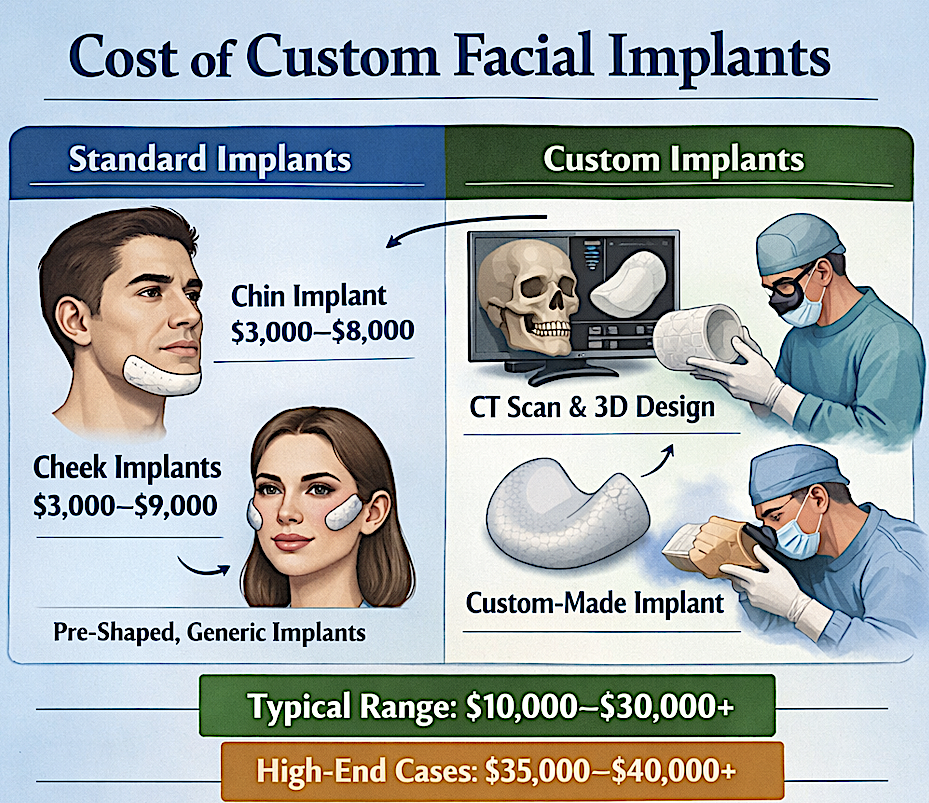
These are designed from CT scans and CAD/CAM planning to match your exact anatomy. These are generally cost ranges:
- Typical range: about $10,000 – $30,000+
- Multiple implant cases: can reach $35,000–$40,000+
👉 This includes:
- Custom design + manufacturing
- Surgeon fees (often higher for complex cases)
- OR, anesthesia, etc.
What actually makes up the cost
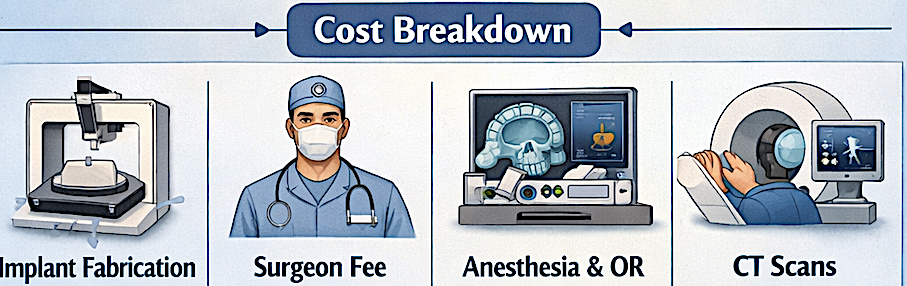
Even for custom implants, the price is a combination of:
- Implant fabrication
- Surgeon fee
- Anesthesia + OR
- Imaging (CT scans) + planning
⚠️ Why custom costs more
Custom implants are expensive because they:
- Require CT imaging + digital design
- Are manufactured individually
- Often involve more complex surgery (jawline, wraparound implants, etc.)
- Are typically done by high-end or specialized surgeons
Quick reality check
The accurate cost of custom facial implants must be determined on an individual case basis. Submitting information by pictures and a decription of yout goals is the best way to get a cost estimate. Having an virtual consultation will allow for the most accurate pricing.
What Can I Do If I Can’t Afford Custom Facial Implants
If custom facial implants aren’t financially feasible, you still have several solid alternatives—some temporary, some permanent, and some more about perception than structure. The right option depends on what you’re trying to improve (chin, jawline, cheeks, asymmetry, etc.).
1. Injectable fillers (most common alternative)
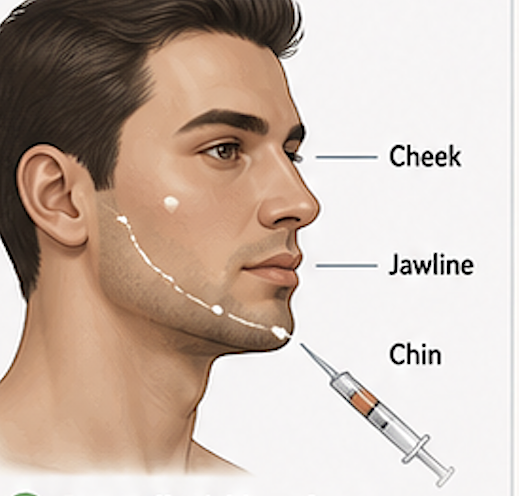
- Hyaluronic acid fillers (like Juvederm, Restylane) can mimic implants in areas like the chin, jawline, and cheeks.
- Pros: much cheaper upfront, no surgery, reversible.
- Cons: temporary (typically 6–18 months), can add up over time.
- Best for: mild–moderate enhancement, “trial run” before committing to implants.
2. Fat grafting (autologous fat transfer)
- Uses your own fat (usually from abdomen/thighs) and injects it into the face.
- Pros: more natural, potentially long-lasting.
- Cons: less predictable (some fat resorbs), still a surgical procedure.
- Often cheaper than custom implants but not always “cheap.”
3. Standard (off-the-shelf) implants
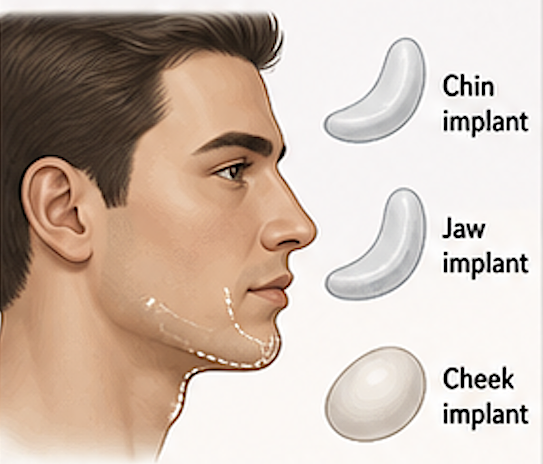
- Pre-shaped implants (chin, jaw, cheek) are less expensive than custom-designed ones.
- Pros: permanent, lower cost than custom.
- Cons: less tailored to your exact anatomy.
4. Orthodontic or jaw surgery (if structural issue)
- If your concern is bite, jaw position, or recession, orthognathic surgery might address both function and appearance.
- Sometimes covered partially by insurance if medically necessary.
5. Non-surgical contouring tricks
- Strategic facial hair (for men), makeup contouring, hairstyle changes.
- These sound simple but can significantly change perceived facial structure.
6. Skin tightening / energy devices
- Treatments like radiofrequency or ultrasound (e.g., Ultherapy) can improve definition slightly.
- Subtle results, but helpful in combination with other approaches.
7. Saving / financing strategies
- Many practices offer payment plans or staged treatments (e.g., doing fillers over time).
- Some patients use fillers first, then transition to implants later when feasible.
What Happens If Custom Facial Implants Are Removed
When custom facial implants (like chin, jawline, or cheek implants) are removed, what happens next depends on how long they were in place, the material, and how your body adapted to them. Here’s the realistic breakdown:
1. Soft tissue changes (most noticeable)
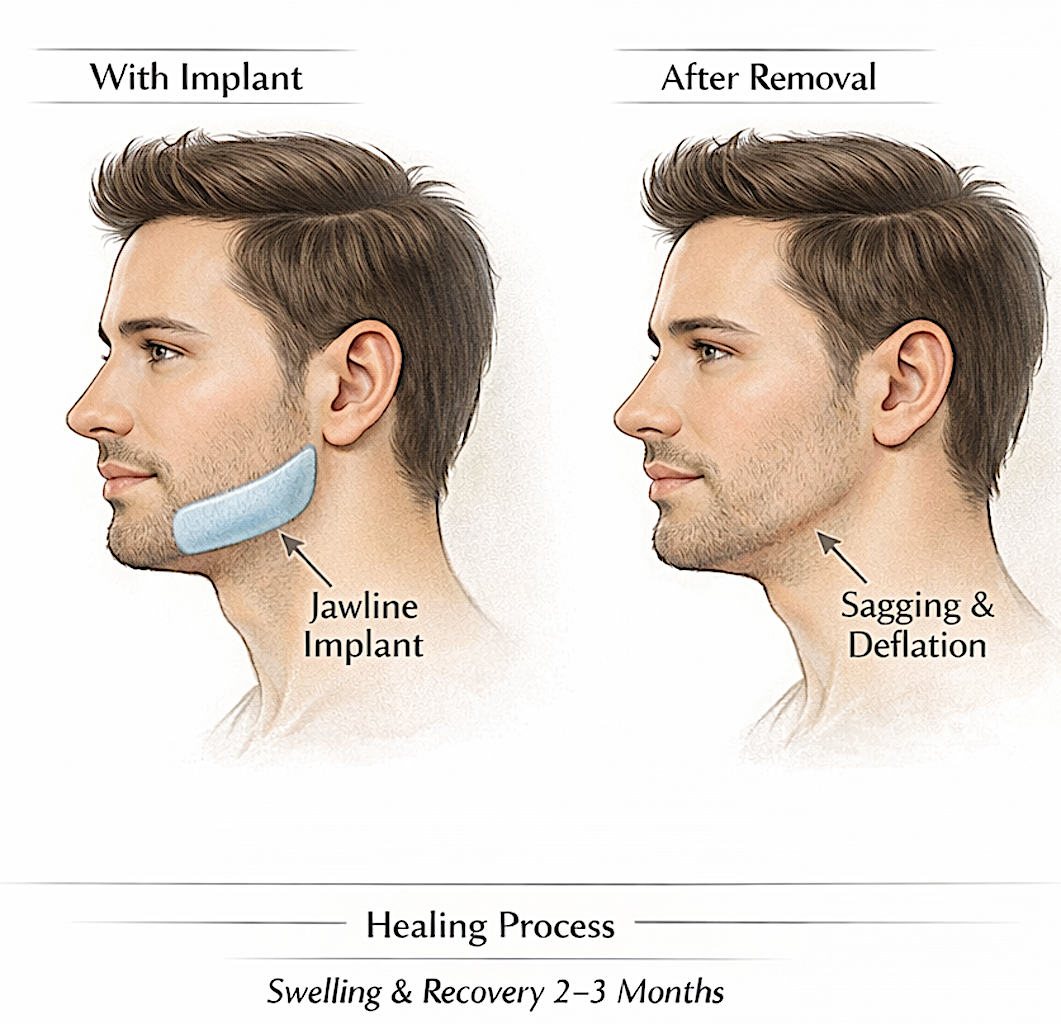
- The skin and soft tissue that stretched to accommodate the implant may not fully “snap back.”
- You can see:
- Loose or sagging skin
- Loss of projection/definition
- A slightly deflated look in that area
- The longer the implant was in and the bigger the implant was, the more likely this is.
2. Bone underneath
- Facial implants sit on bone and can cause pressure remodeling (a shallow indentation in the bone).
- After removal, that indentation usually remains, at least partially.
- It’s typically not dangerous and it does not usually affect contour.
3. Capsule formation
- Your body forms a thin scar layer (capsule) around the implant.
- After removal:
- The capsule may shrink over time
- Or it may persist but has little impact on external shape
- Sometimes surgeons remove or modify the capsule during explant.
4. Aesthetic result
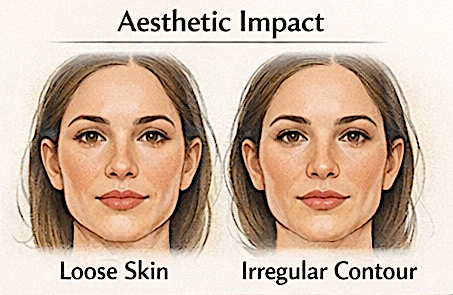
- You don’t always return to your exact pre-implant appearance.
- Possible outcomes:
- Back to near-original look (more likely if implant was small and short-term)
- Slight irregularities or asymmetry
- Need for revision (fat grafting, lift, or smaller implant)
5. Swelling and healing phase
- Initial swelling can make things look uneven for weeks.
- Final result can take 2–3 months (sometimes longer) to settle.
6. Functional issues (rare but possible)
- Temporary numbness or nerve irritation
- Muscle tightness or stiffness (especially jaw implants)
Important nuance:
If the implants were large, in place for years, or placed in areas like the jawline, removal alone can sometimes leave the face looking less defined than expected—this is why surgeons often plan replacement, contouring, or soft tissue support at the same time.
Why Don’t More Surgeons Perform Custom Facial Implants Given Their Benefits
Despite the advantages of custom facial implants, they remain a relatively niche procedure. The reasons are less about the implants themselves and more about the expertise, workflow, economics, and patient population required to use them successfully.
1. Most surgeons don’t have enough case volume
Custom facial implants are fundamentally a planning-intensive procedure. To become proficient, a surgeon needs to perform a substantial number of facial skeletal augmentations.
Many plastic surgeons may perform:
- Chin implants
- Standard cheek implants
- Occasional jaw angle implants
But they may only encounter a handful of patients each year who would benefit from fully custom implants. Without consistent volume, it is difficult to justify developing the experience needed.
2. The learning curve is significant
Unlike choosing an off-the-shelf implant during surgery, the surgeon becomes part of the design team.
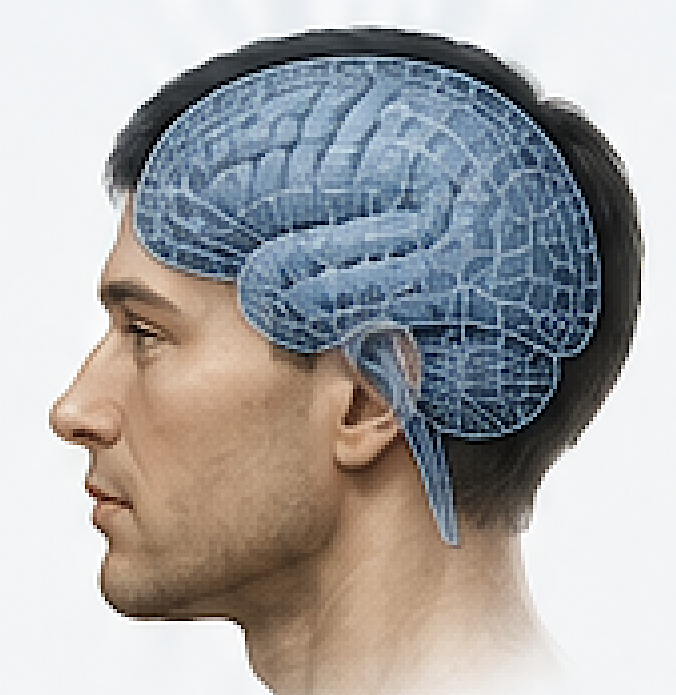
The surgeon must understand:
- Three-dimensional facial skeletal anatomy
- Facial aesthetics
- CT-based planning
- CAD design software concepts
- Implant fixation
- Soft tissue response
- Surgical approaches for large implants
The implant is essentially designed before the patient ever enters the operating room.
3. Planning takes considerable time
A standard implant can often be selected in minutes.
A custom implant requires:
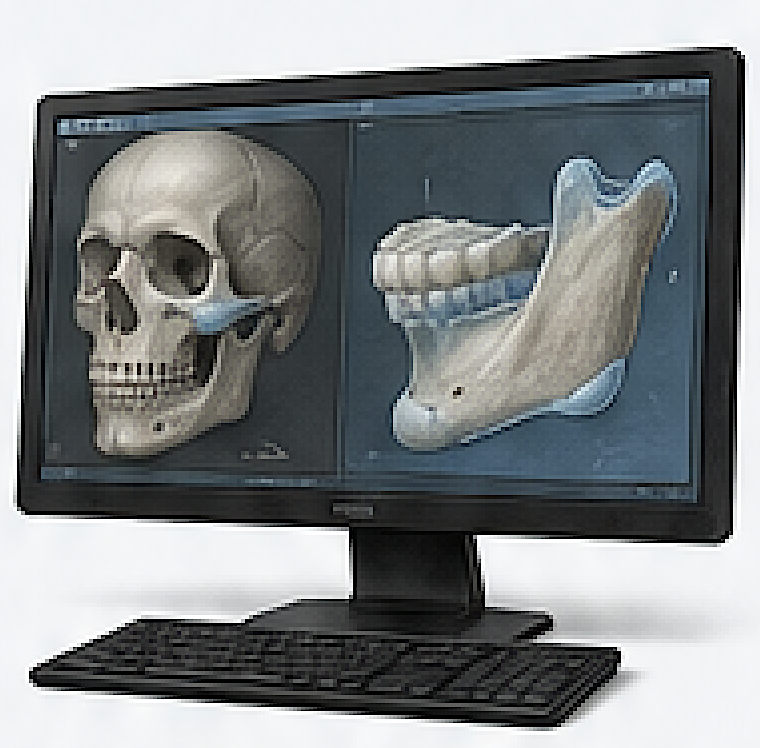
- High-resolution CT scan
- Digital segmentation
- Virtual surgical planning
- Multiple design revisions
- Surgeon review and approval
- Manufacturing
Several hours of surgeon time may be invested before surgery even begins.
4. Most training programs don’t teach it
Plastic surgery and maxillofacial surgery residencies typically teach:
- Standard implant placement
- Orthognathic surgery
- Craniofacial surgery
Very few programs teach:
- Custom implant design
- CAD/CAM workflows
- Digital implant engineering
Most surgeons who perform custom implants are self-taught or have developed the expertise over many years through collaboration with biomedical engineers.
5. Patients requiring custom implants are relatively uncommon
Custom implants are most beneficial for:
- Complex asymmetries
- Previous surgery
- Facial masculinization
- Major augmentation
- Multiple implant combinations
- Congenital deficiencies
- Secondary revisions
Many cosmetic patients seeking modest enhancement can achieve satisfactory results with:
- Standard implants
- Fat grafting
- Injectable fillers
For these patients, custom implants may not provide enough additional benefit to justify the extra cost and planning.
6. Higher cost
Custom implants involve:
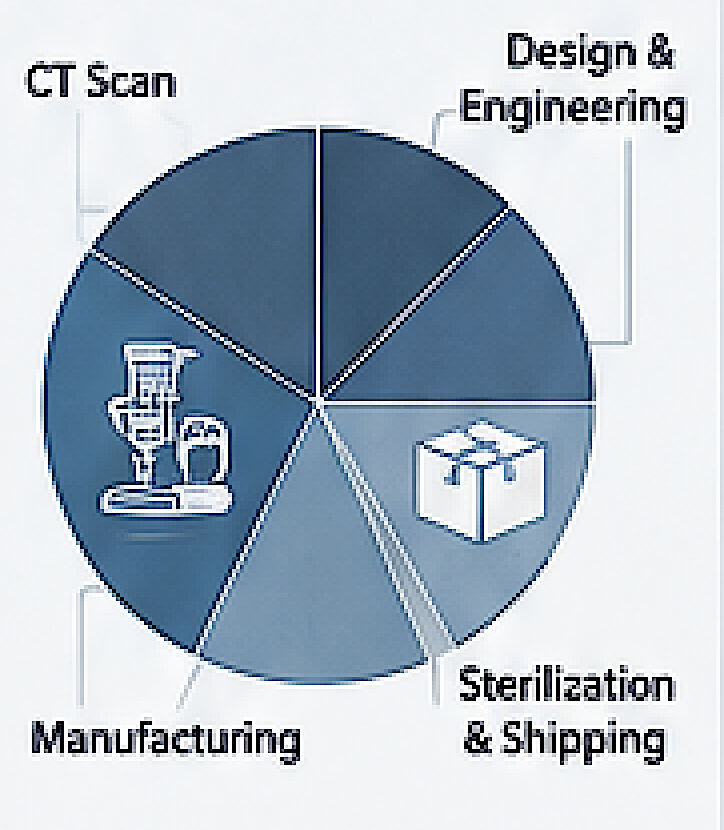
- CT imaging
- Biomedical engineering
- CAD design
- CNC milling or 3D manufacturing
- Sterilization
- Shipping
This typically adds several thousand dollars to the overall treatment cost.
Some patients simply choose less expensive alternatives.
7. Revision responsibility
Once a surgeon approves a custom implant design, they assume responsibility for that design.
If the aesthetic outcome is disappointing, the solution is often:
- redesigning the implant,
- manufacturing a new implant, and
- performing revision surgery.
Some surgeons are understandably hesitant to accept that level of responsibility.
8. Limited industry marketing
Major implant manufacturers heavily market:
- Standard chin implants
- Standard cheek implants
- Breast implants
Custom implants are produced individually rather than sold as standardized products, so there is much less commercial promotion and fewer training courses.
9. Surgeons often remain comfortable with familiar techniques
Many experienced surgeons obtain good results using:
- Sliding genioplasty
- Standard implants
- Fat grafting
- Orthognathic surgery
They may see little incentive to adopt an entirely new workflow.
10. Successful custom implants require an artistic eye
Creating an effective implant is not simply enlarging a bone surface.
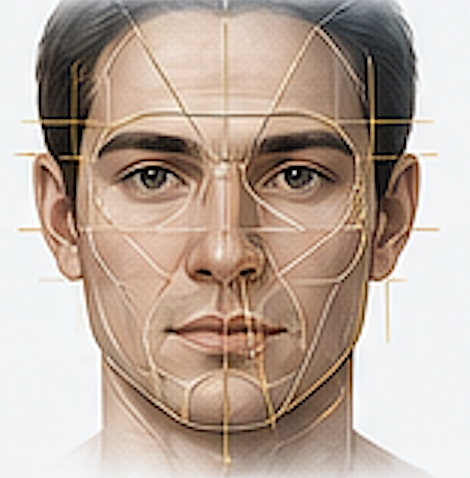
The surgeon must anticipate how changes to the skeleton will translate through the overlying soft tissues. This requires an understanding of:
- facial proportions,
- skeletal balance,
- age-related anatomy,
- ethnic and sex-specific characteristics, and
- the patient’s aesthetic goals.
Even with sophisticated software, the surgeon’s judgment remains the key determinant of the final design.
Why experienced custom implant surgeons tend to achieve more consistent results
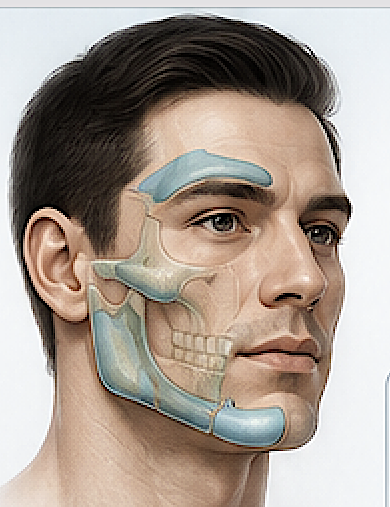
Surgeons who specialize in custom facial implants often develop an iterative process over hundreds or thousands of cases. That experience helps them:
- Predict soft tissue changes from skeletal augmentation.
- Recognize where implants should feather or stop to avoid visible transitions.
- Balance multiple facial subunits (chin, jaw, cheeks, forehead, etc.) into a harmonious whole.
- Refine implant fixation and surgical approaches to minimize complications.
- Learn from previous designs and continuously improve future ones.
This accumulated experience is difficult to acquire without a high-volume practice focused on facial skeletal augmentation.
The future
The field is likely to grow as:
- AI-assisted design tools improve.
- Virtual surgical planning becomes more user-friendly.
- CT-based workflows become increasingly routine.
- More surgeons train with digital planning technologies.
- Patient awareness increases through online education.
Even so, I expect custom facial implants will remain a subspecialized procedure rather than becoming standard practice for all plastic surgeons. Much like complex craniofacial reconstruction or orthognathic surgery, the best outcomes tend to come from surgeons who perform these operations frequently and have extensive experience with facial skeletal anatomy and implant design.
The Engineering Attraction of Custom Facial Implants
Engineer-type patients are disproportionately drawn to custom facial implants because the entire process resembles an engineering problem more than a traditional aesthetic procedure.
They tend to find several aspects especially appealing:
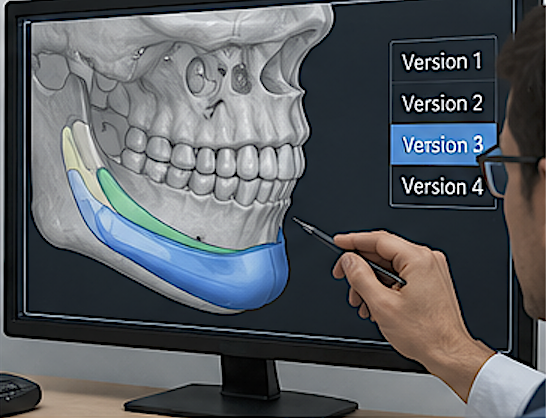
- It is a design problem. A facial deficiency can be defined geometrically—width, projection, angle, curvature, symmetry, and surface transitions—and then addressed with a specifically designed 3D object.
- There is measurable input. CT data, DICOM files, 3D skeletal models, linear measurements, surface maps, and implant dimensions give them something concrete to analyze rather than relying only on adjectives such as “stronger jaw” or “better cheekbones.”
- The process is iterative. Designing a custom implant resembles CAD product development: identify the problem → create a model → modify dimensions → review → manufacture → install.
- They like control over variables. An engineer may want to know exactly where 4 mm of projection occurs, why the posterior jaw angle is lowered 7 mm, or how a contour blends over 25 mm rather than simply being told that the implant will “look natural.”
- Customization fits their mindset. Off-the-shelf implants inherently involve compromise. The idea that an implant can be built specifically for one person’s skeletal anatomy is conceptually attractive to someone accustomed to optimization rather than choosing the closest available standard component.
- Facial asymmetry is particularly compelling. Engineers often recognize that asymmetry is a three-dimensional geometry problem. A custom implant allows the two sides to be deliberately different rather than simply placing identical implants onto asymmetric bones.
- They appreciate reproducibility. A digitally stored implant design provides an exact record of what was intended and manufactured. That is very different from an operation based largely on intraoperative sculpting and visual judgment.
- They often think in systems. A jawline, for example, is not simply a chin plus two jaw angles. They tend to understand immediately that chin width, mandibular body contour, jaw-angle width, vertical length, and transitions between these regions form one continuous geometric system.
There is another important psychological component. Many technically oriented patients are uncomfortable with the inherent subjectivity of cosmetic surgery. Custom facial implant planning gives them a framework in which an aesthetic goal can at least partially be converted into dimensions, geometry, tolerances, and design decisions.
That does not mean the procedure becomes purely mathematical. In fact, that is often the most important point to explain to these patients. The difficult step is translating engineering geometry into human facial aesthetics. A technically perfect implant can still be aesthetically wrong if the design assumptions are wrong. Soft-tissue thickness, muscle coverage, skeletal curvature, facial proportions, and the way millimeters of implant projection translate through the overlying tissues all complicate the relationship between the CAD model and the final face.
A useful way of putting it is:
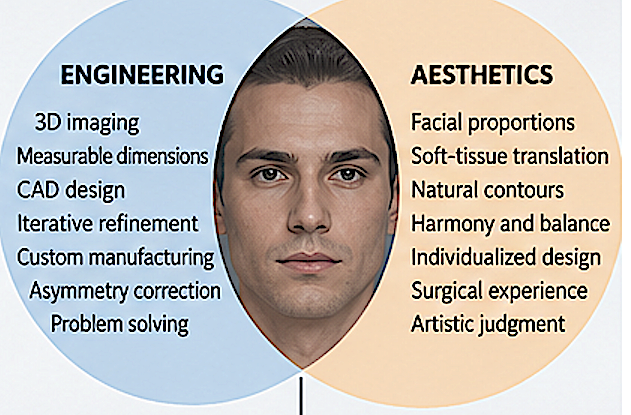
Custom facial implant surgery sits at the intersection of engineering and aesthetics. Engineers are naturally attracted to the engineering half, while the surgeon’s principal contribution is knowing how to translate that geometry into a desirable human facial result.