
Biomechanics and Material Science in Facial Implant Augmentation
Biomechanics and Material Science of Facial Implant Augmentation
Introduction
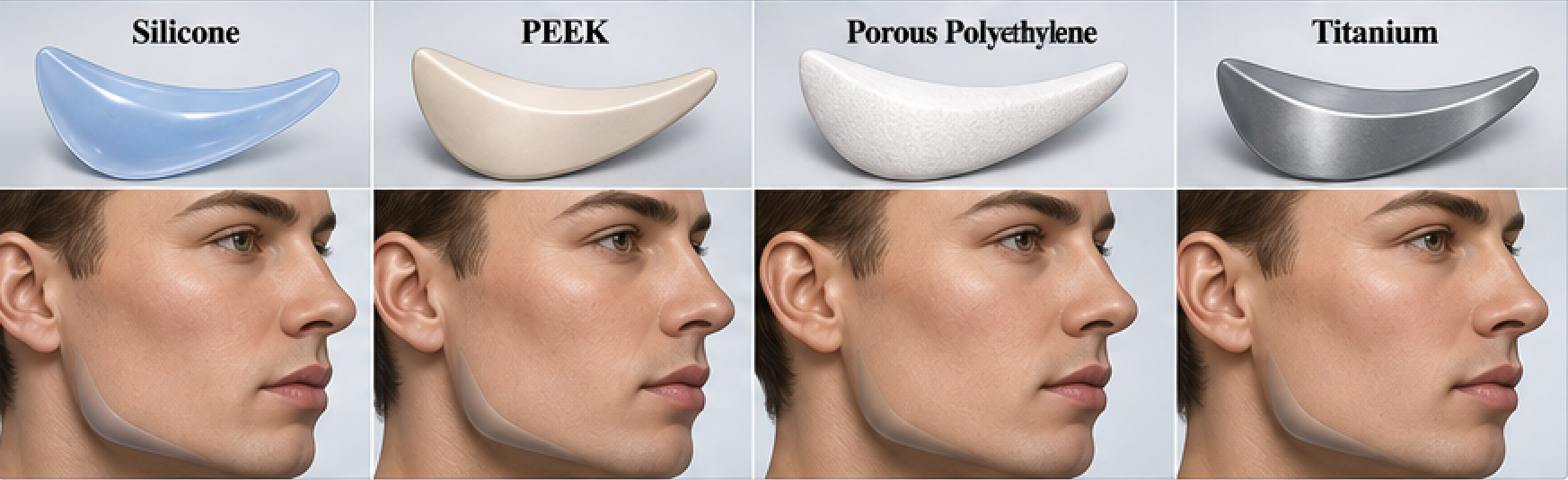
Facial implants are manufactured from materials with markedly different mechanical and biological characteristics. Silicone elastomer, polyetheretherketone (PEEK), porous polyethylene, and titanium differ in elastic modulus, hardness, flexibility, surface behavior, tissue integration, imaging characteristics, and intraoperative handling. Despite these differences, implants with the same external three-dimensional geometry can produce very similar visible facial augmentation.
This observation reflects a fundamental principle of facial implant biomechanics: once an implant is sufficiently stiff to maintain its intended geometry under physiologic loading, external aesthetic projection is governed primarily by implant shape, position, and soft-tissue translation rather than by the absolute stiffness of the implant material.
Thus, the external aesthetic effect of an implant is better conceptualized as a function of:
Implant Geometry + Implant Position + Soft-Tissue Mechanics
rather than a function of:
Elastic Modulus Alone
This distinction is important because the mechanical differences between facial implant materials are substantial, whereas their visible contour effects are essentially equivalent when geometry and placement are held constant.
Elastic Modulus and Structural Stiffness
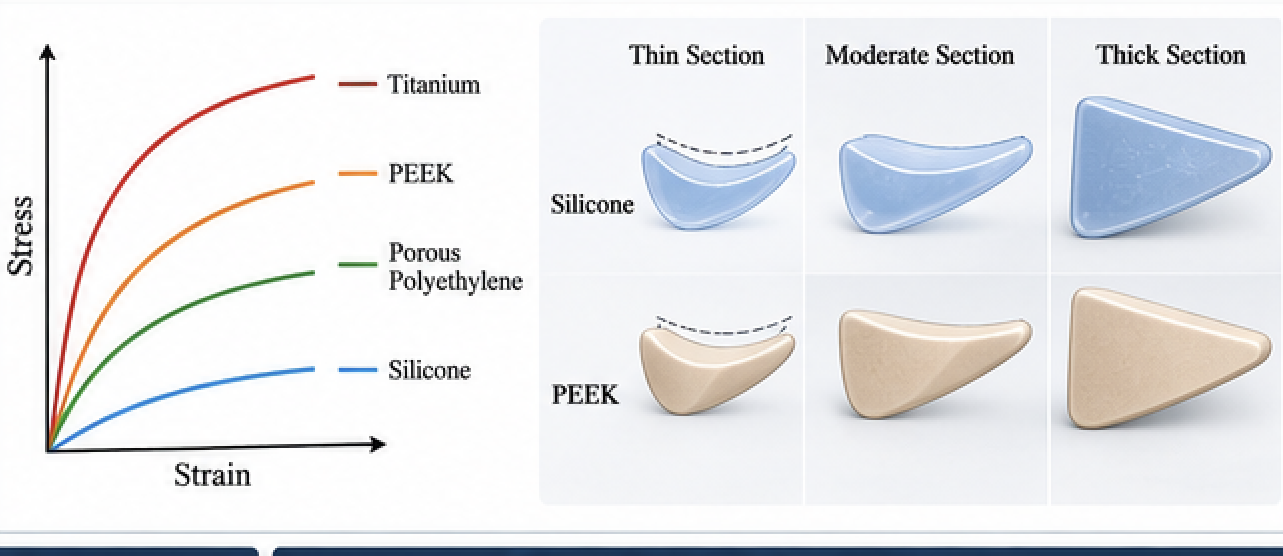
Elastic modulus is a measure of a material’s resistance to deformation under applied stress. A material with a high elastic modulus undergoes relatively little deformation under load, whereas a material with a low elastic modulus deforms more easily.
The classical relationship is:
Elastic Modulus = Applied Stress / Resulting Strain
PEEK and titanium have substantially higher elastic moduli than silicone elastomers. Nevertheless, this difference does not necessarily result in a different visible facial contour.
The reason is that the loads imposed on most facial implants by skin, fat, fascia, periosteum, and muscle are relatively small. Even a comparatively flexible implant such as silicone is generally sufficiently stiff, at customary implant thicknesses, to resist meaningful deformation under these loads.
Therefore, once the condition is reached in which:
implant Deformation Resistance > Soft Tissue Pressure
the implant behaves functionally as a shape-preserving structure.
Beyond this threshold, further increases in elastic modulus produce no improvement in aesthetic effects.
This is the biomechanical basis for the observation that a silicone, PEEK, porous polyethylene, or titanium implant can create a similar visible contour if each has the same geometry.
Material Stiffness Versus Structural Stiffness
It is important to distinguish material stiffness from structural stiffness.
Material stiffness is an intrinsic property of the biomaterial itself and is largely represented by elastic modulus.
Structural stiffness refers to the resistance of the entire implant construct to deformation. It depends not only on the implant material but also on:
- implant thickness
- cross-sectional geometry
- curvature
- length
- width
- degree of skeletal support
- fixation
- presence of unsupported extensions
A relatively flexible material can become structurally quite rigid when manufactured in a thick or curved configuration. Conversely, even a highly rigid material can become mechanically vulnerable if manufactured as an extremely thin or elongated structure.
This principle is especially important in custom implant design.
A thick silicone mandibular angle implant may demonstrate negligible clinically relevant deformation, whereas an extremely thin silicone extension may flex substantially. The same thin extension manufactured in PEEK or titanium may preserve its intended geometry more reliably.
Thus, the absolute modulus of the material becomes aesthetically important primarily when implant geometry permits meaningful deformation.
Stress–Strain Behavior of Implant Materials
Facial implant materials exhibit different stress–strain responses.
Silicone elastomers undergo relatively large strain before failure and behave as flexible, elastic materials. PEEK demonstrates substantially greater stiffness and lower deformation under comparable loading. Titanium demonstrates still greater rigidity.
However, the clinically relevant question is not whether these materials deform differently under laboratory testing. They clearly do.
The more important question is:
Does the expected physiologic soft-tissue load deform the implant enough to alter its external geometry?
If the answer is no, then the differences in stress–strain behavior have little effect on the visible augmentation.
If deformation remains clinically negligible, aesthetic contour is preserved.
The Facial Skeleton as a Mechanical Foundation
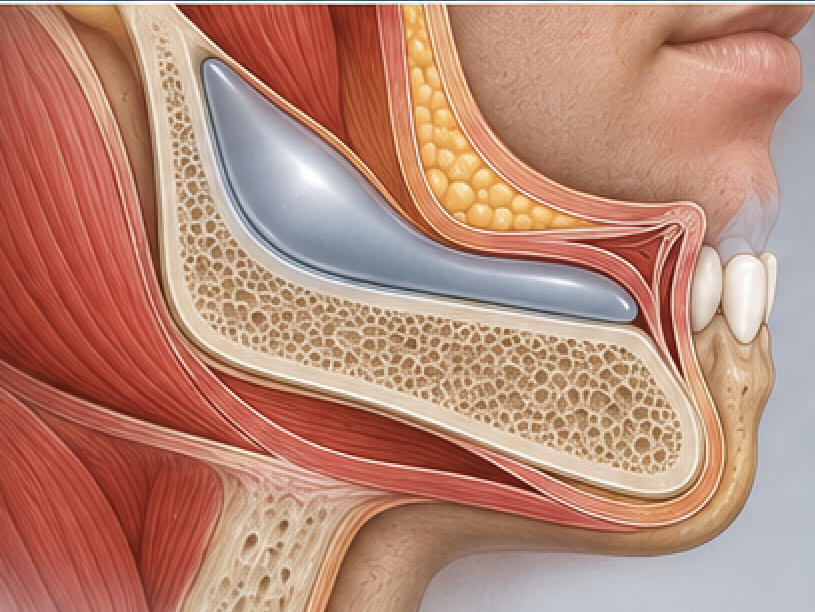
Facial implants are fundamentally different from injectable fillers because they are supported by the facial skeleton.
Bone serves as a rigid structural base. When an implant is properly seated against the skeletal surface, the implant effectively modifies the dimensions of the underlying bone.
The mechanical sequence becomes:
Bone – Implant = Soft Tissue Displacement = External Facial Contour
In this sense, a properly designed facial implant acts as a three-dimensional extension of the skeletal surface.
For example, a custom jawline implant may increase:
- mandibular width
- gonial angle projection
- inferior border height
- mandibular body thickness
- chin projection
- chin width
The visible result is determined by the external location of the newly created skeletal contour rather than by the intrinsic hardness of the material occupying that contour.
Load Transfer at the Bone–Implant Interface
The implant must transfer forces between the skeleton and the overlying soft tissues.
Under ideal conditions, the implant is closely adapted to the bone, and loads are distributed over a broad surface area.
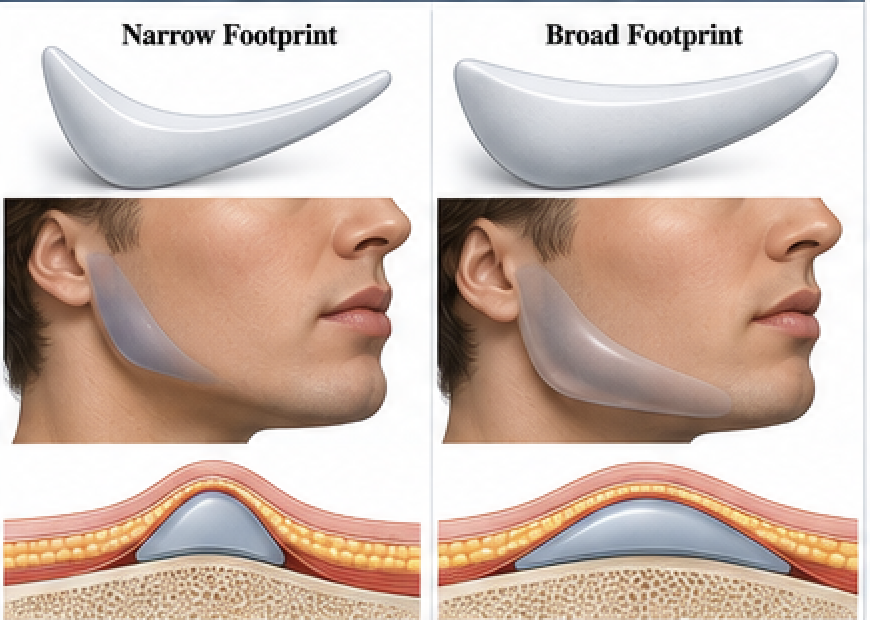
A highly conforming implant produces:
Large Contact Area = Lower Localized Interface Stress
whereas a poorly fitting implant can produce:
Small Contact Area = Higher Localized Stress}
Thus, implant-to-bone conformity has biomechanical importance even when it does not directly change the external contour.
Custom implants have an advantage in this regard because the deep surface can be designed to replicate the underlying skeletal topography as well as having a broader footprint.
Close conformity improves:
- positional stability
- load distribution
- resistance to rocking
- fixation reliability
- accuracy of external projection
This is particularly important in large jawline implants, where poor skeletal conformity can contribute to malposition or asymmetry as well as bone remodeling.
Implant Fixation and Positional Stability
Material stiffness alone cannot ensure an accurate aesthetic result if the implant is not stably positioned.
An implant that rotates, shifts, lifts off the bone, or undergoes asymmetric displacement will produce a different external contour regardless of its elastic modulus.
Therefore:
Desired Geometry + Correct Position = Desired Aesthetic Result
Screw fixation is particularly useful in custom facial implants because it converts the designed implant geometry into a reproducible skeletal position.
Fixation can be viewed as preserving the designed coordinate relationship between the implant and the skeleton.
Thus, the external aesthetic result depends on:
Geometry + Position + Stability
Material selection is secondary if these three variables are properly controlled.
Geometry as the Primary Determinant of Projection
Once adequate structural stability has been achieved, implant geometry becomes the dominant determinant of contour.
The most important geometric variables include:
- maximum thickness
- implant volume
- footprint
- curvature
- location of maximal projection
- transition slope
- edge taper
- regional asymmetry
- relationship to skeletal landmarks
Two implants with identical maximum thickness may nevertheless produce very different external appearances.
For example, consider two implants that each reach 6 mm of maximal projection.
One may achieve that projection over a narrow central footprint, whereas the other distributes the same maximal projection over a broad surface.
The first implant may create a more focal contour change. The second may produce a smoother and more diffuse augmentation.
Therefore:
Maximum Thickness is not a Complete Description of Implant Effect
The spatial distribution of thickness is equally important.
Curvature and Surface Slope
Implant curvature influences how rapidly soft tissues are displaced across the facial surface.

A sharply convex implant produces a rapid increase in projection over a short distance. A more gently curved implant produces a gradual transition.
This can be thought of in terms of surface slope:
Projection = Implant Thickness over Distance
A high surface slope generates a more abrupt contour transition, whereas a low slope generates a smoother contour transition.
This is one reason why custom implant design must consider more than simple linear dimensions.
The visible face is a compound curved surface, and successful augmentation requires control over the rate and direction of contour change.
Soft-Tissue Translation
The implant creates a new skeletal contour, but the external facial surface is separated from that contour by a soft-tissue envelope.
The visible effect therefore depends on how the soft tissues translate the underlying skeletal change.
A simplified conceptual model is:
Implant Projection + Soft Tissue Translation (T) = External Facial Contour Change
The value of (T) varies according to:
- skin thickness
- subcutaneous fat
- muscle thickness
- fascial attachments
- tissue mobility
- scar formation
- regional anatomy
- age-related tissue laxity
A 5-mm skeletal augmentation may therefore produce different visible effects in different patients.
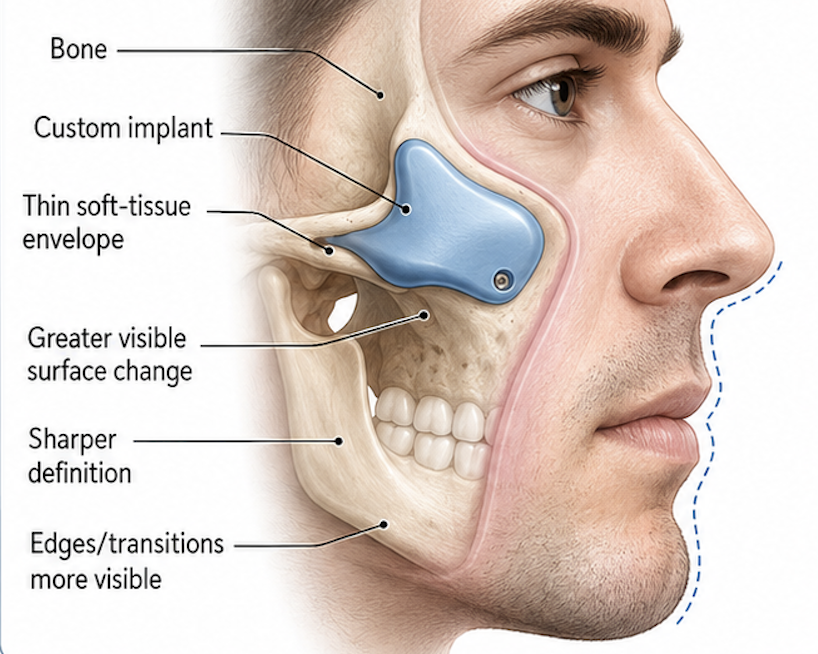
A thin patient with tightly adherent tissues may demonstrate relatively efficient surface translation.
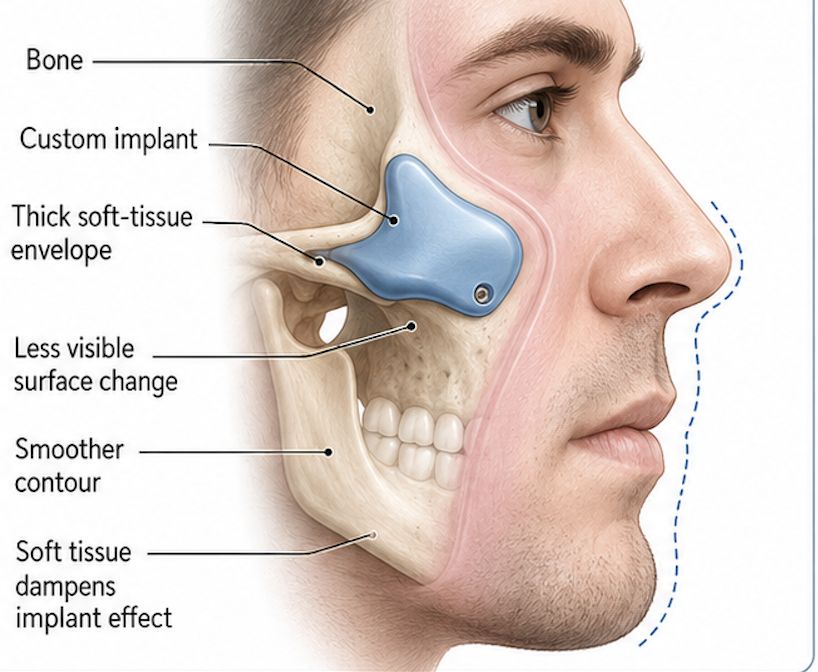
A patient with thicker subcutaneous tissues or greater soft-tissue laxity may demonstrate less sharply defined translation of the same implant geometry.
Direction of Augmentation
Soft-tissue response also depends on the direction in which the implant expands the facial skeleton.
A custom jawline implant for example can produce:
- lateral expansion
- inferior expansion
- anterior expansion
- posterolateral angle projection
These vectors have different aesthetic effects.
Lateral Expansion = Increased Jaw Width
whereas:
Inferior/Vertical Expansion} = Increased Lower Facial Height
Thus, a millimeter of implant thickness does not have a universal aesthetic meaning.
Its effect depends on the direction of projection relative to the facial surface.
Why Different Materials Can Produce the Same Jawline
Custom jawline implants provide a particularly clear demonstration of geometry-dominant biomechanics.
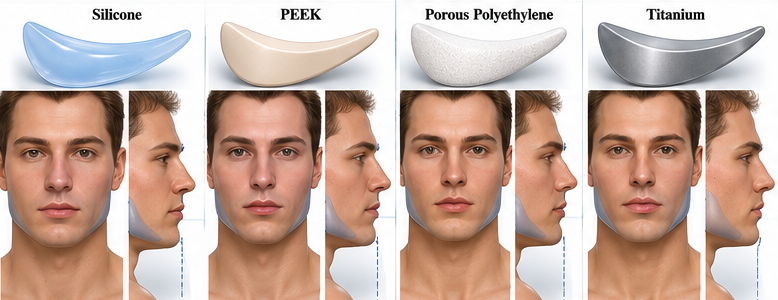
Imagine four custom jawline implants manufactured from:
- silicone
- PEEK
- porous polyethylene
- titanium
Each implant is designed to provide:
- 7 mm lateral projection at the mandibular angle
- 4 mm lateral augmentation along the mandibular body
- 3 mm inferior border lowering
- 5 mm chin widening
- identical edge taper and curvature
If each implant is placed in the same position and maintains its designed form, the external mandibular contour will be similar.
The reason is straightforward.
The soft tissues are displaced by the location of the implant surface, not by the elastic modulus of the material beneath that surface.
Therefore:
Similar external augmentation effect provided that each material maintains dimensional stability.
When Material Properties Do Affect Aesthetic Outcome
Material properties become aesthetically relevant when they alter geometry, support, or position.
This may occur with:
- very thin implant regions
- long unsupported extensions
- highly flexible implant tails
- sharp transitions
- insufficient fixation
- areas exposed to repeated muscular loading
- inadequate bone contact
- implant warping or bending
In such circumstances, PEEK or titanium may preserve a thin structural feature more faithfully than silicone.
The principle is therefore:
Material Properties Affect Appearance Primarily When They Alter Geometry
This is a more accurate concept than assuming that a stiffer material inherently produces greater projection.
Material Properties That Matter for Reasons Other Than Projection
Although elastic modulus may have limited influence on visible projection once structural stability is achieved, material selection remains clinically important.
Silicone
Silicone is flexible, easily handled, and readily modified intraoperatively. Its flexibility can facilitate insertion through smaller incisions. It generally does not undergo substantial tissue ingrowth and is comparatively easy to remove or revise.
Its flexibility can become a disadvantage in very thin or unsupported regions.
PEEK
PEEK is significantly more rigid and dimensionally stable. It is well suited to precise CAD/CAM manufacturing and maintains thin structural shapes effectively.
Its rigidity may require larger surgical exposure and can make intraoperative modification more difficult.
Porous Polyethylene
Porous polyethylene allows fibrovascular tissue ingrowth, increasing tissue adherence over time.
This may improve biological integration but can make removal and revision more difficult.
Titanium
Titanium provides extremely high structural stiffness and dimensional stability.
It is useful when a very thin but rigid structure is required. Its stiffness, radiopacity, and difficulty of intraoperative modification distinguish it from polymer-based materials.
These material differences are important primarily in relation to:
- surgical handling
- implant insertion
- fixation
- tissue integration
- revision surgery
- removability
- imaging
- infection management
- long-term stability
rather than the magnitude of external projection alone.
Comparison With Injectable Filler Mechanics
The biomechanical behavior of facial implants differs fundamentally from injectable fillers.
Fillers exist within soft tissue and are themselves deformable. Their rheologic properties therefore influence how they behave after placement.
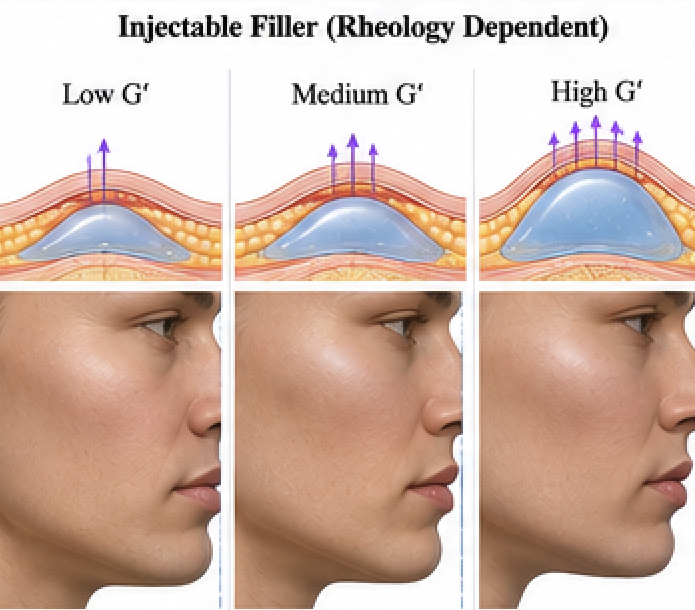
One important rheologic parameter is storage modulus, or G′, which describes the elastic component of filler behavior.
Higher-G′ materials resist deformation more strongly and can maintain localized projection more effectively.
Thus:
G′ effect = Cohesivity + Volume + Placement
Facial implants behave differently because they are solid structural devices supported by bone.
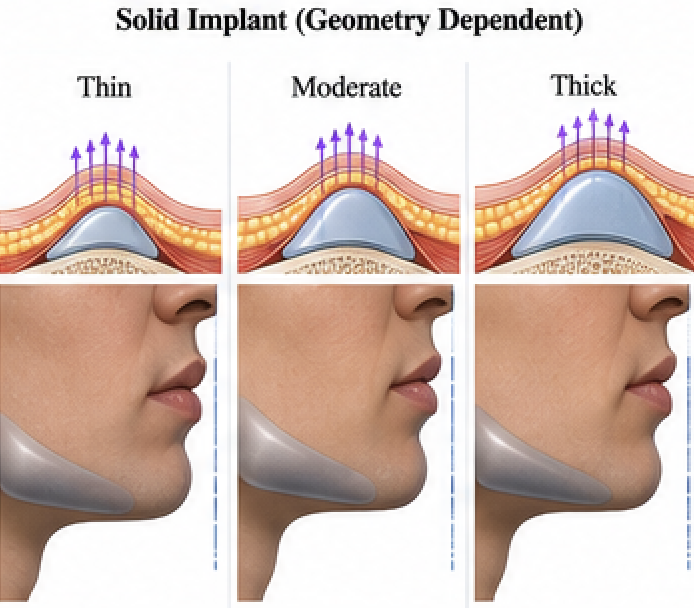
For implants:
Geometry + Position + Soft-Tissue Translation = External Facial Contour Change
Once the implant has sufficient rigidity to preserve its geometry, increasing material stiffness does not necessarily increase projection.
The closest implant analogue to increasing filler G′ is therefore not simply selecting a stiffer material.
It is more accurately achieved by modifying:
- implant thickness
- curvature
- surface slope
- footprint
- location of peak projection
Effective Projection Efficiency
A useful conceptual parameter in facial implant design is projection efficiency.
Projection efficiency describes how effectively an implant’s skeletal dimensions translate to the external facial surface.
One might conceptualize:
Visible Surface Change/Implant Projection}
A value approaching 1 would indicate near-direct translation of skeletal augmentation to the skin surface.
Lower values would indicate greater damping by the soft-tissue envelope.
Projection efficiency is likely to vary across facial regions and among patients.
For example, the mandibular border, chin, infraorbital rim, and temporal regions all possess different soft-tissue characteristics and therefore different translation behavior.
This concept may be more clinically relevant to custom implant design than the elastic modulus of the implant material itself.
Design Implications for Custom Facial Implants
The biomechanical principles described above lead to several practical design conclusions.
First, implant geometry should be prioritized over material stiffness when predicting aesthetic contour.
Second, implant design should consider not only peak thickness but also:
- spatial distribution of projection
- curvature
- edge taper
- transition slope
- vector of augmentation
Third, the designer should account for the characteristics of the overlying soft-tissue envelope.
Fourth, highly thin or unsupported regions may require greater material stiffness to preserve the intended geometry.
Fifth, material selection should be based primarily on the surgical, biological, and revision characteristics appropriate for the individual case rather than on an expectation that a stiffer implant inherently produces greater visible augmentation.
Conclusion
Facial implant materials exhibit large differences in elastic modulus, hardness, flexibility, surface characteristics, and biological behavior. Nevertheless, these differences do not necessarily translate into corresponding differences in visible aesthetic augmentation.
The explanation lies in the relative mechanical environment of facial implantation.
Once an implant is sufficiently stiff to maintain its designed geometry under physiologic soft-tissue loading, the external facial result is determined predominantly by:
Geometry + Position + Soft Tissue Translation
Material stiffness becomes aesthetically important mainly when it affects the ability of the implant to preserve its intended form or position.
Thus, in custom facial implant design, the most important biomechanical principle is:
The face responds primarily to implant shape, not to implant modulus
This explains why materials with profoundly different physical properties can nevertheless create nearly identical external aesthetic changes when their three-dimensional geometry and skeletal position are the same.