
Custom Facial Implant Recovery
What Patients should Expect
Custom facial implant surgery has a unique recovery process because the implants are designed to augment the underlying facial skeleton, often over larger anatomical areas than standard facial implants. While the surgical procedure creates the desired skeletal changes immediately, the visible aesthetic results take considerably longer to develop as the overlying facial soft tissues recover and adapt to their new contours.
One of the most important concepts for patients to understand is that recovery from custom facial implant surgery is not the same as recovery from the swelling it creates. Patients may feel physically recovered and return to most normal activities within a few weeks, even though the final facial appearance may require several months to become fully apparent.
1. Why Custom Facial Implant Recovery Is Different
Custom facial implants differ from standard facial implants in several important ways that affect postoperative recovery.
Standard facial implants typically augment relatively small anatomical areas, such as the chin or cheeks. Custom facial implants, by comparison, may cover much larger skeletal surfaces, including the entire jawline, infraorbital rims and cheeks, brow bones, forehead, or multiple facial regions simultaneously.
Three major factors influence recovery:
- Extent of surgical dissection: Larger implants usually require greater soft tissue elevation and wider implant pockets, which can produce more swelling.
- Location of the implant: Different facial regions have different muscle attachments, lymphatic drainage patterns, and soft tissue thicknesses, affecting the postoperative response.
- Magnitude of skeletal augmentation: Larger increases in facial projection or width require greater accommodation by the overlying soft tissue envelope.
As a result, two patients who undergo custom facial implant surgery may experience substantially different recovery patterns, even when the implants are made from the same material.
2. The Timeline of Recovery

Typical recovery progression
Illustrative timeline
Days 1–3
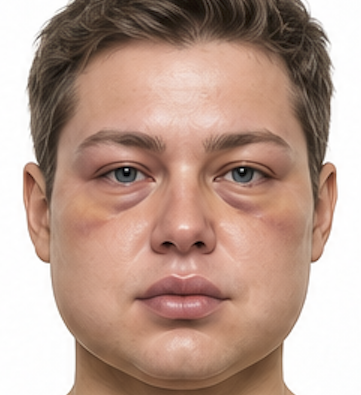
Swelling develops and often reaches its peak.
Days 4–7
Swelling begins to decrease; tightness and stiffness remain. But the overall facial appearance will not change much from the peak swelling and bruising.
Weeks 1 – 3
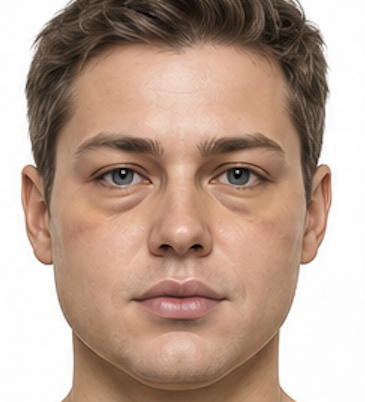
Visible reduction of facial swelling and bruising and return to many daily activities minus heavy strenuous activities.
Weeks 4–6
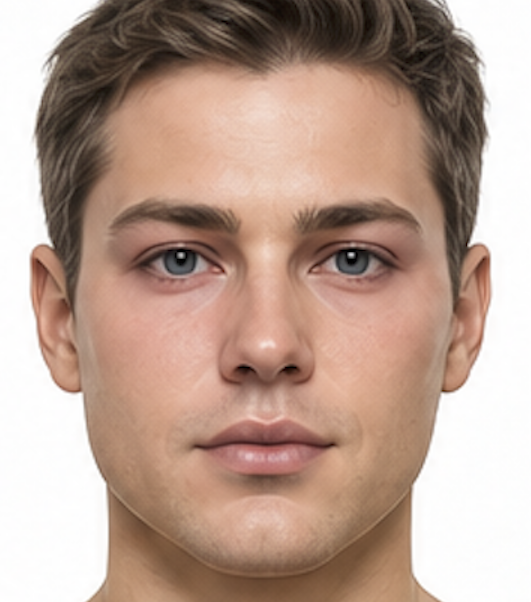
Most major swelling has resolved and one can pass in public looking fairly normal and without a need for explanation, Some residual fullness persists and the true final result is not yet seen.
Months 2–3
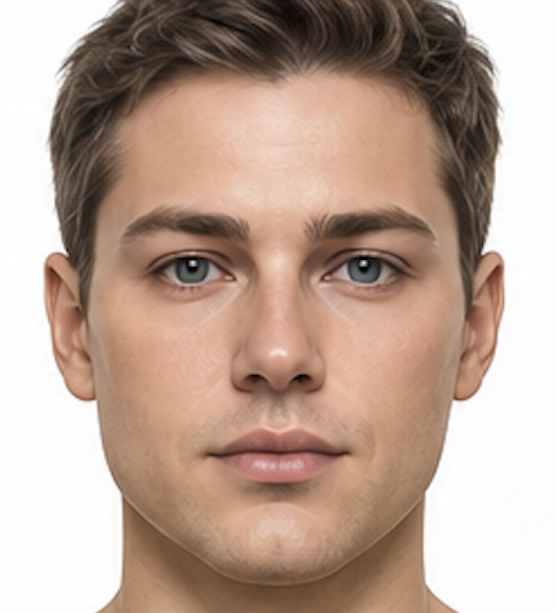
Facial contours become more defined and natural. The shrinkwrap effect of the soft tissues occurs in this time period.
Months 3–6+
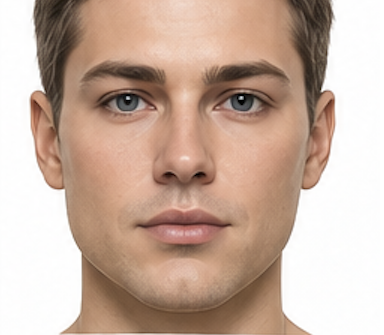
Continued refinement of facial definition through soft tissue adaptation.
Recovery Progression
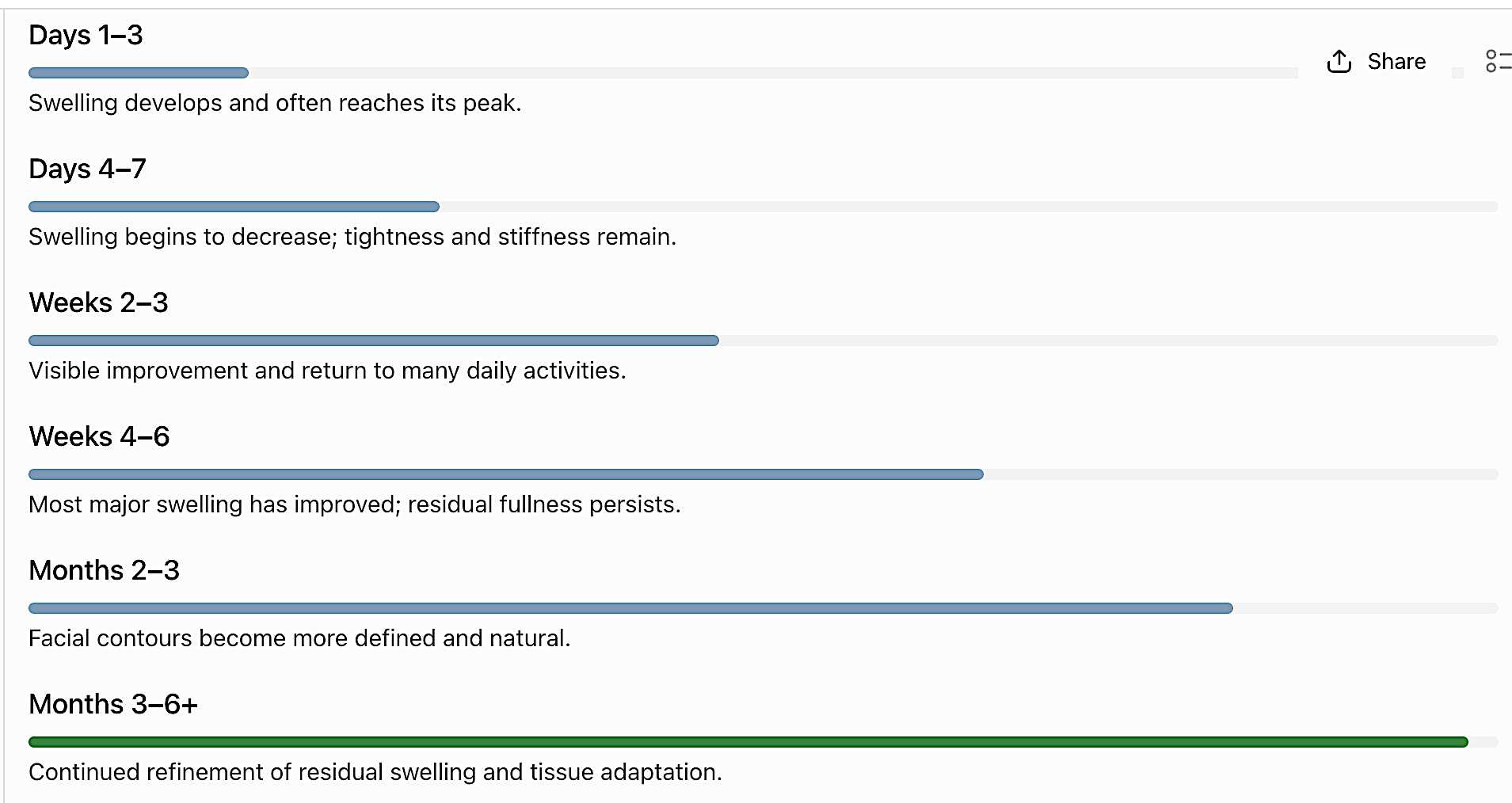
Bars illustrate progression through recovery phases, not measured percentages of swelling resolution. Larger or combined implants may require longer.
The first 72 hours: Peak swelling
During the first two to three days after surgery, the face undergoes an inflammatory response to surgical tissue manipulation. Swelling usually increases during this period and may peak around 48 to 72 hours.
Patients may experience facial tightness, pressure, bruising, temporary numbness, and limitations in mouth opening or facial movement. These symptoms can be particularly noticeable after custom jawline and midface implant procedures.
Discomfort is generally manageable with prescribed medications, although its severity varies by the extent of surgery. Head elevation and surgeon-directed postoperative care can help reduce swelling.
Days 4–7: Early improvement
During the remainder of the first postoperative week, facial swelling usually begins to diminish. Bruising may become more visible as swelling decreases.
Patients often feel significantly better physically, although their facial appearance may remain quite distorted from swelling. The face may appear excessively wide, full, or projected compared with the intended outcome.
This appearance should not be interpreted as the final result.
Weeks 2–3: Functional recovery
By the second and third weeks, many patients have recovered sufficiently to return to work and routine social activities.
Nevertheless, noticeable facial swelling is still common, particularly around the jaw angles, lower cheeks, and infraorbital regions.
Some patients experience temporary smile stiffness, altered lip mobility, or tightness with chewing. These symptoms usually improve as postoperative inflammation decreases, although persistent or worsening functional deficits require evaluation.
Weeks 4–6: Major swelling reduction
Between four and six weeks, the majority of the more obvious postoperative swelling has typically improved.
Facial contours become better defined, and the relationship between the underlying implant and the overlying facial soft tissues becomes easier to assess.
However, residual swelling can remain substantial enough to obscure fine implant contouring, particularly with larger custom jawline and midface implants.
Months 2–3: Aesthetic refinement
During the second and third postoperative months, more subtle changes become apparent.
The jawline may become sharper, cheek contours more distinct, and the transitions between augmented and nonaugmented facial regions smoother.
Temporary sensory changes and soft tissue tightness may continue to improve.
Months 3–6 and beyond: Final tissue adaptation
Although many patients have a reasonably accurate impression of their results by three months, final soft tissue adaptation may require six months or longer.
This is particularly relevant for extensive custom facial implants involving multiple anatomical regions, patients undergoing revision surgery, and procedures requiring significant soft tissue elevation.
3. Recovery Differences by Custom Facial Implant Type
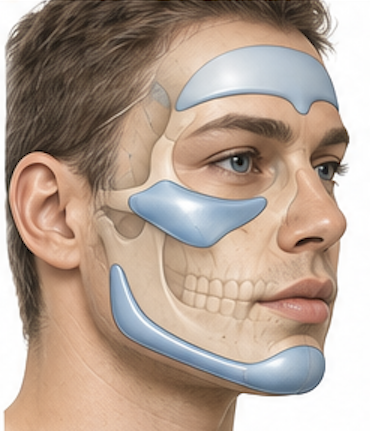
Not all custom facial implant procedures have the same recovery characteristics.
| Custom implant type | Typical recovery characteristics |
| Chin | Lower lip and chin swelling, temporary numbness, tightness with smiling |
| Jaw angles | Lower facial swelling, masseteric tightness, temporary chewing discomfort |
| Complete jawline | More extensive lower facial swelling, stiffness, prolonged jawline definition refinement |
| Infraorbital–malar | Lower eyelid and cheek swelling, possible temporary altered sensation and eyelid tightness |
| Cheek | Midfacial fullness and swelling, temporary smile stiffness |
| Midface mask | Broad central facial swelling involving cheeks, infraorbital and paranasal regions |
| Brow bone | Upper eyelid and forehead swelling, temporary forehead numbness |
| Forehead | Broad upper facial swelling and scalp tightness, often with relatively limited functional restriction |
These represent expected patterns, not fixed recovery durations. The extent of dissection and combination of procedures can be more influential than the implant’s anatomical name alone.
4. Why Facial Swelling Can Be Misleading
One of the most psychologically challenging aspects of custom facial implant recovery is the temporary difference between the postoperative appearance and the planned aesthetic result.
Patients may initially believe their implant is too large or incorrectly shaped because swelling exaggerates the augmentation.
This is especially common after custom jawline implants, where swelling in the masseteric and lower cheek regions can produce an excessively wide or rounded facial appearance.
Likewise, patients with custom infraorbital–malar implants may initially observe excessive cheek fullness or lower eyelid puffiness.
The problem is that postoperative swelling occurs within the same soft tissue envelope that the implant is intended to support. Thus, the desired skeletal change and temporary postoperative fluid accumulation both contribute to the early external appearance.
The early postoperative facial contour represents the combination of implant augmentation and surgical swelling, not the implant’s true aesthetic effect alone.
5. What Determines How Quickly Patients Recover?
The speed of recovery depends on several variables beyond the type of implant.
These include the implant’s surface area and projection, the amount of soft tissue dissection required, the use of intraoral versus external incisions, individual inflammatory responses, previous facial surgery, and whether multiple facial regions are treated simultaneously.
Revision procedures may have a more variable recovery due to scar tissue, altered anatomy, and the possible need to remove existing implants.
It is also important to distinguish implant material from implant design. Silicone, PEEK, and other implant materials possess substantially different physical properties, but no reliable clinical evidence establishes that material stiffness alone determines the duration of postoperative facial swelling. The surgical approach and extent of tissue manipulation are generally more relevant considerations.
6. Postoperative Care and Activity Restrictions
Patients should follow the specific protocol given by their surgeon. Common recommendations include:
- Keeping the head elevated during early recovery.
- Avoiding strenuous exercise, heavy lifting, and activities that increase facial pressure until cleared.
- Maintaining oral hygiene and following prescribed mouth-rinse protocols when intraoral incisions are used.
- Using a soft diet when chewing or mouth opening is uncomfortable or restricted.
- Avoiding direct pressure or trauma to the implanted facial regions.
- Attending scheduled postoperative evaluations.
Patients should contact their surgical team promptly for progressively increasing or one-sided swelling, worsening pain, fever, redness, wound drainage, new visual symptoms, or an unexpected change in facial movement. Rapidly expanding swelling, breathing difficulty, or significant visual impairment requires emergency evaluation.
7. The Difference Between Physical and Aesthetic Recovery
An important distinction in custom facial implant surgery is that there are two separate recovery endpoints.
Physical recovery refers to the resolution of discomfort, restoration of facial movement, healing of the incisions, and return to normal activities. This often occurs within the first several weeks.
Aesthetic recovery refers to the reduction of residual swelling, soft tissue redraping, normalization of facial animation, and establishment of the final visible contours. This often requires several months.
The patient may therefore be physically recovered long before their facial appearance has fully stabilized.
This distinction should be emphasized during preoperative counseling because it helps patients interpret their early appearance and avoid prematurely judging the success of the surgery.
Conclusion
Custom facial implant surgery produces immediate changes to the underlying facial skeleton, but the external appearance evolves gradually as the surrounding tissues heal.
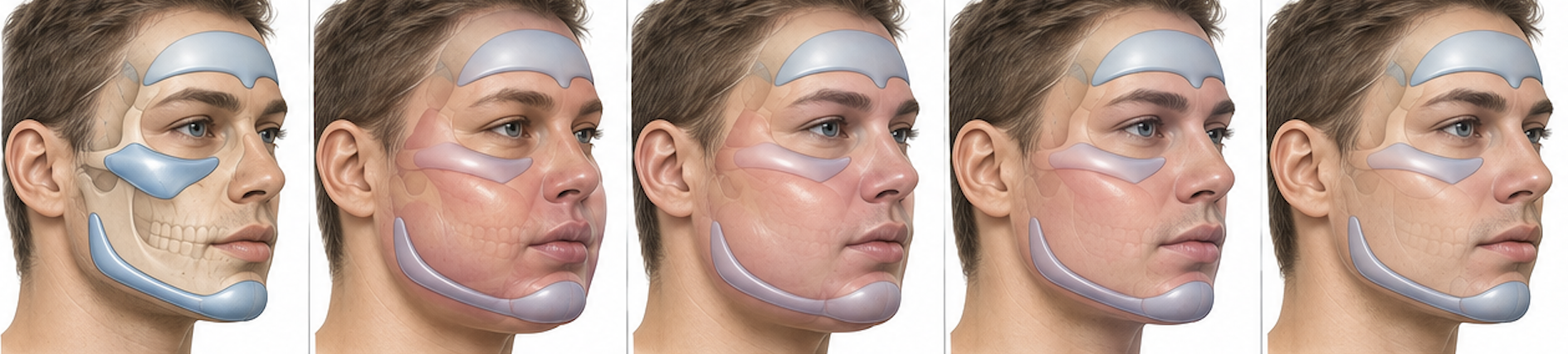
For many patients, the most difficult portion of recovery occurs during the first week, substantial physical improvement occurs during the next two to three weeks, and the majority of major swelling subsides over approximately four to six weeks.
The final aesthetic result, however, may require three to six months or longer, particularly after large or combined custom facial implant procedures.
The central principle of custom facial implant recovery is that the skeletal result is created during surgery, but the visible result is revealed over time.